



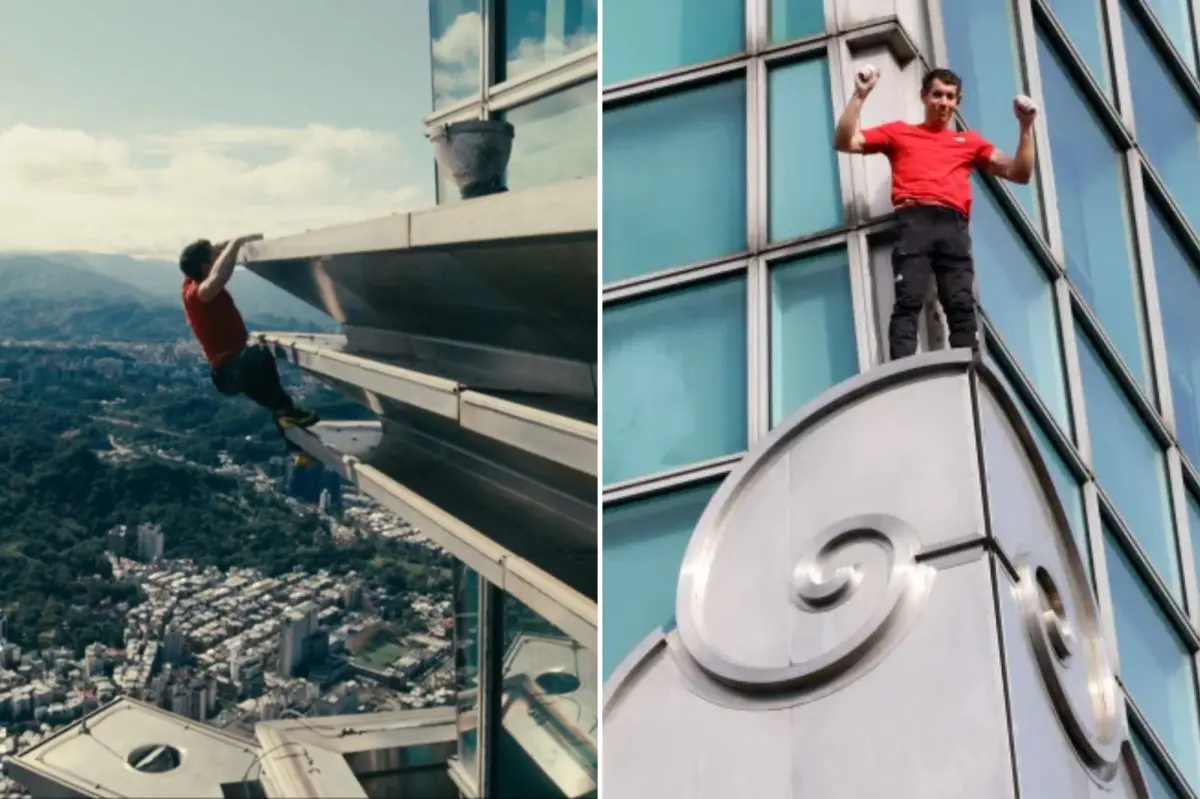
Imagine Alex Honnold, that intrepid adventurer with a knack for defying gravity, pushing the boundaries of human possibility yet again. Picture this: on a crisp January day in Taiwan, he embarks on a heart-stopping urban ascent that’s equal parts bravado and brilliance. The stage? The towering Taipei 101 skyscraper, a gleaming 101-story behemoth of steel and glass piercing the heavens. Honnold, clad in his climbing gear, approaches the structure with the calm determination of someone who’s turned sheer cliff faces into personal playgrounds. No ropes. No safety nets. No harnesses. Just his hands, feet, and an unyielding belief in his own abilities. As the world watches via a live Netflix stream, he begins the climb, fingers gripping minute ledges, toes pressing into invisible holds, his body a study in controlled precision. The challenge is immense—winds whip around the building, threatening to unsettle the balance of any lesser climber, and if he slips, there’s nothing to catch him but the unforgiving ground far below. Yet Honnold scales upward with a rhythmic grace, like a modern-day mountain goat wandering the skies. After precisely one hour and thirty-one minutes, he conquers the summit, arms thrust triumphantly into the air as waves of cheers erupt from onlookers. From that dizzying height, the city of Taipei sprawls out below, a vibrant tapestry of bustling streets and neon lights, a view he later describes as “amazing,” even amid the gusty breezes that tousle his hair and test his resolve. It’s a moment that captures the essence of exploration and risk-taking, where ordinary fears melt away in the face of sheer exhilaration.
This wasn’t just another feat for Honnold; it was a testament to a life lived on the edge, where the impossible becomes routine. Raised in Sacramento, California, Alex has always been drawn to the outdoors, channeling his energy into conquering nature’s wildest offerings. His resume reads like an epic saga: he’s summited some of the toughest peaks in the American mountain ranges, those rugged monoliths that scrape the clouds, where avalanches lurk and temperatures plummet. But perhaps his most jaw-dropping triumphs are in Greenland, on those colossal sea cliffs that dwarf the Empire State Building by three times over. Imagine scaling walls of icy blue, waves crashing below like thunderous applause, and the air so thin it feels like breathing through a straw. Honnold has faced these beasts not once, but multiple times, each climb a dance with death that most of us can only fathom from the safety of our couches. Yet, there’s something deeper here, a psychological puzzle that intrigues scientists and fans alike. What makes a person like Alex tick? Why does he embrace danger while others recoil in horror? His post-climb reflections hint at an inner world where the view atop Taipei 101 isn’t just breathtaking—it’s a reward that erases the perils. Windy or not, he revels in the panorama, a subtle nod to how his mind rewires fear into fuel.
Enter the realm of neuroscience, where we peek inside Honnold’s head to unravel the mysteries. In 2016, neuroscientist Jane Joseph, a trailblazer in brain imaging, decided to scrutinize Alex’s noggin through the lens of functional magnetic resonance imaging, or fMRI. Imagine lying still in a claustrophobic scanning tube, your thoughts on display as colorful brain maps flicker into life. Joseph’s goal was to understand what sets high-stakes thrill-seekers apart from the rest of us. She presented Honnold with images that would send shivers down anyone’s spine: snakes coiled to strike, spiders dangling ominously, or sheer drops into abyss-like voids. For most people, these visuals ignite a brain wildfire, setting off alarms in the amygdala, that almond-shaped hub deep in our gray matter responsible for processing fear and stress. Heart rates spike, palms sweat, and instincts scream to flee. But not for Alex. Joseph’s scans unveiled a surprising quiet: his amygdala lay dormant, virtually unresponsive, like a storm that never erupts. It’s as if the fear circuits, those ancient survival switches, are dialed down to a whisper. To her astonishment, there was “nowhere in the fear center of Honnold’s brain could the neuroscientist spot activity,” a revelation that echoes the calmness of a seasoned sailor navigating choppy seas. This wasn’t just an anomaly; it suggested a brain wired for boldness, where terror doesn’t reign supreme.
Building on this, Joseph and her team flipped the script for a twist. They introduced a reward-based task, where success could translate to cold, hard cash. For your average Joe, this lights up the brain like a Christmas tree: the amygdala blazes, anticipation builds in reward-seeking pathways, and dopamine dances through the neurons, coaxing a rush of excitement. Yet, in Honnold’s scan, it was eerily still—”lifeless in black and white,” as Joseph described, with mere flickers in visual processing areas proving he was awake and attentive. No colorful explosions of motivation, no eager nudges toward riches. This profound numbness to both fear and reward paints a picture of a mind operating on a different frequency, one where external stimuli lose their sting. “There’s just not much going on in my brain,” Honnold himself admitted to Joseph, a humble confession from the man who stares fear in the face. To humanize this, think about those moments in your own life when you push through anxiety for a passion—whether it’s public speaking or a daring hobby. For Alex, it’s as if the usual emotional storms don’t even gather storm clouds; his brain’s responses are so muted that they’ve become almost irrelevant to his pursuits. It’s a glimpse into how extreme performers evolve, their minds pruning away the noise that dithers others, leaving raw clarity behind.
Delving deeper, Dr. Daniel Amen, a renowned psychiatrist and founder of Amen Clinics in California, brings his expertise to the forefront, drawing from a treasure trove of nearly 300,000 brain scans. Without directly scanning Honnold, Amen illuminates patterns seen in adrenaline-fueled daredevils like him. In these individuals, brain imaging often reveals a lower baseline activity in the prefrontal cortex, the brain’s command center for weighing risks, curbing impulses, and tempering fear. It’s almost paradoxical: you’d think higher activity here would mean more caution, but for these thrill-seekers, a dialed-down baseline paradoxically enables them to leap into uncertainty. Concurrently, their reward and motivation circuits—the dopamine highways that spur excitement and drive—fire intensely, making high-stimulation activities feel not just tolerable, but essential for engagement. “Meaning, high stimulation feels normal — or even necessary — for them to feel engaged,” Amen explains, as if their brains crave the adrenaline rush like caffeine. Some scans show reduced amygdala reactivity too, so scenarios that trigger primal dread in you and me barely register as blips on their radar. “In short, their brains are less easily ‘scared’ and more strongly driven by challenge and novelty,” he aptly sums up. To humanize this, consider how some people thrive in chaos—perhaps you’re the friend who loves roller coasters while others clutch the bar in terror. For extreme performers, it’s as if their neural wiring predisposes them to seek out that edge, where boredom feels like the real danger. Amen pinpoints “exceptional top-down control” in the prefrontal cortex, ensuring that even under duress, it remains sharp and focused, regulating emotions and decisions with laser precision. Fear circuits activate just enough to heighten awareness, not to paralyze it, creating a symphony of calm amid the storm.
Finally, comparing these extraordinary brains to the average Joes offers a profound insight into human potential. In typical folks, fear erupts swiftly and loudly upon threat, hijacking the prefrontal cortex and sending it offline like a circuit breaker tripping. This triggers hesitation, overanalysis, or outright panic—a mismatch between perceived danger and actual control that’s evolutionarily protective but stifling for bold feats. High adrenaline, instead of sharpening accuracy, fogs judgment for most, prioritizing safety like a built-in lifeguard. Yet, in elite performers like Honnold, the system shifts; adrenaline organizes the brain into a seamless flow state, where sensory-motor integration—vision, balance, and movement—operates with remarkable efficiency. “Instead of panic, the brain enters a highly regulated, flow-state pattern where attention is narrow, calm and precise,” Amen describes, evoking a meditative dance where every step aligns with instinct. Here, separating fear from folly allows for mastery under pressure, not recklessness. To humanize this divide, reflect on everyday challenges: when facing a big presentation, some freeze in internalized terror while others, like Honnold on a cliff, channel it into focus. In extremis, their brains aren’t anomalies but masterclasses in regulation, proving that what limits the masses empowers the elite. As we ponder Honnold’s Taipei triumph, we’re reminded of how human ingenuity, from neurological quirks to urban ascents, can transcend the ordinary, inspiring us all to confront our edges with a bit more courage. His story isn’t just about conquering skyscrapers; it’s about the quiet revolution in our heads that turns trepidation into triumph, a feat as breathtaking as any climb. Whether it’s the wind-swept peak or the neural pathways, what emerges is a narrative of resilience, showing how the human spirit, when unshackled, can soar to unimaginable heights. In essence, brains like Honnold’s transform peril into poetry, a reminder that within each of us lies the potential for such extraordinary endeavors, if only we dare to look within.