



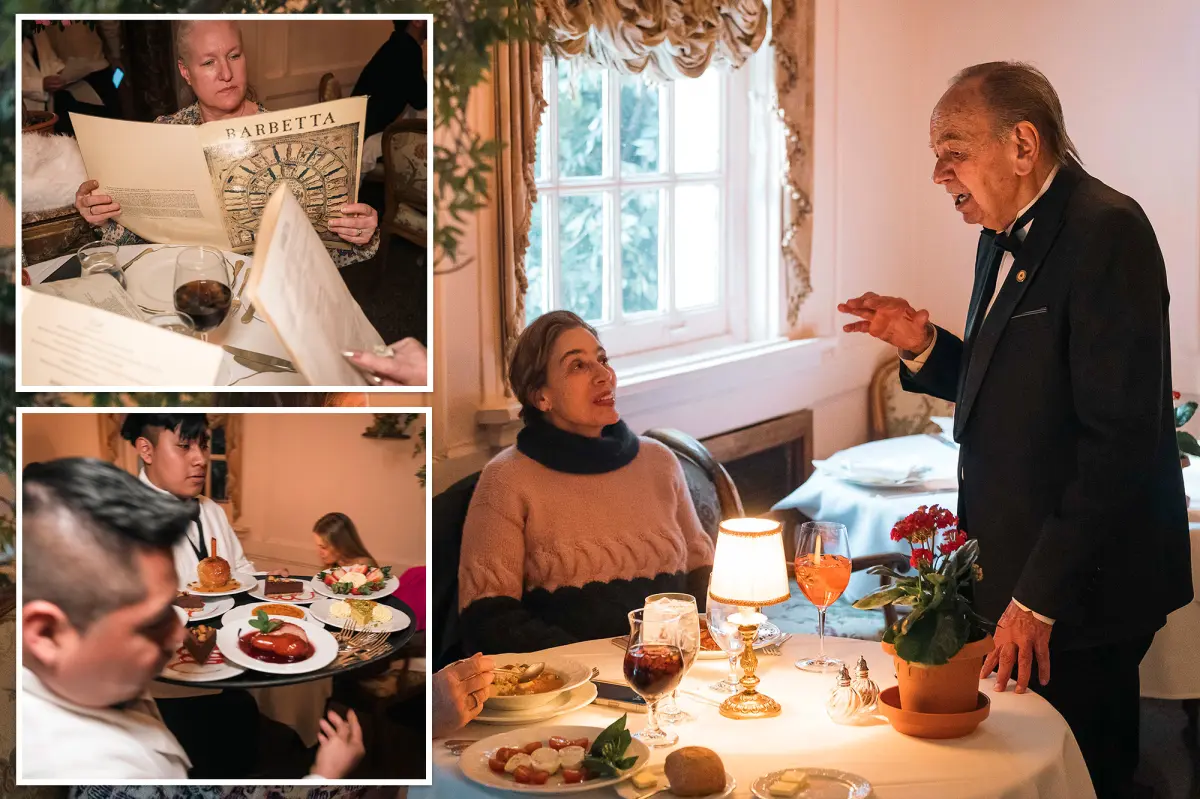
After exactly 120 years, the curtain fell on Barbetta, the iconic Italian restaurant in New York’s Theater District, serving its final meal on a poignant Friday night. Nestled in the stately Astor family-built townhouse at 46th Street, the eatery overflowed with Italian antiques, polished furniture, and the warm glow of memories etched into every corner. But beneath the elegance lay a tidal wave of emotion as patrons—lifelong devotees, celebrities, and staff alike—bid farewell to a place that had become more than a restaurant; it was a slice of history, a family home for many. Suzanna Gardijan, the Private Events Manager who had dedicated 38 years to the space, stood at the coat check, her eyes welling up as she watched the throngs pour in. “It left such an impact on people,” she said softly, her voice steady despite the lump in her throat. Everyone seemed to sense the finality—friends reuniting, strangers connecting over shared nostalgia, and a collective sadness hanging thick in the air like the aroma of simmering sauces. One woman clutched a tissue, recounting how Barbetta had hosted her grandmother’s birthday decades ago; a man hugged an old waiter as if saying goodbye to kin. The dining room buzzed with chatter, but it was punctuated by sniffles and long, lingering embraces. Diners craved one last taste of Barbetta’s treasures: the Pacific swordfish with its delicate herb crust, the robust bolognese, or the signature bue al Barolo—a rich red wine and beef stew that warmed the soul on chilly nights. Waiters moved with practiced grace, plating dishes that evoked childhood feasts in Italian kitchens across the Atlantic. Beyond the food, it was the atmosphere that lured them back: the soft clink of silverware on antique china, the flicker of candlelight casting long shadows on frescoed walls, and the distant hum of Broadway shows just blocks away. Barbetta wasn’t just a spot for a meal; it was a time capsule of New York’s vibrancy, where generations had toiled and celebrated. Bill Bradley, the NBA Hall of Famer and former Senator from New Jersey, sat among the revelers, his eyes misty after savoring his last plate. “There’s a genuine sadness because there won’t be another Barbetta,” he told reporters, his voice cracking. “From the people first—to the atmosphere, the unbelievable food, and that perfect location—you put it all together and have something irreplaceable. All thanks to Laura.” In that moment, the restaurant felt alive not with tragedy, but with gratitude, as if each bite was a final nod to a legacy that had outlasted empires.
Running Barbetta since 1962, Laura Maioglio was the heart and soul of the operation, a woman whose meticulous passion turned the restaurant into an extension of her own home. With an eagle eye for detail, she ensured every napkin was folded just so, every ingredient sourced from the finest purveyors, and every guest felt like family. Staff like Suzanna often reminisced about Laura’s trips to Italy for culinary inspiration—week-long excursions to Piedmontese vineyards and trattorias, returning with stories, sketches, and secret recipes that kept the menu evolving yet timeless. “Laura was an amazing woman who taught me everything,” Suzanna shared, her fondness palpable. “She wanted Barbetta to feel like her home, where imperfections were polished away, and memories were built.” Laura’s journey began as a young woman taking over from her Italian-born father, Sebastiano, who had opened the doors at the turn of the century when Italian fare was still exotic—a delicacy among America’s elite. Back then, Barbetta introduced Piemontese cuisine to the sparsely acquainted American palate, popularizing treasures like white truffles that were flown in like precious gems, their earthy musk a revelation in dining. It became the oldest restaurant in New York owned by the same founding family, and arguably the oldest Italian spot in Manhattan, a feat that filled Laura with quiet pride. She ran it for over six decades, navigating economic ups and downs, from the Great Depression echoes to modern gentrification pressures, always prioritizing quality over shortcuts. Her decision to close upon her death at 93 on January 17 resonated deeply—perhaps a deliberate choice to let the restaurant pass with its matriarch, rather than endure without her guiding hand. Suzanna speculated as much, adding tearfully, “She was our anchor; without her, it just wasn’t the same.” Laura’s legacy wasn’t merely professional; she fostered a workplace where loyalty bred friendships that lasted lifetimes. Mornings at Barbetta started with hugs and plans for the day, evenings ended with shared laughter over leftover tiramisu. Guests often lingered, sharing personal tales, knowing Laura would listen with the warmth of an old confidante. Yet, running such a beacon took its toll—Laura juggled family life too, her husband Gunther Blobel, a Nobel Prize-winning molecular biologist, often joining her for intimate dinners in the garden.
In the tapestry of New York City’s cultural fabric, Barbetta was a vibrant thread, woven through the lives of film stars, musicians, and everyday dreamers. Jackie Kennedy dined there during her White House days, finding solace in its cozy booths after public scrutiny; John Lennon sketched in his notebook at the bar, inspired by the ambiance for melodies yet to be sung. The Rolling Stones, in their leather-clad heyday, charmed Laura’s mother Piera, who adored Mick Jagger’s playful antics. Once, after Piera’s passing, the band returned with flowers for her memorial photo in the coat room, a touching gesture that underscored their bond. Woody Allen filmed scenes in its grand halls for movies like “Celebrity” and “Alice,” where the antique piano took center stage in montage moments of love and longing. Martin Scorsese captured a pivotal “Departed” scene amid the chandeliers, infusing the space with cinematic tension. Even Jimmy Stewart shot parts of “The FBI Story” in 1959, his everyman charm fitting the restaurant’s welcoming aura. On TV, Barbetta popped up in “Mad Men” as a backdrop for corporate lunches and whispered deals, and in “Sex and the City” episodes where characters toasted life’s ironies over antipasti. Geraldo Rivera, a devoted patron, called it a “great loss to the city,” mourning the end of spaces that defined neighborhoods. In the 1960s, Laura hosted groovy fashion shows in the sunny garden, with models sashaying past mildew-flecked statuary under tulip-strewn skies. And when Gunther won his Nobel in 1999, the celebration dinner was held right there, with toasts echoing off the walls. Rivera fondly recalled a 2016 night amid election fervor, when Laura graciously introduced Hillary Clinton to guests—not endorsing, but welcoming—navigating politics with the finesse of a seasoned diplomat. These stories painted Barbetta as more than a venue; it was a connector, bridging eras and egos. The marquee’s blazing sign outside symbolized its glow in Broadway’s shadow, attracting post-theater crowds for “Hamilton” openings just a block away, where actors mingled with fans over prosecco. In the end, Barbetta’s fame lay not in notoriety, but in genuine belonging—a place where the famous felt ordinary, and the ordinary felt celebrated.
Deep into the final night, the dining room pulsed with personal stories, each table a microcosm of Barbetta’s emotional gravity. Suzanna, ever the gracious hostess, paused by the piano as patrons burst into spontaneous applause, her surprise genuine amidst the emotion. “I wasn’t expecting that,” she admitted later, her cheeks flushed. Margarito “Mario” Morales, a waiter who’d risen from kitchen duties 13 years ago, dashed between tables with infectious energy. “My favorite memory is whenever Laura was here,” Mario said, a bittersweet smile on his face. “She made us feel part of something bigger.” Alan Reiff, a longtime diner since his post-“Hello Dolly” visit 39 years ago, reserved his spot immediately upon hearing the news, fighting back tears as he ordered the famed swordfish. Brides who wed in Barbetta’s leafy garden returned with husbands and old photos—Alice Uhul, married to her late husband Mitch in 1996, choked up while recalling their vows beneath blooming roses: “I’m ordering the swordfish tonight, just like our wedding.” The garden, once a sun-drenched retreat for al fresco risotto and lingering conversations, had hosted countless milestones: engagements sealed with Chianti, 50th anniversaries toasted with spheres of burrata as golden as childhood summers. Karla Murray, a photographer documenting New York’s small businesses, echoed the communal grief: “When you lose a place that’s been around so long, the neighborhood’s character fades a bit. Now’s the time to cherish what’s left—you can’t assume it’ll be here tomorrow.” Her husband James, sharing their Instagram chronicles, nodded solemnly, urging support for mom-and-pop gems amid rising rents and corporate juggernauts. Staff themselves grappled with the void; Antonio, the head bartender, reminisced about late-night chats with Laura over espresso, turning shifts into therapy sessions. The kitchen crew, from sous-chefs to dishwashers, shared tales of ingredient hunts—truffle forays in hidden markets—and the pride in presentations that won rave reviews without a single compromise. One dishwasher, tears streaming as he packed up, whispered of how Barbetta had paid for his kids’ college, a debt of gratitude unspoken till now. Patrons lingered, reluctant to depart, phones out for one last selfie by the bar or a group shot with Suzanna, turning final hours into a impromptu reunion.
Amid the farewells, Barbetta’s absence loomed as a void in the city’s cultural scene, a reminder of how institutions shape collective identity. With Eliza from Elaine’s Restaurant also gone since 2011, Geraldo Rivera mourned the “two shining lights” of New York hospitality—women whose graces defined an era of elegance now waning. Laura’s knack for diplomacy shone brightest in diverse crowds: business tycoons debating markets over osso buco, families celebrating graduations with antipasti platters that evoked Italian Sundays. Yet, as rents soared and traditional eateries faced extinction, Barbetta’s closure sparked broader reflections on preservation. Sal Scognamillo from nearby Patsy’s praised their A-1 integrity: “They kept it first-class, never compromising. That’s how a restaurant should be run.” Barbetta’s innovation—being first to fanfare truffles, to blend American palettes with Piedmontese bold flavors—had educated palates nationwide, turning curiosity into lifelong love for Italian eats. Its theater adjacency made it a magnet for after-show raves, where jittery nerves calmed with fettuccine alfredo and lively debates. Film productions added mystique, blending fiction with reality until the lines blurred; visitors often stole glances, whispering about Scorsese’s crew or Allen’s cameras. But beyond hype, Barbetta nurtured quiet moments—solitary diners poring over heirloom menus, or couples rediscovering romance in intimate booths shrouded by velvet drapes. The antique furnishings, lovingly restored, whispered histories: a carved chair from Laura’s first Iberian trip, a chandelier once dangling in a Milan palazzo. Staff and patrons alike pondered the whys—a nod to changing tastes? Economic strains? Or simply preservation’s paradox, where longevity demands an end. In the final bustle, noise gave way to melancholic toasts, glasses clinking like a symphony’s coda. The restaurant, once a hub of creation and connection, stood poised to transition—perhaps reimagined, but its spirit indelible in hearts.
As closing time neared, the weight of “what now” pressed heavily, staff and regulars alike facing uncertainty with a mix of sorrow and resilience. Suzanna, wiping away tears, admitted, “I have no idea where we’re going next. A lot of people are asking, ‘Where are you going? We’ll follow you!'” Her 38-year tenure had forged bonds deeper than employment; Barbetta was kin, and leaving felt like orphaning. Mario, juggling trays one last time, hinted at a possible kitchen elsewhere, but emotions ran raw—calls for staff reunions already brewing. Patrons like Bill Bradley, still in the throes of grief, emphasized legacy’s continuity: “We must keep these stories alive.” The photographer Karla urged communities to rally around hidden gems, her photos capturing Barbetta’s essence for posterity. In the quiet after, as the townhouse doors locked for good, echoes lingered—the sizzle of pans, laughter over forgotten lyrics from “Hamilton.” Barbetta’s closure wasn’t just an end; it was a catalyst for appreciation, a nudge to celebrate enduring places before they’re lost to time. From Sebastiano’s pioneering days to Laura’s unwavering stewardship, the restaurant had mirrored New York’s soul: resilient, enchanting, ever-evolving. As night fell, the marquee dimmed, but memories blazed on, a testament to how one home away from home could touch countless lives, leaving the city a little warmer in its absence. Yet, in the voids left by such legends, new stories emerge—perhaps another Suzanna somewhere, crafting magic from scratch, reminding us that while institutions fade, their spirit inspires eternal feasts of the heart.