




The Surprising Spiritual Side Effect of Botox: Is Your Third Eye at Risk?
For Sophie Villensky, a 28-year-old manifestation advocate from Minneapolis, the strange sensation came immediately after her first Botox treatment. Beyond the expected inability to move her forehead muscles, something deeper felt off. “Instead of being able to focus energy in on that spot, I felt a whole lot of nothing,” she explained to The Post. “It was like there was a block when I tried to energetically connect with that area of my body.” This unusual side effect wasn’t what she had bargained for—a spiritual numbness that contrasted sharply with the energetic openness she typically experienced after practices like reiki or acupuncture.
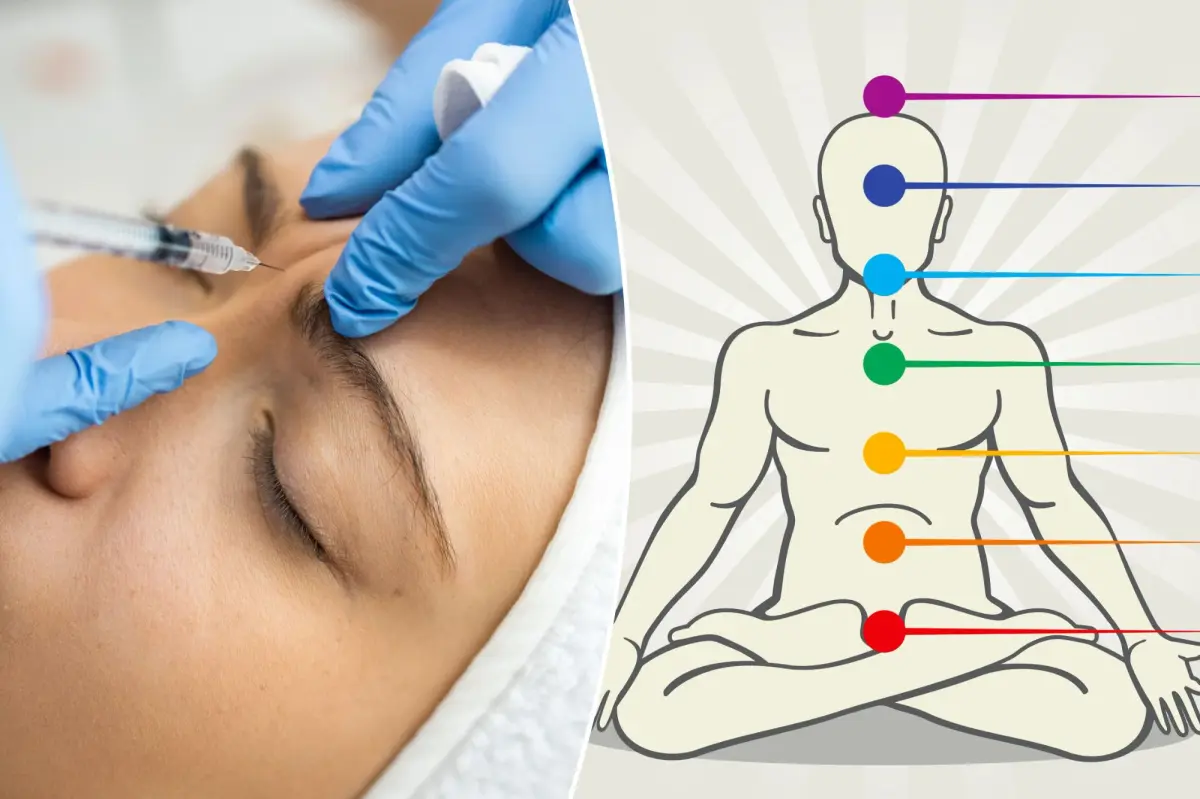
Villensky isn’t alone in her experience. A growing conversation is emerging on social media about whether forehead Botox might interfere with the “third eye”—the spiritual energy center associated with intuition and heightened awareness in many belief systems. Even celebrities are joining the discussion, with Kourtney Kardashian recently revealing on her family’s reality show that she’s avoided Botox for four years specifically to “keep my third eye open.” The 46-year-old reality star firmly told her sister Kim (who had just gotten Botox two nights before) that she’ll “never get it again,” highlighting a growing divide between those who prioritize conventional beauty standards and others concerned about potential spiritual consequences.
Social media has become a battleground for this debate, with passionate voices on both sides. Some spiritually-minded individuals make bold claims about the cosmic dangers of the treatment: “Botox f–ks up your third eye,” declared one person online, suggesting that those who freeze their foreheads are seeking “outside validation” rather than doing their “inner work.” Others warn that injections in this area can leave you “constantly overthinking, doubting yourself” and experiencing a “lack of clarity.” The phenomenon represents a fascinating intersection of beauty culture, spiritual awakening, and what some might call new-age neurosis—leaving medical professionals and energy healers to debate whether these experiences are biological, psychological, symbolic, or perhaps something even deeper.
Energy practitioners and spiritual coaches offer nuanced perspectives on this emerging concern. Seena Stoane, an energy-healing practitioner, told The Post that Botox doesn’t technically block chakras, which operate on a “subtle, non-physical” level, though it may alter how energy or sensation manifests in the treated area. Spiritual coach Lisann Valentin describes the third eye as “the seat of the soul—where your intuition lives,” suggesting that individual intention plays the most significant role in how treatments affect spiritual connection. “There’s no right or wrong,” she emphasized. After her experience, Villensky described her third eye as feeling “closed for business—or there but sleeping,” though she isn’t ready to call Botox the “enemy of enlightenment.” She thoughtfully reflected, “If a Botox treatment is going to ruin my relationship with my higher self, I probably have some other stuff to figure out intuitively that I should work on before worrying about wrinkles.”
Not all spiritually-minded individuals share these concerns. Intuitive healer Rachel Ruth Tate, who uses Botox herself, firmly dismisses the panic: “Botox doesn’t block your third eye, and hair color doesn’t block your crown chakra,” she stated, encouraging people to “do whatever makes you feel most empowered and at one.” This perspective highlights an important counterpoint in the spiritual community—that personal empowerment and self-confidence may ultimately contribute more to spiritual wellbeing than avoiding certain cosmetic treatments. The debate reveals how deeply personal these decisions are, existing at the intersection of beauty standards, spiritual beliefs, and individual bodily autonomy.
From a medical perspective, dermatologists offer straightforward explanations for what some perceive as spiritual interference. Board-certified dermatologist Dr. David Johnson clarified to The Post that “Botox is localized, and it doesn’t reach the brain. It doesn’t interfere with thinking, intuition or emotions.” The treatment simply works by temporarily freezing small muscles in the forehead, not affecting the brain or nervous system. While some patients report feeling “off” after injections, doctors attribute this to the brain receiving different feedback from facial muscles, creating an unfamiliar sensation. The real risks of Botox, according to Johnson, are purely medical—potential “temporary weakness, asymmetry, headaches, or eyelid drooping when the injections are not administered properly”—rather than spiritual disconnection. “The third eye is considered spiritual, but it’s not a body part,” Johnson concluded. “Scientifically, there’s nothing to block.” This tension between scientific explanation and lived spiritual experience perfectly encapsulates a modern dilemma: as cosmetic procedures become increasingly normalized, how do we balance physical transformation with potential metaphysical concerns?