


Europe has always been a place people dream about visiting, and the next decade is going to prove that the old continent’s magnetism is not fading. From the afternoon sun in a Roman plaza to the midnight glow of a Nordic summer, from the crowded charm of Barcelona’s narrow streets to the quiet majesty of Alpine peaks, Europe has long been the world’s favorite travel destination. But according to a new report from the global hospitality group Accor, called “The Changing Face of Europe’s Tourism Map to 2036,” the next ten years will bring not just more visitors, but a fundamental reshaping of how, where, and by whom Europe is explored. The study, based on data commissioned from Tourism Economics, predicts that demand for tourist accommodation across Europe will grow by a third by 2036. Specifically, accommodation nights are projected to increase by 32 percent between 2026 and 2036, adding 1.6 billion additional overnight stays each year. Hotel accommodation is expected to grow even faster, at 33 percent. These numbers are remarkable on their own, but they become even more striking when you consider the starting point. In 2025, Europe welcomed 810 million international visitors, more than any other region on Earth. It attracted 53 percent of all international tourists globally and generated more than €700 billion in international tourism receipts. In other words, Europe isn’t just holding onto its crown—it’s preparing to wear it with more confidence than ever.
So what accounts for this enduring popularity? Accor’s report suggests that beneath the straightforward growth figures lies a complex web of factors, including changing travel flows, massive infrastructure investment, the emergence of new destinations, and rising international mobility. But perhaps the most important reason, the report argues, is Europe’s extraordinary diversity. Few regions on the planet can offer such a wide range of tourism experiences in such a comparatively compact area. You can go from a world-class shopping capital to a remote mountain village in a few hours by train. One week you might be skiing in the Swiss Alps, and the next you could be sunbathing on a secluded Greek island. Europe is not a single destination but a mosaic of many different worlds. It includes global gateway cities like Paris, London, and Amsterdam; beach destinations along the Mediterranean; ski resorts in the Alps and Pyrenees; legendary cultural cities like Prague and Florence; national parks and wild landscapes; deep-rooted heritage sites; a food culture that changes with every border; and festivals that range from ancient rituals to futuristic music events. This combination of history, nature, art, and gastronomy means that Europe can attract almost every type of traveler, from budget backpackers to luxury-seekers, from first-time tourists following the classic highlights to seasoned explorers looking for hidden corners. As Accor puts it, Europe’s lasting appeal lies in its “infinitely varied mosaic of landscapes, languages and cultures.” That diversity is not just a nice idea—it is a practical strength that helps the tourism industry weather crises and adapt to changing tastes.
But who exactly will be doing all this traveling in the coming years? One of the most interesting findings in the report is that the world’s travelers are changing, and so are their origins. International travelers are expected to drive the majority of the growth, with the number of nights they spend across all accommodation types rising by 42 percent over the next decade. Domestic holidaymakers, meanwhile, will see a slower growth rate of 24 percent. Yet despite the rise of long-haul visitors, the largest share of arrivals will come from within Europe itself. According to the data, 77 percent of all arrivals in 2036 will be intra-continental travelers—people from one European country visiting another. Germany is set to become the strongest source market, representing around 14 percent of all arrivals, followed by British travelers at 8 percent, French and American travelers at 5 percent each, and Dutch travelers at 4 percent. This tells a compelling human story: after a few difficult years of global uncertainty, Europeans are rekindling their love affair with their own continent. They are taking advantage of affordable flights, high-speed rail networks, and the simple pleasure of discovering a nearby country that feels different enough to be exciting but close enough to feel manageable. The report also highlights specific bilateral connections that will become increasingly important. By 2036, Germany is expected to be the largest source market for both France and Poland. The Netherlands will lead among source markets for Germany. British travelers will make up the biggest group of visitors to Spain, and American travelers will be the leading source market for the United Kingdom. These relationships show that tourism is not just a global phenomenon—it is deeply rooted in geography, history, and cultural ties.
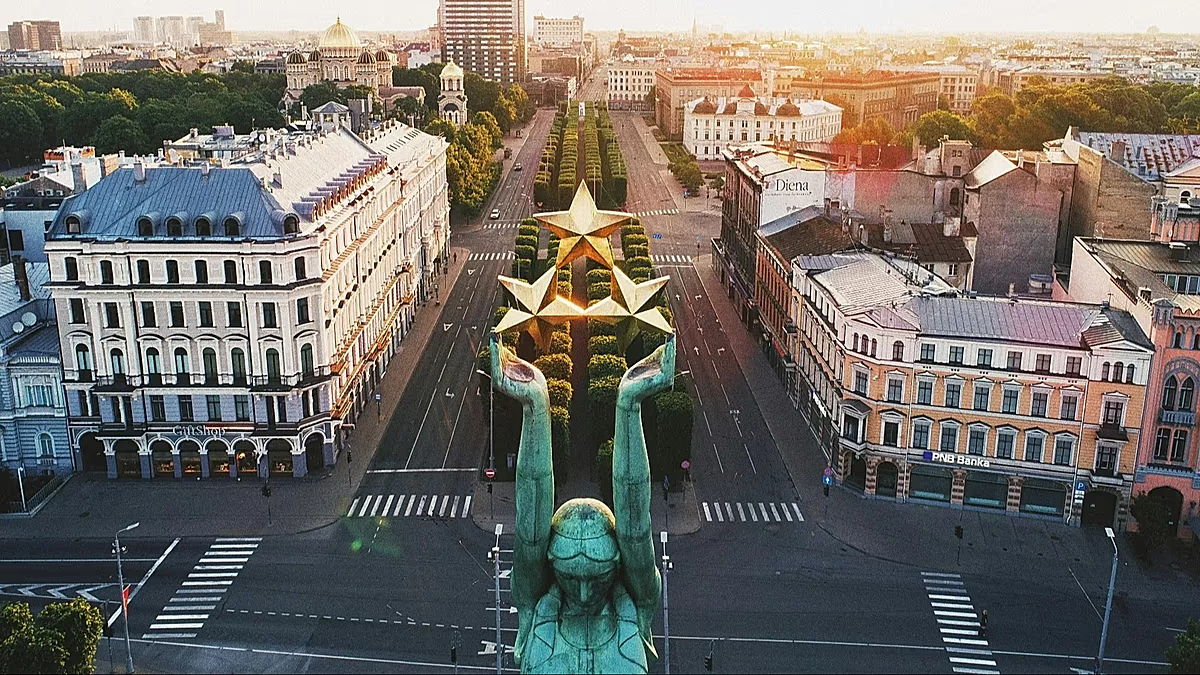
While the classic destinations like France, the United Kingdom, and Germany will remain enormously popular, one of the most exciting parts of the report is the rise of emerging tourism hotspots. The next decade could transform countries that used to be overlooked into must-visit places. Azerbaijan is predicted to see a 116 percent increase in international accommodation nights over the next ten years—the highest growth in the entire report. Latvia is close behind, with an expected rise of 83 percent, followed by Romania at 82 percent. These numbers reflect a broader trend in travel: many people are growing tired of overcrowded cities and overexposed tourist attractions. They are searching instead for places that feel authentic, less expensive, and still somewhat undiscovered. Azerbaijan, with its dramatic Caspian Sea coastline and the ancient-modern blend of Baku, offers a fascinating mix of East and West. Latvia’s capital, Riga, is known for its stunning Art Nouveau architecture and its forested landscapes, while Romania offers the wild beauty of the Carpathians, the gothic mystery of Transylvania, and the energetic streets of Bucharest. These destinations are not just trendy alternatives—they are thriving, evolving places with improving infrastructure, new hotels, better transport links, and a growing international profile. The report suggests that Europe’s tourism map is becoming more diverse, and that the countries outside the traditional core are gaining a share of the spotlight. For travelers, this is a win: more choices, fewer crowds, and the chance to have genuine experiences before the hordes arrive.
The growing appetite for Europe extends far beyond the continent’s own borders. According to Accor’s research, demand from international source markets is accelerating at an exceptional pace. Arrivals from the Middle East are expected to skyrocket by 93 percent over the next decade, while arrivals from Asia will rise by 88 percent. Among specific countries, the numbers are even more dramatic: Saudi visitors to Europe are projected to grow by 55 percent, while arrivals from China are expected to surge by an extraordinary 138 percent. Africa is not far behind, with a predicted increase of 46 percent, while South American arrivals are set to grow by 42 percent and North American arrivals by 26 percent. These trends are driven by a combination of factors: a rapidly expanding global middle class, new airline routes connecting more cities than ever before, more favorable visa policies, and a growing desire among people from distant parts of the world to experience Europe’s history, culture, and sophistication. Chinese travelers, for instance, have long been drawn to Europe’s luxury shopping and iconic landmarks, and their return at scale will have a profound impact on cities like Paris, Milan, and London. Travelers from the Gulf states, meanwhile, have become increasingly important in the summer months, and their preferences are already shaping the hospitality industry in places like the French Riviera and London. South Americans, especially Brazilians and Argentines, are drawn to Portugal and Spain by language and family connections. What this means is that Europe will soon welcome a much more diverse range of visitors than it has ever seen. The future of European tourism is not just about more people—it is about people from all corners of the globe, each bringing their own expectations, traditions, and ways of traveling.
Taken together, these forecasts paint a future that is both exciting and demanding. By 2036, Europe will still be the heavyweight champion of world tourism, but the shape of that tourism will be very different. There will be more visitors from Asia and the Middle East, more travelers exploring the newer frontiers of Europe, and more Europeans rediscovering the treasures in their own backyard. Yet with this growth come serious challenges. Overcrowding, environmental pressures, housing shortages, and the sheer strain on infrastructure are already a concern in some of the continent’s most popular places. If Europe is to absorb an additional 1.6 billion overnight stays a year, it must think carefully about sustainability, conservation, and the quality of life for local residents. The Accor report does not shy away from the scale of this transformation, but it also frames it as an opportunity. The continent’s greatest asset has always been its ability to evolve while preserving its soul. The rise of new destinations is one way of relieving pressure on the old favorites. The spread of travel across seasons and regions can help balance the load. The growing diversity of source markets will make Europe’s tourism industry more resilient to global shocks. For the traveler, the next decade promises a Europe that is more accessible, more varied, and more welcoming than ever before. Yes, you may still need to plan ahead if you want to get a table at that restaurant in Paris or a room with a view in Positano. But with the map widening, there is always somewhere new to explore. The old continent is not just restating its classic appeal—it is rewriting its future, and everyone is invited to be part of the story.