




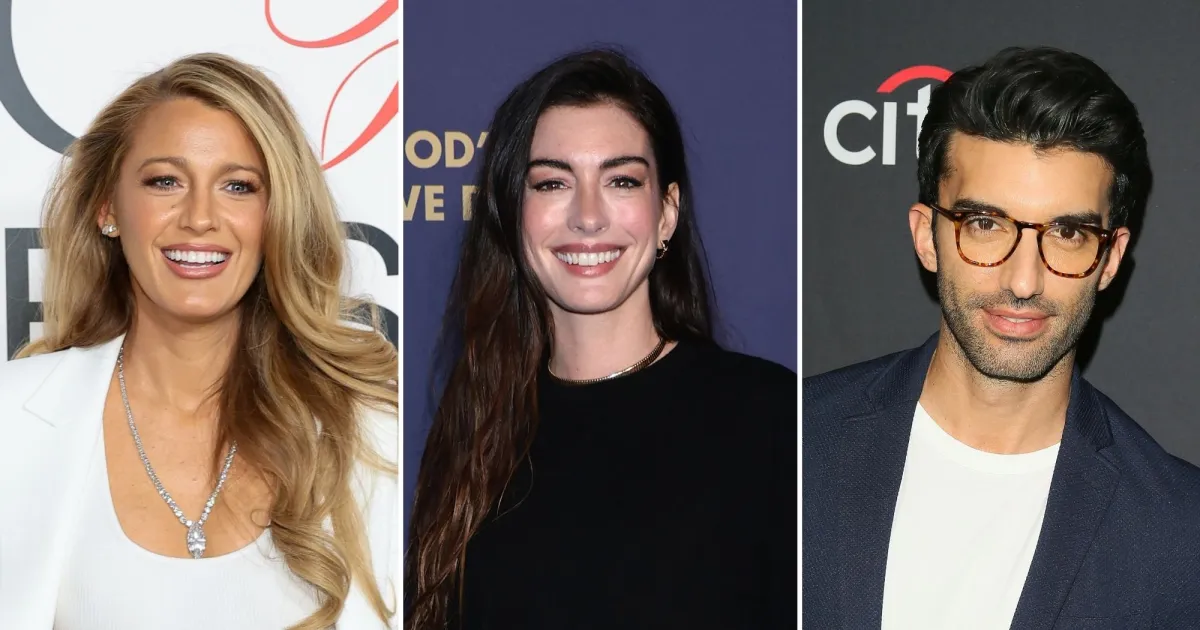
Anne Hathaway Mentioned in Blake Lively and Justin Baldoni’s Legal Battle Documents
The ongoing legal dispute between Blake Lively and Justin Baldoni related to their film “It Ends With Us” took an unexpected turn when court documents unsealed in January 2026 revealed correspondence that name-dropped several celebrities, including Anne Hathaway. While Hathaway herself is not directly involved in the legal proceedings, her name appeared in a notable email exchange between Sony executives Tom Rothman and Tony Vinciquerra. These documents have drawn public attention not only to the primary dispute between the film’s stars but also to broader conversations about how female celebrities face public criticism. The revelation provides an intriguing glimpse into how entertainment industry executives perceive and discuss the public reception of their stars, particularly comparing different experiences of female celebrities who have faced intense public scrutiny despite their success.
The mention of Hathaway came specifically in an email where Sony executives were discussing the backlash Lively received during the promotion of “It Ends With Us.” After Vinciquerra contributed a supportive quote about Lively to The Hollywood Reporter, Rothman responded appreciatively, noting he had observed the harsh criticism Lively was receiving on social media platforms. In his message, Rothman drew a direct parallel between Lively’s situation and what Hathaway had experienced years earlier, writing: “I guess it’s an ugly reflection of society — she has so much (looks, money, fame, hunk husband, kids etc etc), that the instinct of the crowd is to tear her down. Like what happened to Anne Hathaway and neither of them deserve it, even tho she did bring it all on herself by refusing to listen to advice… and by selling her products.” This comparison is particularly revealing as it demonstrates how executives recognize patterns in public treatment of female celebrities while simultaneously attributing some blame to Lively herself, creating a somewhat contradictory assessment of the situation.
The comparison between Lively and Hathaway illuminates a troubling pattern in how successful women in Hollywood are treated by both the public and industry insiders. During the 2010s, Hathaway faced what became known as “Hathahate” – an inexplicable wave of public animosity that peaked around her 2013 Oscar win for “Les Misérables.” Despite delivering an acclaimed performance, Hathaway was criticized for seeming “too perfect” and “inauthentic,” with her acceptance speech being labeled as overly rehearsed. The criticism had no substantial basis in any actual wrongdoing but stemmed from a perceived inauthenticity that resonated with online communities. Similarly, Lively faced intense backlash for promoting “It Ends With Us” in what many considered an inappropriately lighthearted manner, encouraging viewers to “grab your friends and wear your florals” for a film dealing with the serious subject of domestic violence. Both cases represent instances where accomplished actresses faced disproportionate criticism that seemed motivated more by their success and public image than by genuine grievances.
Hathaway herself has spoken candidly about how this period of public disfavor affected her career. In a March 2024 Vanity Fair interview, she revealed, “A lot of people wouldn’t give me roles because they were so concerned about how toxic my identity had become online.” This professional impact underscores the real consequences of such public sentiment shifts, reaching beyond mere social media unpleasantness into concrete career limitations. Hathaway credited director Christopher Nolan with “backing her” during this difficult period by casting her in significant roles despite the negative online discourse. “I don’t know if he knew that he was backing me at the time, but it had that effect. And my career did not lose momentum the way it could have if he hadn’t backed me,” she explained. Her experience demonstrates the crucial role that industry support plays in helping talents weather periods of unwarranted public criticism, highlighting how vulnerable even established stars can be to shifts in public perception.
The unsealed documents also mentioned other high-profile celebrities including Taylor Swift, Ben Affleck, and Matt Damon, suggesting the entertainment industry’s interconnected nature and how discussions about one celebrity often reference others as points of comparison or context. It’s worth noting that following her initial promotional missteps for “It Ends With Us,” Lively attempted to course-correct by sharing resources for domestic violence victims on her social media platforms. This response mirrors the careful image management that many celebrities must undertake, particularly when handling sensitive topics. The situation highlights the challenging balance public figures must strike between authentic self-expression and meeting audience expectations for appropriate behavior, especially when promoting projects dealing with serious social issues. The court documents inadvertently provide a window into how these dynamics are discussed behind closed doors by the executives who help shape and manage celebrity personas.
The parallel between Hathaway and Lively’s experiences points to a broader pattern in how female celebrities in particular are built up and then subjected to intense scrutiny and criticism, often for reasons that seem arbitrary or disproportionate to any actual misstep. Both actresses reached tremendous heights of success – Hathaway with her Oscar win and Lively with her leading role in a major adaptation of a popular novel – only to face waves of public criticism that threatened to undermine these achievements. The executives’ discussion reveals an awareness of this phenomenon even as they participate in it to some degree, acknowledging the unfairness while still critiquing Lively’s choices. This contradiction perhaps reflects the industry’s complicated relationship with the female stars it both celebrates and scrutinizes, recognizing the systemic unfairness while still operating within its constraints. As these legal documents continue to shed light on behind-the-scenes dynamics, they offer valuable insights into not just this specific dispute between Baldoni and Lively, but the broader cultural context in which female celebrities navigate their careers and public images.