





Late Night Shows Pay Tribute to Rob and Michele Reiner Amid Tragedy
The entertainment world was rocked on Sunday, December 14, when acclaimed filmmaker Rob Reiner and his wife Michele Singer Reiner were found dead in their Brentwood home in Los Angeles. As news spread of the couple’s tragic deaths, late-night television hosts across networks took time during their Monday shows to honor the beloved director of classics like “When Harry Met Sally…” and former “All in the Family” star. Their tributes came with heavy hearts, as the circumstances surrounding the deaths were particularly shocking—the couple had suffered stab wounds, and by Monday, their 32-year-old son Nick had been arrested and charged with their murders. The late-night community, many of whom had personal relationships with the Reiners, struggled to find the right words while balancing the need to acknowledge the tragedy and continue with their shows.
Jimmy Fallon offered a heartfelt tribute on “The Tonight Show,” calling Reiner “one of the smartest and funniest people I’ve ever met” and emphasizing the tremendous legacy he leaves behind. “Thank you for all the great work on and off screen and continuing to be an inspiration to me and millions of people around the world,” Fallon said, his voice carrying genuine emotion. “In the end, I’m going to remember all of the laughs that you’ve given us.” This sentiment captured what many felt about Rob Reiner—that beyond his considerable artistic achievements, he brought joy to countless people through his humor, storytelling, and presence. Fallon’s words reflected not just the loss of a talented filmmaker but of someone whose work had become woven into the cultural fabric of American entertainment.
Stephen Colbert took a more somber approach on “The Late Show,” acknowledging not only the Reiners’ deaths but also recent shootings at Brown University and a Hanukkah celebration in Sydney, Australia. “Other people’s tragedy is sacred ground and we try very hard not to walk there,” Colbert said, noting that these events were “too dark” for his usual witty monologue. Yet he struck a balance, adding, “We are going to do a comedy show tonight, in light of, and in spite of, the darkness.” His comments recognized the difficult position late-night hosts find themselves in when tragedy strikes—how to acknowledge the gravity of real suffering while fulfilling their role as providers of lightness and humor. Colbert’s approach demonstrated the delicate tightrope walk performers must navigate when personal or national tragedies intersect with their professional obligations.
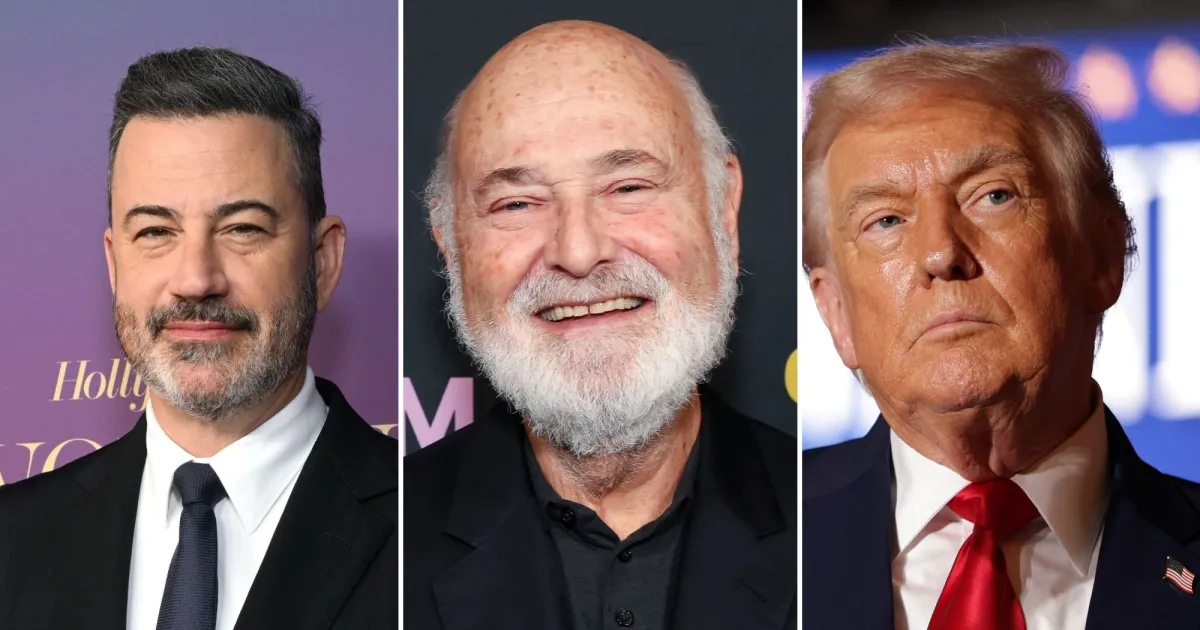
The tributes took on an additional dimension as Jimmy Kimmel and Seth Meyers addressed not only the deaths but also then-President Donald Trump’s inflammatory social media comments about Rob Reiner. Trump had posted that Reiner died due to “TRUMP DERANGEMENT SYNDROME,” referring to Reiner’s outspoken liberal politics and criticism of the Trump administration. Kimmel, visibly disturbed by these remarks, said, “It’s so hateful and vile. When I first saw it, I thought it was fake… But nothing is ever too much for him.” He suggested that based on his personal interactions with Reiner, the director “would want us to keep pointing out the loathsome atrocities that continue to ooze out of this sick and irresponsible man’s mouth.” Kimmel’s comments highlighted the political polarization that had followed Reiner even in death, while also suggesting that standing up against divisiveness was part of honoring Reiner’s legacy.
Seth Meyers shared personal memories of both Rob and Michele, describing them as “delightful people to be in a room with” and emphasizing, “He was a person who was so full of love. So was Michele. You could tell how much they loved each other.” This intimate perspective gave viewers a glimpse into the Reiners’ relationship and character beyond their public personas. Meyers also addressed Trump’s comments, saying he “feared” the president would make some negative remark about the deaths, “but it was even worse than I could imagine.” He lamented, “What a good time it would be to have a leader with a moral compass,” before concluding with perhaps the most touching tribute to Reiner’s character: “He was a man who set an example. There’s such a value in that and we have to do everything we can to not make setting an example a lost art.” In these words, Meyers captured not just what was lost with Reiner’s death but what he stood for in life—integrity, principle, and moral courage.
The late-night hosts’ responses to the Reiners’ deaths reflected the multifaceted nature of public mourning in the modern era. Their tributes acknowledged Rob Reiner’s immense contributions to film and television, the personal warmth and character of both Rob and Michele, and the complex political backdrop against which their deaths occurred. In a media landscape often criticized for superficiality, these moments stood out for their genuine emotion and thoughtfulness. The hosts managed to honor the Reiners’ memory while continuing to entertain their audiences—a balancing act that Rob Reiner himself, as a director who seamlessly blended humor with heart in films like “The Princess Bride” and “Stand By Me,” would likely have appreciated. Their tributes served as a reminder that beyond the headlines and politics, the entertainment community had lost two beloved members whose impact extended far beyond their creative work to touch the lives of those who knew them personally and the millions who knew them through their art.