




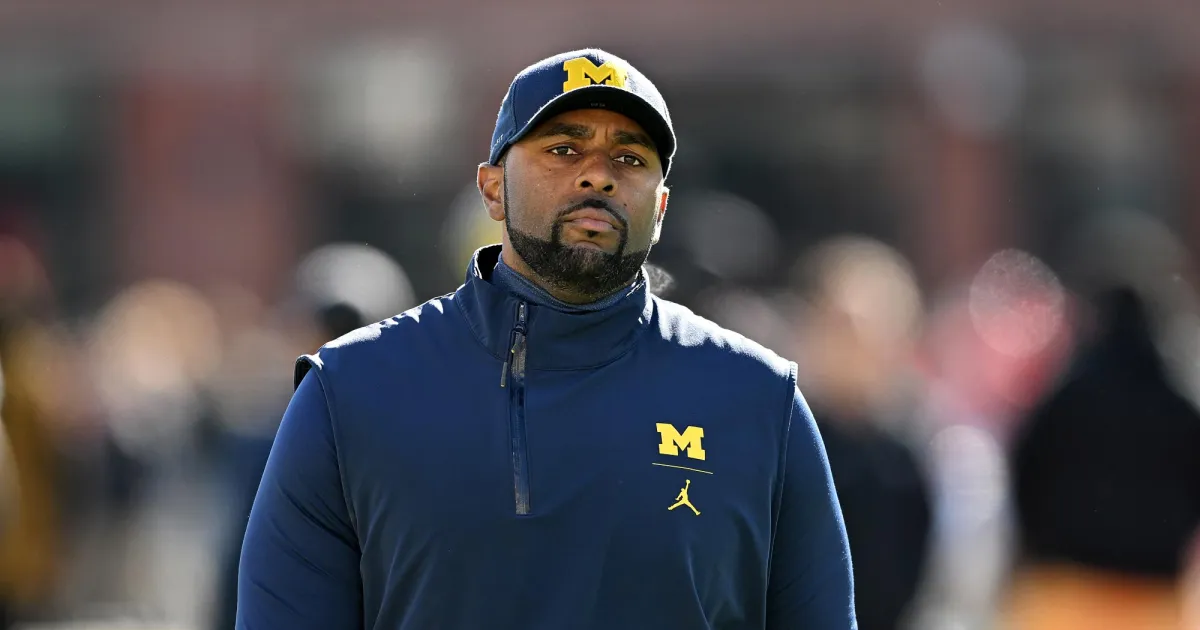
The Fall of Sherrone Moore: A Sudden Dismissal and Detention
In a stunning turn of events that sent shockwaves through the college football world, former University of Michigan head football coach Sherrone Moore was both fired and taken into police custody on the same December day, bringing an abrupt end to his brief tenure at the helm of one of college football’s most storied programs. The 39-year-old coach, who had just completed his second season leading the Wolverines after taking over from Jim Harbaugh following Michigan’s national championship victory in January 2024, found himself at the center of a rapidly unfolding scandal that combines allegations of both professional misconduct and potential legal troubles. The University of Michigan announced Moore’s termination at 4:43 p.m. on Wednesday, December 10, citing an “inappropriate relationship with a staff member” as the reason for his dismissal. Athletic Director Warde Manuel emphasized in his statement that “this conduct constitutes a clear violation of University policy, and U-M maintains zero tolerance for such behavior,” making it clear that the university considered the infraction serious enough to warrant immediate termination “for cause” – a designation that could potentially impact the more than $6 million per year Moore was set to earn over the remaining three years of his contract.
The situation grew more complicated when it emerged that Moore’s firing coincided with police involvement. Just minutes before the university’s announcement, at approximately 4:10 p.m., the Pittsfield Police Department had responded to an address on the 3000 block of Ann Arbor-Saline Road “for the purposes of investigating an alleged assault.” According to police statements and sources speaking to the Detroit News, the suspect taken into custody in connection with this incident was indeed Moore. The Saline Police Department reportedly assisted in “locating and detaining” Moore before turning him over to Pittsfield authorities “for investigation into potential charges.” While police have been careful in their public statements, noting that “the incident does not appear to be random in nature, and there appears to be no ongoing threat to the community,” they have provided few specific details about the nature of the alleged assault or any formal charges. Court records indicate Moore was booked at the Washtenaw County Jail at 8:30 p.m. that evening, with the Pittsfield Police Department explaining their limited disclosure by citing “the nature of the allegations, the need to maintain the integrity of the investigation, and its current status at this time.”
The timing of these events raises questions about the relationship between Moore’s termination for an inappropriate workplace relationship and his detention by police. While the university’s statement focused exclusively on policy violations regarding a staff relationship, the near-simultaneous police involvement has led to speculation about whether the two situations are directly connected or represent separate issues converging at once. What makes the situation particularly jarring is how quickly everything unfolded. Just days earlier, on Sunday, December 7, Moore had publicly expressed enthusiasm about Michigan’s upcoming appearance in the Cheez-It Citrus Bowl, scheduled for New Year’s Eve in Orlando against the University of Texas. “We are excited to take part in the 80th Citrus Bowl, a game that traditionally features some of the most storied programs in college football,” Moore had said. “Our team is eager for the challenge of competing against Texas, and it is a great honor to represent the Big Ten on this stage.” The stark contrast between these optimistic statements and the events that transpired just three days later highlights the sudden nature of Moore’s downfall.
The University of Michigan, facing the immediate need to stabilize its football program amid this turmoil, quickly announced that Biff Poggi would step in as interim head coach to lead the team through its Citrus Bowl preparation and appearance against Texas. This rapid response underscores the high stakes involved for a program that had only recently transitioned leadership after Jim Harbaugh’s departure for the NFL’s Los Angeles Chargers. Moore had been seen as the continuity candidate who could maintain Michigan’s momentum following their national championship win, making his abrupt removal all the more disruptive to the program’s trajectory. The university’s decision to fire Moore “for cause” – a specific contractual designation that can affect severance and financial obligations – suggests that administrators viewed the alleged misconduct as significant enough to warrant not only termination but potentially relief from financial commitments that would normally accompany a coaching change.
This situation has created ripple effects throughout the college football landscape, where coaching stability is prized and mid-December is typically a quiet period between the regular season’s end and bowl game preparations. Moore’s firing comes at a particularly sensitive time in the recruiting and transfer portal calendars, potentially affecting Michigan’s ability to maintain commitments from prospective players. For current players, many of whom had just adjusted to Moore’s leadership following Harbaugh’s departure, this represents yet another significant transition. The interim appointment of Poggi provides some immediate stability, but questions about the program’s long-term direction now loom large just as Michigan prepares for a high-profile bowl matchup against Texas, which will be heavily scrutinized as both a football contest and as an indicator of how well the program is weathering this unexpected storm.
As the legal process unfolds and more details potentially emerge about both the nature of the “inappropriate relationship” cited by the university and the alleged assault that led to police involvement, the Moore situation stands as a sobering reminder of how quickly fortunes can change in high-profile coaching positions. Just 11 months ago, Moore was celebrating a national championship as Harbaugh’s successor, viewed as a rising star in the coaching profession who had earned the opportunity to lead one of college football’s blue-blood programs. Now, his career hangs in the balance as both university investigators and law enforcement examine his conduct. For Michigan, a program that prides itself on tradition and integrity, this represents a significant challenge in maintaining institutional reputation while also ensuring competitive continuity in its football program. As the Wolverines prepare for their bowl game under interim leadership, the university community finds itself processing not just the loss of a coach, but the complicated circumstances surrounding his departure and what they might reveal about institutional oversight and the pressures of major college athletics.