



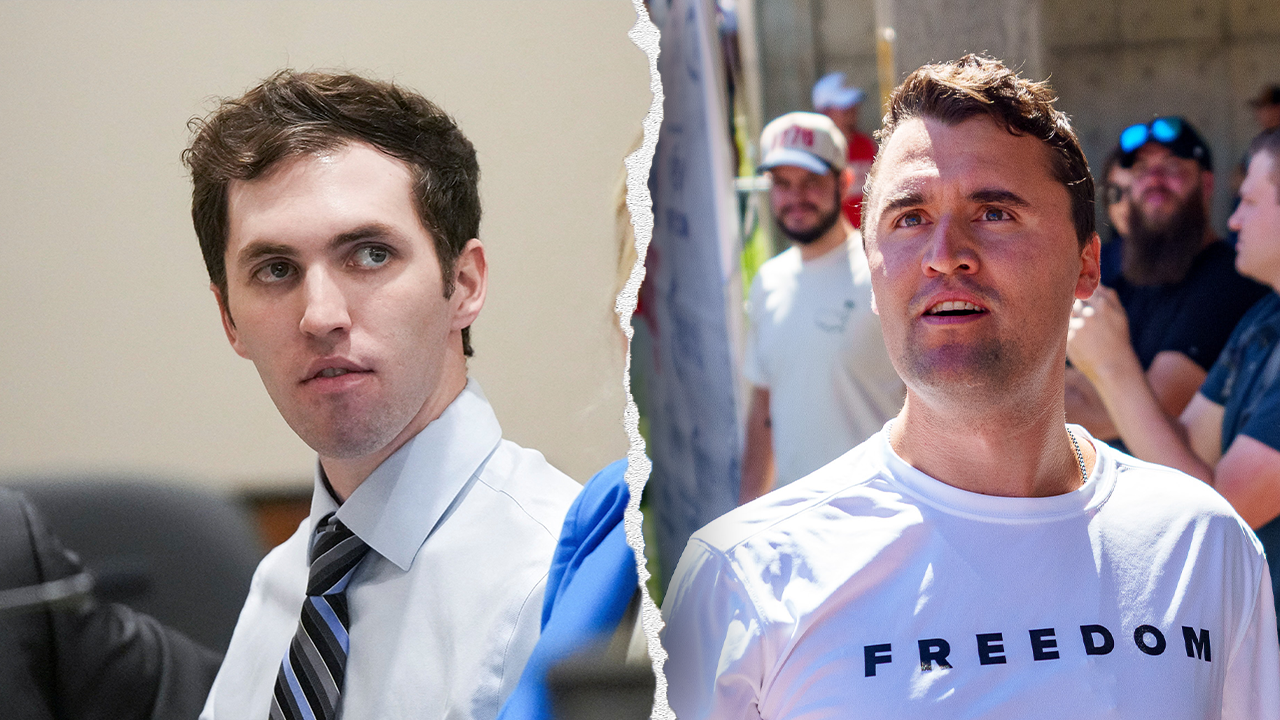
The article opens in a Provo, Utah, courtroom where the fate of a deeply painful case remains suspended in procedural uncertainty. Tyler Robinson, the 23-year-old man accused of assassinating Charlie Kirk at a Turning Point USA event, sat in a light gray suit, uncuffed and unshackled, a quiet presence in a room filled with sharp legal arguments and heavier silences. He did not address the court. He did not explain himself. Instead, he spoke in hushed tones with his attorneys, Richard Novak, Kathy Nester, and Staci Visser, and at one point passed a small note to Visser, a gesture that somehow made the alleged killer seem less like a monster and more like a defendant struggling to navigate a system that had consumed his life. Judge Tony Graf Jr. had entered the hearing expecting to set a trial date. But after nearly three hours of oral arguments, with lawyers on all sides describing sprawling discovery, scheduling conflicts, and deeply felt concerns about rushing toward a verdict, the judge conceded that he needed more time to decide. The courtroom emptied with no date confirmed, leaving the Kirk family to face yet another season of waiting. For them, each procedural delay is not merely a docket entry; it is another day without resolution, another reminder that the man at the center of their grief remains alive, while Charlie Kirk does not. Jeffrey Neiman, the attorney representing Kirk’s widow, Erika, put it plainly: “Justice delayed this long stops being justice for the Kirk family.” Those words seemed to hang in the air long after the hearing adjourned, a quiet challenge to a legal system that moves at its own pace, indifferent to the human cost of its caution.
Neiman has become the voice of urgency in this case, and his plea on this day was both legal and deeply personal. He reminded the court that every day of delay adds to the family’s uncertainty, invites public speculation, and erodes confidence in the very institutions that are supposed to provide justice. He spoke not only as a lawyer but as someone who has watched a widow, parents, and loved ones be forced to relive their trauma through endless hearings, motions, and continuances. Erika Kirk, who has been designated by the court as the official victim’s representative, has been present through this ordeal, carrying the weight of a loss that no legal ruling can repair. Under Utah’s state constitution, victims and their representatives have a right to a speedy resolution of their cases, and Neiman argued that this right is not optional. It is a promise. He also pointed out that only about five percent of federal cases ever actually make it to trial, meaning that the mere fact of proceeding toward a trial should not be treated as an inevitability that can be endlessly delayed. For the Kirk family, the criminal justice system is not an academic exercise; it is the only avenue left to them to see accountability in the face of a loss that can never be undone. Neiman’s repeated requests to accelerate the case have been met with patience from the court and resistance from the defense, but he remained undeterred. He asked the judge to think about what the family endures every time a hearing is postponed, every time a trial date is pushed further into the future. Time, he argued, is the defense’s best ally, and the defense knows it. Each passing month makes memories fainter, witnesses harder to locate, and the public’s attention more likely to drift. For the family, however, time does not heal. It simply extends the waiting, and waiting has a way of turning hope into exhaustion.
On the other side of the courtroom, the defense offered a very different vision of what justice requires. Robinson’s attorneys argued that this is a case of enormous complexity, one that cannot be rushed without risking serious mistakes. Staci Visser told the court that pretrial litigation “builds upon itself,” and she invoked staggering numbers to illustrate the scale of the undertaking: more than 31,000 pieces of discovery and an estimated 8 million artifacts of digital evidence. She said that discovery review is foundational and that it impacts everything else in the case. Before the defense can make meaningful decisions about motions, witnesses, or even a potential plea, the legal team must thoroughly understand the evidence against their client. The state had floated Jan. 31, 2028, as a preferred trial date, while saying it could theoretically be ready by October 2027. But Visser argued that even that timeline is not practical. The defense instead asked the court to consider a “soft target” date in the third quarter of 2029, a proposal that would place the trial nearly six years after the initial charges. To the Kirk family, and to anyone listening, that timeline sounds staggeringly distant. But the defense framed it not as an attempt to delay justice, but as a realistic assessment of the work involved. They insisted that rushing to trial does not lead to closure or finality; it leads to mistakes. Novak, one of Robinson’s attorneys, drove the point home when he said, “The reality is rushing to trial does not lead to closure. It does not lead to finality. It leads to mistakes.” In a case this serious, where the prosecution is seeking the death penalty, the defense argues that the stakes demand not speed but precision.
The scheduling conflict that emerged during the hearing underscored how difficult it is to find a clean window for a trial of this magnitude. Novak revealed that he already has a federal racketeering case scheduled to begin on Jan. 10, 2028, which directly collides with the prosecution’s proposed start date. That federal case, he said, is “set in stone,” and he could not simply abandon it to accommodate state court. The judge, Graf, expressed concern that if he did not set a date soon, additional conflicts would inevitably arise, making the process even more complicated. Both sides acknowledged that any trial stretching through the holiday season would create serious hardships for potential jurors and witnesses, many of whom have their own families, jobs, and obligations. The idea of asking citizens to sit through a lengthy death-penalty trial while shopping for Christmas presents or traveling to see relatives seemed absurd to everyone in the room. But behind the logistical maneuvering, there was a painful irony that Neiman highlighted: while the court carefully balanced calendars and considered the convenience of witnesses, Charlie Kirk himself would not be spending another Christmas with his family. No scheduling accommodation could give that back. In a moment that cut through the legal jargon, Neiman offered to help resolve the conflict by having the Kirk family write to the federal judge in Novak’s other case, asking that the federal trial be rescheduled so Robinson’s attorney could be free for the murder case. It was a striking gesture—a grieving family volunteering to accommodate a man accused of taking their loved one’s life, simply to move the legal process forward. It was also a reminder that, for the Kirks, the only thing worse than a trial is no trial at all.
The hearing was not without its own chaotic moments. There were several interruptions caused by technical difficulties with WebEx, the video conferencing platform used to bring in remote participants. Robinson’s defense attorney Michael Burt attended by video, as did Robert and Kathy, Charlie Kirk’s parents. The glitches, frozen screens, and muffled audio seemed almost insulting under the gravity of the occasion, reducing a moment of profound legal significance to a frustrating exercise in remote meeting management. But the people in the room pushed through, because the case demanded it. Judge Graf listened carefully, asking pointed questions of both sides about their timelines and commitments. He was clearly trying to find a balance between the defendant’s right to adequate preparation and the victim’s right to timely justice. His decision to delay setting a date came not from indecision, but from a recognition that a poorly scheduled trial would only create more problems down the road. Yet Neiman’s final plea was hard to ignore. “Your honor, if you set it, it will happen,” he said. “Set it, please.” There was something almost desperate in that request, a sense that the family had grown tired of all the abstract legal talk and wanted a concrete answer, a specific day on which they could begin the painful process of confronting what happened. For them, a trial is not a burden to be avoided; it is the one place where they hope to find some measure of accountability, some acknowledgment that their loss matters. Neiman’s words also carried a quiet warning: if the court continues to delay, the public will begin to lose trust in the system, and the family will be left with nothing but speculation and unanswered questions.
The next hearing is scheduled for Monday, Nov. 9 at 1 p.m. Mountain Time, when Judge Graf said he would read his ruling on a proposed trial date. Until then, the case remains suspended in a strange limbo, a state of anticipation that has become the new normal for everyone involved. Tyler Robinson still has not entered a plea beyond the initial court actions, and the death penalty remains on the table, as the judge previously decided. The defense team continues to review millions of pieces of digital evidence, while prosecutors maintain that they can be ready in a few years. The Kirk family, meanwhile, is left to mark the passage of time in a world that keeps moving forward without their loved one. Erika Kirk has written essays about grief, sharing with readers the wrenching reality of losing a husband and raising children in the shadow of public tragedy. The legal system offers no healing, only procedure. But the deep human need for justice persists, and it is that need, more than any legal doctrine, that has driven Neiman’s relentless push to get the case on a calendar. As the judge prepares to rule, the families, the lawyers, and the public wait to see whether the trial will happen in 2027, 2028, or 2029. For the courtroom, those are just dates. For the Kirk family, they are lifetimes. In the end, this case is not merely about scheduling or discovery or legal strategy. It is about whether a grieving family can find closure within the slow machinery of justice, and whether the constitutional right to a speedy resolution means anything when every year stretches into the next. The judge’s upcoming ruling will not answer those questions fully, but it will set the stage for the long and painful road ahead. For now, all anyone can do is wait, together, in the quiet space between grief and accountability.