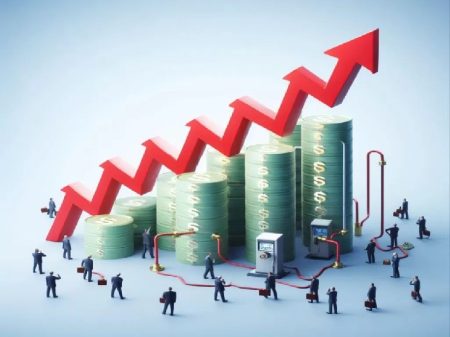



Bitcoin’s Political Rally: Why Arthur Hayes Believes U.S. Politics Will Drive the Next BTC Bull Run
The ‘10% Rule’: How Gas Prices and Presidential Politics Could Fuel Bitcoin’s Future
In a financial landscape increasingly intertwined with political decisions, BitMEX co-founder Arthur Hayes has presented a compelling case that U.S. politics—rather than cryptocurrency fundamentals—will propel Bitcoin’s next significant price surge. In a detailed analysis that has caught the attention of crypto investors and political analysts alike, Hayes argues that a Republican victory in 2028 would almost certainly trigger aggressive monetary expansion, provided gasoline prices remain stable—creating ideal conditions for Bitcoin appreciation.
The veteran cryptocurrency entrepreneur has outlined what he terms the “10% rule,” establishing a direct correlation between rising fuel prices and electoral outcomes in American politics. According to Hayes’ thesis, when the national average gasoline price increases by more than 10% in the three months preceding an election compared to January levels, control of at least one branch of government typically changes hands. This observation forms the foundation of his investment strategy and political forecast, suggesting that President Trump’s administration faces powerful incentives to stimulate economic growth while simultaneously keeping fuel costs under control—a delicate balancing act with significant implications for cryptocurrency markets.
“There are two elections that concern US President Trump: the November mid-term elections, and the 2028 presidential election,” Hayes writes in his widely-circulated blog post. “While he himself is not up for re-election in 2026 and cannot run for a third presidential term in 2028, the loyalty and obedience of his phalanx of political supporters depends on their chances of re-election.” This political calculation, Hayes argues, will drive policy decisions that ultimately benefit Bitcoin and other digital assets, as the administration seeks to maintain voter satisfaction through economic prosperity without triggering inflation concerns centered around gasoline prices.
Walking the Tightrope: Economic Stimulus Without Oil Price Spikes
The path forward for policymakers appears narrow but clear in Hayes’ analysis. To maintain political power, the Trump administration must expand credit and nominal GDP while simultaneously preventing oil prices from rising too quickly. This challenging economic balancing act could determine not only the political landscape but also the trajectory of cryptocurrency markets in the coming years.
“The base case is oil prices remain subsided if not outright fall and Trump and Buffalo Bill Bessent print money like it’s 2020,” Hayes predicts, referring to Treasury Secretary-designate Scott Bessent. “This is because the market will initially believe US control of Venezuelan oil will cause a massive increase in the daily amount of pumped crude oil.” Whether this anticipated supply increase materializes remains secondary to the political imperative of keeping inflation-sensitive voters placated, according to Hayes’ assessment.
The BitMEX co-founder identifies two critical market indicators that could signal trouble for this strategy: the 10-year Treasury yield and the MOVE Index, which measures bond market volatility. When yields approach 5% and volatility increases substantially, Hayes notes that leveraged financial markets typically experience significant disruption, forcing policymakers to abandon expansionary policies. He points to last year’s tariff-induced market turbulence as evidence of how quickly political pressure can reverse policy decisions. Should oil prices rise too rapidly, Hayes warns that Treasury yields could climb, bond market volatility might spike, and politicians would face pressure to curtail stimulus measures—a scenario he believes Trump would strongly resist.
Bitcoin’s Unique Position in the Political-Economic Landscape
What distinguishes Bitcoin from traditional assets in this complex political-economic environment? According to Hayes, while conventional markets remain directly vulnerable to oil price fluctuations, Bitcoin operates according to different principles. Because all Bitcoin miners face identical energy price shifts simultaneously, Hayes contends that oil prices have less direct impact on Bitcoin than on fiat currency markets. Instead, Bitcoin’s valuation responds primarily to liquidity expansion and currency debasement—precisely the conditions that political incentives are likely to create.
“Nothing stops this train,” Hayes declares, echoing respected financial analyst Lyn Alden. He describes a self-reinforcing cycle in which deficit spending leads to Treasury issuance, requiring central bank intervention through bond purchases, which ultimately expands the money supply. As dollars become more plentiful, Hayes anticipates that Bitcoin—alongside select other cryptocurrencies—will appreciate substantially, continuing a pattern observed during previous periods of monetary expansion.
This unique positioning allows Bitcoin to benefit from political-economic dynamics that might prove challenging for traditional assets. While stock and bond markets must navigate the complexities of inflation, interest rates, and economic growth, Bitcoin can potentially thrive simply by serving as a hedge against currency debasement—a role that becomes increasingly valuable during periods of aggressive monetary expansion. For investors seeking protection against the effects of politically motivated economic policies, Hayes suggests Bitcoin offers a compelling alternative to conventional investments.
Strategic Investment in the Political Cycle: Hayes’ Approach to 2026
With these political and economic factors in mind, Hayes has outlined his trading strategy for the upcoming 2026 election cycle. His investment firm, Maelstrom, is currently operating near maximum risk exposure with minimal stablecoin holdings—a clear indication of his bullish outlook on cryptocurrency markets. While continuing to accumulate Bitcoin as a core position, Hayes plans to diversify by rotating capital into privacy-focused tokens and decentralized finance projects, which he believes will outperform the broader market if credit expansion continues as anticipated.
“The bottom line, according to Hayes, is that political incentives favor stimulus over restraint, especially in an election cycle,” notes one market observer familiar with Hayes’ strategy. “For investors, he says, that makes the macro case straightforward—stay constructive on risk assets, and stay long Bitcoin.” This approach reflects a growing recognition among sophisticated investors that understanding political incentives has become essential to predicting market outcomes, particularly in the cryptocurrency space where regulatory considerations and monetary policy have outsized impacts.
Hayes’ investment thesis represents more than just a short-term trading strategy; it reflects a deeper understanding of how political cycles influence economic policy and, by extension, asset prices. By positioning his portfolio to capitalize on the expected monetary expansion that political incentives suggest is forthcoming, Hayes demonstrates the increasing sophistication of cryptocurrency investment strategies that incorporate political analysis alongside traditional financial considerations.
The Intersection of Politics, Economics, and Digital Assets
The relationship between political decisions and cryptocurrency markets has evolved significantly since Bitcoin’s creation. Initially viewed as an asset class largely disconnected from traditional financial systems and political considerations, cryptocurrencies now respond to many of the same forces that drive conventional markets—with important distinctions that Hayes highlights in his analysis.
Political decisions regarding monetary policy, financial regulation, and economic stimulus increasingly influence Bitcoin’s price movements, creating new opportunities for investors who can accurately anticipate how political incentives will shape economic conditions. Hayes’ focus on gasoline prices as a key political constraint demonstrates the complex interplay between voter sentiment, political decision-making, and market outcomes that now characterizes the cryptocurrency landscape.
For market participants seeking to navigate this environment successfully, Hayes’ analysis suggests that understanding political incentives may prove as important as technical analysis or traditional economic indicators. As cryptocurrency markets continue to mature and integrate with the broader financial system, this political-economic approach to investment strategy may become increasingly prevalent among sophisticated investors seeking to anticipate market movements.
Conclusion: Political Calculus and the Future of Bitcoin
Arthur Hayes presents a compelling case that the next major Bitcoin bull run will be driven not by technological advancements or increased adoption, but by the predictable consequences of political incentives in the American electoral system. By linking gasoline prices to electoral outcomes and identifying the resulting policy implications, Hayes provides a framework for understanding how political considerations could create economic conditions highly favorable to Bitcoin appreciation.
Whether his predictions prove accurate remains to be seen, but Hayes’ analysis highlights the increasingly sophisticated understanding of how political, economic, and technological factors interact to influence cryptocurrency markets. For investors seeking to position themselves advantageously in this complex landscape, recognizing the political dimensions of market movements may prove essential to navigating the opportunities and challenges that lie ahead.
As the cryptocurrency ecosystem continues to evolve alongside the political and economic systems with which it increasingly interacts, perspectives like those offered by Hayes provide valuable insights into the multifaceted forces shaping the future of digital assets. In an era where political decisions and economic policies can dramatically impact market outcomes, understanding these relationships may prove as important to successful investing as any technical or fundamental analysis—particularly for Bitcoin, which continues to serve as both a financial instrument and a barometer of monetary policy effects in an increasingly uncertain world.