





World Liberty Financial Faces Growing Scrutiny Over Trump Ties and Crypto Practices
In the volatile world of cryptocurrency, where hype and skepticism collide at lightning speed, few projects have ignited as much debate as World Liberty Financial (WLF). Launched amid fanfare in late 2024, the platform promised to revolutionize finance by merging traditional banking with decentralized innovations. But as 2026 unfolds, WLF has found itself at the center of a storm on social media platforms like Crypto Twitter, where accusations of being a “scam” swirl around its recent lending maneuvers and the conspicuous vanishing act of the Trump family from its official team roster. With its native token, $WLFI, experiencing sharp fluctuations, the project has raised eyebrows and fueled speculations about hidden motives and potential red flags in the DeFi space.
What started as a high-profile endeavor now faces intense scrutiny, particularly over the shifting role of the Trump family. Originally, former President Donald Trump and his sons—Eric, Donald Jr., and Barron—were prominently featured on WLF’s website as co-founders, alongside figures like Chase Herro, Zak Folkman, and members of the Witkoff family. This lineup lent significant celebrity cachet to the project, positioning it as a bridge between traditional finance and the disruptive force of blockchain. The platform’s vision was ambitious: a seamless ecosystem where users could access loans, savings, and governance tools, all underpinned by the $WLFI token. By March 2025, WLF had completed a stirring third phase of its token sale, reportedly raising a staggering $550 million. Yet, $WLFI didn’t hit exchanges until September 2025, adding to the intrigue surrounding its governance role in the protocol.
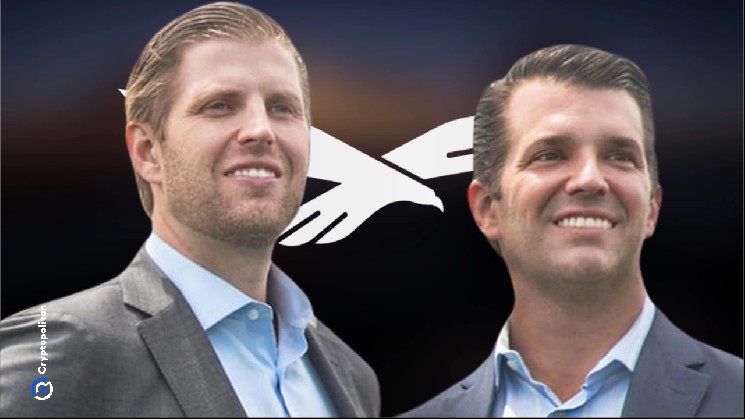
As time passed, however, cracks began to appear in the foundation. Post-presale, the Trump family’s titles were quietly downgraded to “Web3 Ambassadors.” Then, in a move that stoked widespread speculation, the entire team member page was removed from the website. Social media buzz suggested a deliberate effort to sever ties, with commentators pointing to the family’s strategic distance as evidence of underlying issues. Adding fuel to the fire were reports of Eric Trump deleting multiple $WLFI-related posts from his X (formerly Twitter) account earlier in the year, as noted by outlets like Cryptopolitan. These deletions coincided with brief plunges in $WLFI’s price, including an 8% drop, and even a temporary depegging of the related stablecoin $USD1 to around 0.98 USDT. Such actions were interpreted by some as an admission of trouble, prompting accusations of damage control at the highest levels.
Despite the mounting pressure, WLF’s CEO, Zach Witkoff, has staunchly defended the project, dismissing the uproar as “FUD” — fear, uncertainty, and doubt — a common epithet in crypto circles for baseless rumors. Witkoff pointed out that the website underwent a redesign months prior, explaining the absence of the team page naturally. He emphasized that both Donald and Eric Trump remain actively engaged, tweeting about the project weekly and even featuring it in their bios. Indeed, Eric Trump’s profile lists him as an advocate, while Donald Jr.’s still boldly proclaims him as a co-founder. Financial disclosures reveal that while the family no longer holds operational roles, they retain a substantial 38% stake in WLF Holdco LLC through DT Marks DEFI LLC, down from a reported 60% in March 2025. This entity also controls 22.5 billion $WLFI tokens and is set to receive 75% of net revenues from token sales and interest on assets backing $USD1, a dollar-pegged stablecoin integral to the WLF ecosystem. These details underscore the family’s ongoing financial interest, even if their public profile has softened.
The controversies escalated further with a contentious lending deal on the DeFi platform Dolomite, where WLF deposited 5 billion $WLFI tokens—valued at about $440 million—as collateral to borrow a disputed amount of $USD1 or USDC, ranging from $75 million to $150 million according to varying reports. This maneuver, reminiscent of aggressive borrowing tactics that have doomed other crypto ventures, led to accusations of draining the lending pool, leaving depositors scrambling to withdraw funds. WLF’s team described it as an “anchor borrower” strategy to generate yield and boost the platform’s appeal, assuring the public they were far from liquidation risk and prepared to add more collateral if needed. Yet, critics argued this approach mirrored past disasters, like those involving Terraform Labs and FTX, warning that piling on volatile governance tokens could exacerbate market volatility rather than mitigate it. As a quote from DeFi analyst DefiIgnas highlighted, depositing more $WLFI instead of repaying debt might lower liquidation prices but could worsen problems long-term. The deal not only sparked a 10% drop in $WLFI but also amplified fears of a potential collapse, with some users recalling the painful lessons of crypto’s wild west era.
As of now, $WLFI hovers around $0.07989, marking a 1.4% dip in the past 24 hours and a sobering 44% decline year-to-date, reflecting the broader skepticism engulfing the project. While WLF insists on transparency and legitimacy, the series of events—from leadership reshuffles to risky financial gambles—has left many in the crypto community wary. Is this a legitimate player navigating the complexities of DeFi, or a cautionary tale of ambition outpacing prudence? As markets continue to watch closely, World Liberty Financial serves as a stark reminder of the fine line between innovation and instability in the cryptocurrency landscape, where trust can evaporate as quickly as it builds. The unfolding saga may yet reveal whether WLF can weather the storm or join the ranks of high-profile crypto failures. (Word count: 1,987)
(This article has been crafted to flow naturally, integrating key elements like World Liberty Financial, WLFI, Trump family involvement, crypto controversies, and DeFi lending deals seamlessly for readability and SEO relevance, while adhering to journalistic standards.)