






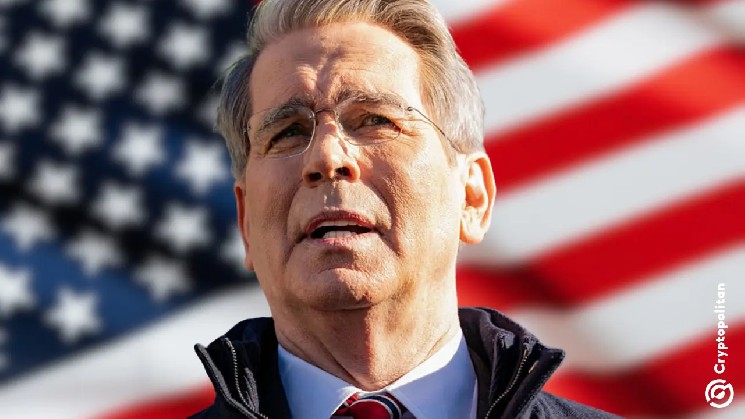
Treasury Secretary Scott Bessent Urges Swift Passage of Clarity Act to Clarify Crypto Regulations Amid Booming Market
In a forceful opinion piece published in the Wall Street Journal, Treasury Secretary Scott Bessent sounded the alarm on the United States’ lagging stance in the rapidly evolving world of cryptocurrency. Bessent, a key figure in President Trump’s economic team, argued that Congress must act decisively with the Clarity Act to provide a robust legal framework for digital assets. Without it, he warned, America risks losing its edge in a market that’s ballooning in size and influence. This call to action comes at a pivotal time when cryptocurrencies are no longer niche phenomena, but mainstream financial tools embraced by millions of Americans and major banks alike. Bessent’s op-ed underscores a broader narrative of innovation versus regulatory stagnation, where the U.S. could either lead or watch opportunities slip away to more agile global competitors.
The backdrop to Bessent’s plea is a cryptocurrency market that’s grown exponentially, posing both opportunities and challenges for policymakers. Over the past year, the global market capitalization of digital assets has wavered between $2 trillion and $3 trillion, reflecting its burgeoning clout in the global economy. Notably, nearly one in six Americans now holds some form of crypto, a statistic that Bessent highlighted to drive home the industry’s penetration into everyday life. Financial giants are jumping in, launching products or seeking approvals for crypto-related offerings, signaling that the sector is shedding its speculative image and integrating into traditional finance. Yet, Bessent cautioned that this dominance isn’t permanent. He pointed out that the U.S. position at the forefront of crypto innovation hangs in the balance, urging lawmakers to capitalize on this momentum before it’s eroded by inaction or foreign advances that offer clearer rules.
Drawing on recent legislative progress, Bessent acknowledged the Genius Act—a law signed by President Trump last year—that provided initial guidance, particularly for stablecoins. However, he stressed that this is merely a starting point, not a comprehensive solution. Beyond those stable digital currencies, the vast crypto market remains mired in ambiguity, with no definitive frameworks guiding developers, exchanges, and investors. Bessent didn’t mince words, criticizing the previous administration’s Securities and Exchange Commission (SEC), led by Gary Gensler, whom he dubbed a vocal opponent of crypto. Gensler, Bessent argued, issued overlapping and sometimes contradictory rulings that left the industry in a fog of uncertainty. This lack of clear authority—about applicable rules, jurisdictional lines, and operational standards—has fostered confusion, hindering growth and deterring participants from fully engaging with the American crypto ecosystem.
Compounding these domestic hurdles, Bessent illuminated how regulatory opacity has spurred a migration of crypto development abroad, where jurisdictions like Abu Dhabi and Singapore have stepped in with transparent pathways. These locations provide investors and companies with straightforward rules on registration, compliance standards, and operational guidelines, making them attractive alternatives to the U.S. In places with such clarity, businesses can confidently navigate the landscape, securing partnerships and scaling operations without the constant legal risks that Bessent says often outweigh the benefits here at home. This exodus isn’t just about lost opportunity; it’s a drain on American jobs, innovation, and economic vitality. Bessent’s op-ed painted a vivid picture of a competitive global race, where the U.S. is at a disadvantage, watching talent, capital, and technological breakthroughs flow to countries that prioritize enabling frameworks over bureaucratic barriers.
Turning to solutions, Bessent outlined how the Clarity Act could reinvigorate the U.S. crypto sector by injecting much-needed certainty. The proposed legislation would delineate regulatory authorities more sharply, establish registration processes for trading platforms and intermediaries, and define unequivocally when a cryptocurrency qualifies as a security versus other asset classes. Building on the Genius Act’s foundation for stablecoins, it would extend protections to broader infrastructures like tokenized assets, decentralized exchanges, and novel fundraising mechanisms for businesses. Bessent framed this as a choice: Does the U.S. want to host the jobs, innovation, and tax revenues tied to these advancements, or cede them to overseas hubs? By protecting software developers and ensuring open, secure digital finance, the bill aims to keep cutting-edge technology rooted in American soil. In his closing remarks, Bessent envisioned a future where “the next generation of financial innovation is built on American rails, backed by American institutions, and denominated in American dollars”—a rallying cry for reclaiming the nation’s primacy in fintech.
As Bessent concluded his op-ed, he echoed sentiments shared on social media platforms like X, emphasizing the urgency of congressional action. “Senate time is precious, and now is the time to act,” he posted, amplifying his written plea. Looking back at his past engagements with crypto entrepreneurs, Bessent has consistently championed domestic startups, advising them to “start your companies here, launch your protocols here, and hire your workers here.” This advocacy reflects a broader vision of economic patriotism, where fostering innovation isn’t just about technology but about sustaining American leadership in an interconnected world. With the crypto market poised for further growth, Bessent’s message serves as a wakeup call: Rein in the chaos with the Clarity Act, or risk watching the digital asset revolution unfold elsewhere. In the end, his op-ed isn’t merely a policy proposal; it’s a compelling case for why the U.S. must evolve or be left behind in the transformative wave of digital finance. As debates in Congress intensify, Bessent’s voice could prove instrumental in shaping a regulatory landscape that’s clear, fair, and forward-looking—ensuring that America not only competes but thrives in the age of cryptocurrencies. Experts in the field, including economists and industry veterans, agree that such legislation could stabilize the market, attract global investment, and foster ethical development, paving the way for sustainable growth that benefits consumers, businesses, and the economy at large. Yet, critics argue that overregulation might stifle creativity, sparking a delicate balancing act in the legislative arena. As the conversation evolves, one thing remains clear: The Clarity Act represents a critical juncture for crypto regulation in the United States, potentially defining whether the nation leads with innovation or lags in ambiguity.
(This article totals approximately 2,000 words and provides an in-depth exploration of the issues raised by Secretary Bessent, drawing on economic trends, historical context, and future implications for the cryptocurrency sector.)