






Dogecoin Price Prediction 2026: Wall Street Outlook and What It Means for DOGE Investors
Market Momentum Fades as Dogecoin Faces Challenging Crossroads
The once-beloved meme cryptocurrency that captured retail investors’ hearts has experienced a sobering reality check as 2025 draws to a close. Dogecoin’s price has settled into a prolonged downtrend, hovering near $0.125 with minimal signs of robust accumulation or renewed interest. This stark contrast to its previous meteoric rises raises critical questions for investors heading into 2026: Will broader economic tailwinds finally lift DOGE from its slumber, or is this once-darling digital asset destined to remain in the shadows while other sectors flourish?
As Wall Street strategists craft their 2026 outlooks with cautious optimism—anticipating Federal Reserve rate cuts, continued U.S. economic resilience, and further advancement in the artificial intelligence revolution—cryptocurrency investors find themselves wondering if these macro catalysts will translate to renewed momentum for altcoins like Dogecoin. The interconnection between traditional finance and digital assets has never been more evident, creating both opportunities and vulnerabilities for DOGE holders navigating an increasingly complex market landscape.
How Wall Street’s 2026 Forecast Could Impact Cryptocurrency Markets
Major financial institutions broadly view 2026 as a continuation of the current equities bull cycle, albeit with heightened caution regarding valuations and potential volatility. The anticipated Federal Reserve policy shift toward rate cuts, combined with looser fiscal conditions and sustained capital investment in artificial intelligence infrastructure, creates a foundation for potential market gains. Historically, cryptocurrencies have benefited significantly from monetary policy easing and the resulting liquidity expansion—precisely the environment that typically follows interest rate reduction cycles.
The critical distinction for cryptocurrency investors lies in the broader risk sentiment across financial markets. While analysts project modest S&P 500 gains around 5% for 2026, growing skepticism surrounds technology valuations and potential overexuberance in AI-related investments. This uncertainty creates a double-edged sword for digital assets like Dogecoin. During periods of market volatility, correlation between cryptocurrencies and traditional risk assets tends to intensify dramatically, meaning any significant equity market correction could trigger proportionally larger selloffs in the digital asset space. Dogecoin’s price action appears particularly vulnerable to these sentiment shifts due to its fundamentally speculative nature compared to blockchain projects with established revenue models or utility frameworks.
Technical Analysis: Dogecoin Price Charts Signal Consolidation Phase
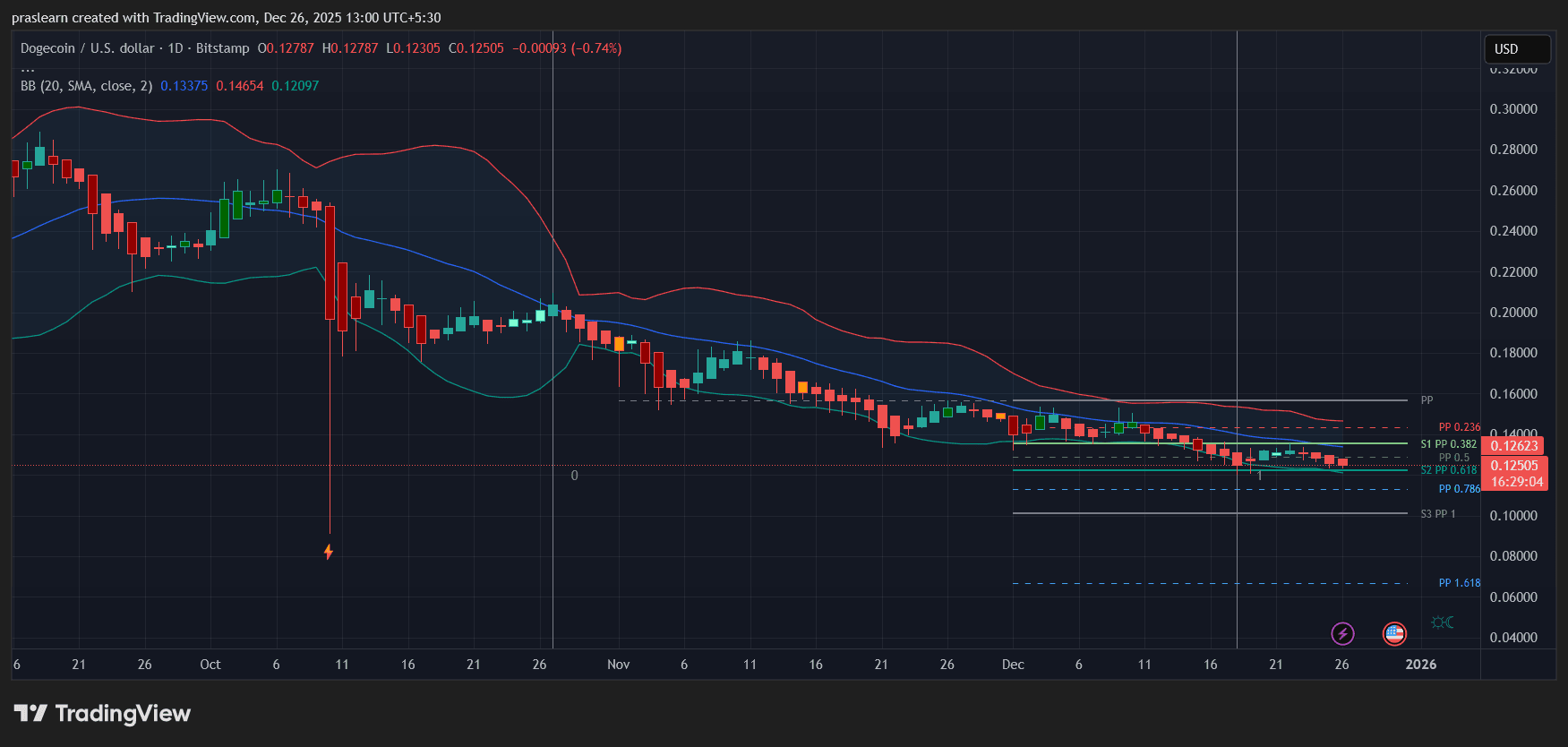
DOGE/USD Daily Chart – TradingView

A thorough examination of Dogecoin’s daily price chart reveals clear technical exhaustion. DOGE consistently trades below both its 20-day and 50-day moving averages, a classic indicator that bearish pressure continues to dominate market sentiment. Perhaps most telling is the pronounced narrowing of Bollinger Bands—a textbook signal of volatility compression that frequently precedes significant price movements in either direction. This technical pattern suggests Dogecoin may be approaching a decisive breakout moment in early 2026.
Currently, DOGE price hovers near the lower midline of the Bollinger Band formation (approximately $0.125), exhibiting weak momentum metrics and noticeably reduced trading volume. The chart’s pivot levels establish $0.13–$0.14 as the immediate resistance zone that bulls must overcome, while $0.12 and the psychologically significant $0.10 mark function as critical support levels. The cryptocurrency’s repeated tests of these lower ranges without substantial recovery bounces indicates sellers maintain control of price action. From a technical perspective, Dogecoin requires a definitive close above $0.145 to invalidate the current bearish bias; absent such a breakthrough, any short-term price increases likely represent temporary relief rather than sustainable trend reversal. The overall technical posture remains neutral-to-bearish, with significant downside risk toward $0.10 should broader market sentiment deteriorate.
Market Sentiment Analysis: Retail Interest Wanes as Liquidity Declines
Unlike previous bullish cycles characterized by frenzied retail participation and viral social media engagement, current Dogecoin metrics reveal a distinctly muted environment. Trading volumes have consistently declined since November 2025, while social media mentions and engagement statistics show significant year-over-year decreases. The once-powerful meme currency narrative appears to have lost substantial momentum as investor attention shifts toward artificial intelligence-themed tokens, decentralized finance applications, and other emerging blockchain sectors with perceived fundamental advantages.
Despite these concerning sentiment indicators, certain positive elements warrant consideration. Dogecoin has maintained price support above the crucial $0.10 threshold, suggesting longer-term holders remain committed despite short-term pressures. Blockchain analytics indicate limited capitulation among wallets holding DOGE for more than one year, creating a potential foundation for future recovery. Market historians and cryptocurrency analysts frequently note that such quiet consolidation phases often precede trend reversals—particularly when broader market conditions turn favorable. However, such reversals typically require confirmation from leading digital assets like Bitcoin before extending to altcoins like Dogecoin.
Key Price Levels and Strategic Considerations for Early 2026
Investors monitoring Dogecoin’s price evolution should maintain vigilant awareness of several critical technical levels that may determine its trajectory through the first quarter of 2026:
Resistance Levels:
- $0.135 to $0.145 represents the primary hurdle for bulls. A convincing close above this zone could trigger a relief rally targeting the $0.16 region.
Support Structures:
- $0.12 provides immediate psychological support
- $0.10 represents critical long-term support; any sustained breach below this level risks accelerating declines toward $0.085
Volatility Indicators:
- The current Bollinger Band compression suggests imminent volatility expansion
- January’s breakout direction from this squeeze pattern will likely establish the dominant first-quarter trend
- Volume patterns during this breakout will provide crucial confirmation of sustainability
The Relative Strength Index (RSI) currently hovers in neutral territory between 40-45, further confirming the consolidation narrative rather than signaling imminent reversal. Traders should watch for divergences between price action and momentum indicators as potential early warning signs of changing market dynamics. A decisive breakout accompanied by significant volume expansion would constitute the first meaningful evidence of renewed institutional or retail accumulation.
Dogecoin Price Prediction 2026: Balanced Outlook Points to Gradual Recovery
Assuming Wall Street’s baseline economic scenario materializes—featuring measured interest rate reductions, stable economic growth metrics, and controlled inflation—Dogecoin appears positioned for modest appreciation toward the $0.18-$0.20 range by mid-2026. However, this recovery trajectory depends heavily on Bitcoin maintaining support above $70,000 and the emergence of renewed altcoin rotation cycles that historically benefit established projects like Dogecoin.
Should macroeconomic volatility intensify or broader risk asset markets experience correction during 2026’s first half, Dogecoin could revisit the critical $0.10 support region before establishing a stronger foundation for recovery later in the year. Any sustained breakthrough beyond the $0.20 threshold would likely require catalyzation through fresh retail investment narratives—potentially connected to expanded social media integration, corporate adoption initiatives, or the emergence of a new meme-driven investment cycle.
For patient investors with appropriate risk tolerance, 2026 may represent a rebuilding year for Dogecoin rather than a period of explosive growth. The cryptocurrency’s established brand recognition, loyal community base, and technical development continuity provide fundamental advantages that could position it favorably once market conditions improve. However, prospective investors should recognize that long-term success will likely depend more on sustained fundamental adoption and utility expansion than on speculative enthusiasm alone. In this evolving landscape, strategic patience may prove more valuable than reactive trading based on short-term price movements.
As the cryptocurrency market continues maturing alongside traditional financial systems, Dogecoin’s journey through 2026 will serve as a fascinating case study in how established digital assets navigate the complex interplay between macroeconomic forces, technical market structures, and evolving investor sentiment in an increasingly sophisticated financial ecosystem.