





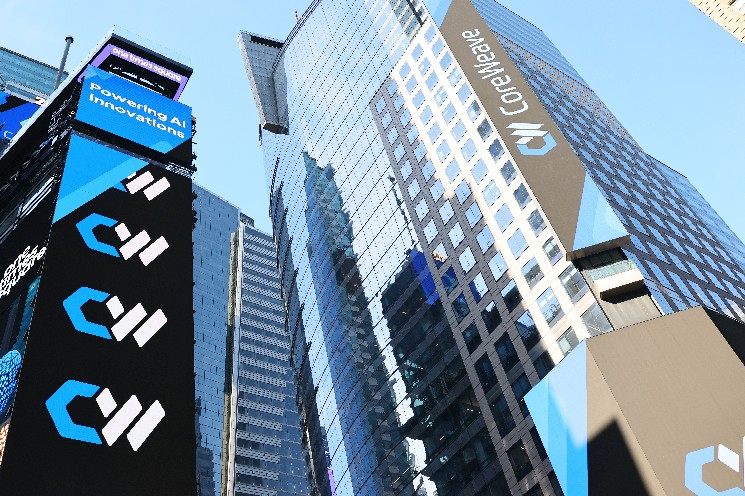
Nvidia Doubles Down on AI Future with $2 Billion CoreWeave Investment
Tech Giant Strengthens Strategic Partnership to Accelerate AI Infrastructure Development
In a significant move that underscores the growing importance of artificial intelligence infrastructure, shares of CoreWeave (CRWV) surged 9% in pre-market trading Monday following news that AI chipmaker Nvidia (NVDA) has invested an additional $2 billion in the cloud computing company. This substantial capital injection aims to accelerate CoreWeave’s ambitious expansion of next-generation data centers specifically engineered for AI workloads, signaling both companies’ commitment to building the computational backbone needed for tomorrow’s AI innovations.
The investment comes at a pivotal moment in the AI industry’s development, as demand for specialized computing resources continues to skyrocket amid the proliferation of increasingly sophisticated AI models and applications. According to market analysts tracking the sector, the transaction—structured through the purchase of CoreWeave’s Class A stock at $87.20 per share—represents more than just financial backing; it cements a strategic alliance between two companies positioned at the forefront of AI infrastructure development. CoreWeave’s stock, which closed at $92.98 on Friday, climbed above $101 in early trading following the announcement, while Nvidia shares experienced a modest 0.5% decline in pre-market activity.
“This partnership goes beyond traditional investment relationships,” explained Dr. Eleanor Winters, senior technology analyst at Capital Research Partners. “What we’re seeing is the formation of a vertically integrated ecosystem where Nvidia’s hardware expertise combines with CoreWeave’s specialized cloud deployment capabilities. The result is a more streamlined path from chip design to AI application deployment.” This sentiment was echoed by Jensen Huang, founder and CEO of Nvidia, who stated in the announcement: “CoreWeave’s deep AI factory expertise, platform software, and unmatched execution velocity are recognized across the industry.” Industry observers note that Huang’s personal endorsement carries significant weight in the tech sector and reflects Nvidia’s confidence in CoreWeave’s strategic importance to its broader AI ambitions.
Building the Infrastructure for AI’s Next Frontier
The fresh capital is earmarked for an aggressive expansion plan that will see CoreWeave scale to more than 5 gigawatts of AI-dedicated data centers—dubbed “AI factories”—by the end of this decade. These specialized facilities represent a new generation of computing infrastructure designed specifically for the unique demands of training and running large-scale AI models, which require exponentially more computational resources than traditional software applications. The expansion comes as research firm Gartner estimates that AI-related infrastructure spending will exceed $150 billion annually by 2027, representing one of the fastest-growing segments of the technology sector.
Beyond the immediate financial implications, the deepened partnership between the two companies extends a years-long collaboration that aligns them on hardware architecture, software development, and data center strategy. According to industry insiders familiar with the arrangement, this coordinated approach will allow for more efficient deployment of AI resources and potentially create competitive advantages in a rapidly evolving market. Furthermore, the companies have announced plans to test CoreWeave’s proprietary software stack, including its resource scheduling platform Mission Control, with the potential to integrate these technologies into Nvidia’s broader ecosystem—a move that could significantly enhance the operational capabilities of AI deployments worldwide.
From Crypto Mining to AI Infrastructure: CoreWeave’s Remarkable Transformation
CoreWeave’s rise to prominence in the AI infrastructure space represents one of the most successful pivots in recent tech history. The company began its journey in 2017 as Atlantic Crypto, focusing primarily on bitcoin mining operations. However, following the cryptocurrency market crash of 2018, the company quickly reimagined its business model, leveraging its expertise in high-performance computing to transition into cloud computing services with a particular emphasis on AI workloads. This strategic repositioning proved prescient, as the subsequent years saw exponential growth in demand for specialized AI computing resources—precisely the market CoreWeave was now equipped to serve.
The company’s transformation culminated in September 2023, when Nvidia entered into a landmark $6.3 billion agreement with CoreWeave to purchase unsold computing capacity through 2032. This earlier deal, which raised eyebrows across the industry due to its size and scope, provided CoreWeave with the financial stability to accelerate its infrastructure buildout while giving Nvidia preferred access to cloud resources optimized for its hardware. “The original agreement demonstrated Nvidia’s belief in CoreWeave’s approach to AI infrastructure,” noted Michael Ramirez, cloud computing analyst at Technology Future Research. “This additional $2 billion investment suggests that the initial collaboration has exceeded expectations and that both companies see tremendous upside in deepening their relationship.”
Strategic Implications for the AI Computing Landscape
The strengthened partnership between Nvidia and CoreWeave carries significant implications for the broader AI computing landscape. As companies across all industries increasingly incorporate AI into their operations, access to specialized computing infrastructure has emerged as a critical competitive differentiator. By combining Nvidia’s cutting-edge hardware with CoreWeave’s optimized cloud deployment capabilities, the two companies are positioning themselves as essential providers in this growing ecosystem. Market analysts suggest that this vertical integration strategy could potentially create barriers to entry for competitors while accelerating the pace of AI innovation.
“What we’re witnessing is the construction of the digital infrastructure that will power the next decade of AI advancement,” said Dr. Sarah Chen, director of emerging technologies at the Global AI Institute. “Just as the industrial revolution required factories and power plants, the AI revolution requires these specialized data centers—’AI factories’—that can efficiently process the massive computational workloads involved in training and running sophisticated AI models.” The strategic alignment between hardware manufacturer and infrastructure provider also addresses one of the key bottlenecks in AI development: ensuring that specialized computing resources are optimally configured and readily available for researchers and developers pushing the boundaries of what’s possible with artificial intelligence.
The Road Ahead: Challenges and Opportunities in AI Infrastructure
Despite the optimistic outlook, significant challenges remain on the path to building the global AI infrastructure envisioned by companies like Nvidia and CoreWeave. Power consumption represents perhaps the most pressing concern, with AI data centers requiring enormous amounts of electricity to operate. CoreWeave’s planned 5-gigawatt expansion will consume roughly the equivalent electricity of 3.5 million American homes, raising important questions about sustainability and environmental impact. Both companies have announced initiatives to address these concerns, including investments in renewable energy sources and more efficient cooling technologies, but critics argue that more comprehensive solutions will be necessary as AI computing requirements continue to grow.
Additionally, the concentration of critical AI infrastructure among a relatively small number of companies has prompted discussions about market competition and technological access. “There’s a legitimate debate to be had about whether the current trajectory leads to democratized AI or more centralized control,” explained technology policy expert Jonathan Martinez. “On one hand, these investments accelerate development of capabilities that benefit everyone; on the other, they potentially concentrate power in the hands of a few key players.” Nevertheless, as businesses and researchers continue to push the boundaries of what’s possible with artificial intelligence, the partnership between Nvidia and CoreWeave represents an important step in building the foundation necessary for the next generation of AI innovation—a foundation that will likely shape technological development for decades to come.