






Bitcoin Surges Then Retreats as Fed Cuts Rates Amid Economic Uncertainty
Powell’s Mixed Signals Send Cryptocurrency Markets on Volatile Ride
In a day marked by significant market volatility, Bitcoin briefly surged above $94,000 before quickly retreating as Federal Reserve Chairman Jerome Powell delivered a message that blended dovish and hawkish tones following the central bank’s decision to implement a 25 basis-point rate cut on Wednesday. The cryptocurrency market’s reaction highlighted the increasingly complex relationship between traditional monetary policy and digital asset valuations in today’s interconnected financial landscape.
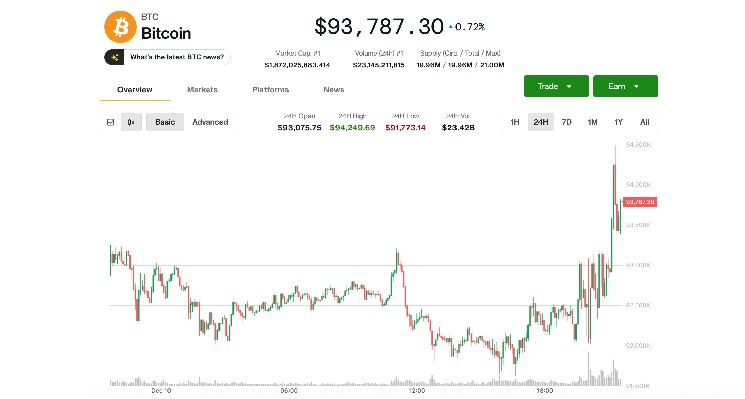
Bitcoin, which had been hovering around $92,000 for most of the trading day, experienced a sudden upward jolt to $94,400 during Powell’s post-meeting press conference when he expressed concerns about potential weakness in the labor market. However, these gains were largely erased when the Fed Chair emphasized that the battle against inflation remains far from over, signaling to investors that the central bank would maintain a cautious approach to further rate reductions. By late afternoon, Bitcoin had settled at approximately $93,500, representing a modest 0.5% increase over the previous 24 hours. Meanwhile, Ethereum displayed notable relative strength, trading above $3,400 with an impressive 2.4% gain during the same period, continuing its recent pattern of outperformance compared to Bitcoin.
“Fed policy is now within a range of plausible estimates of neutral, and leaves us well-positioned to determine the extent and timing of additional adjustments,” Powell stated during his press conference, carefully balancing optimism with caution. “We’re well positioned to wait and see,” he added, emphasizing the central bank’s data-dependent approach. Powell acknowledged that substantial economic information will become available before the Fed’s next meeting in January, which will significantly influence the trajectory of monetary policy. This measured stance suggests that while the door remains open for additional rate cuts, they are far from guaranteed, creating an environment of calculated uncertainty that cryptocurrency markets must navigate.
Federal Reserve’s Strategic Shift in Monetary Policy
In conjunction with the Federal Reserve’s decision to lower its federal funds rate range by 25 basis points, the New York Federal Reserve announced a significant operational change that caught market participants’ attention. Beginning Friday, the regional bank will initiate purchases of short-term Treasury bills and Treasury securities with remaining maturities of up to three years if deemed necessary, targeting approximately $40 billion in acquisitions over the upcoming month. This strategic maneuver aims to ease financial conditions without signaling the commencement of a comprehensive quantitative easing program. Powell indicated that these purchases would remain “elevated” for several months, marking a notable shift from the central bank’s three-year policy of reducing its balance sheet following the substantial expansion during the pandemic era.
The Fed’s careful calibration of its monetary policy reflects the complex economic landscape it faces. “The Fed made clear that this cut does not mark the start of an aggressive easing cycle, with emphasis on the fact that future moves will depend heavily on incoming inflation and labour-market data,” explained Daniela Hathorn, senior market analyst at brokerage firm Capital.com. “While policymakers agreed on the need to ease modestly amid patchy post-shutdown data and signs of slowing momentum, the updated communication stressed caution,” she added, highlighting the delicate balance the central bank is attempting to maintain between supporting economic growth and controlling inflation pressures.
Brian Coulton, chief economist at Fitch Ratings, offered additional perspective on the Fed’s decision-making process: “The fact that two FOMC members voted for no change in rates shows that this was a close call, complicated by a lack of full data. The relatively mild pick up in core inflation in recent months probably swayed the committee that another cut—while keeping rates somewhat above neutral—was justified.” Coulton projected a more moderate pace of monetary easing going forward, stating, “It seems unlikely that rates continue to fall at sequential meetings from here. We now expect just two more cuts by June 2026, taking the Fed Funds rate to 3.25% (upper band).” This measured outlook suggests a prolonged period of careful monetary management rather than aggressive easing.
Implications for Cryptocurrency Markets and Future Outlook
The relationship between Federal Reserve policy and cryptocurrency markets continues to evolve in complexity and significance. David Hernandez, crypto investment specialist at 21Shares, observed that “between signaling a rate cut pause and restarting Fed purchases of U.S. Treasuries, Powell is threading the needle between their two mandates.” This delicate balancing act has direct implications for digital asset markets, which have historically shown sensitivity to changes in monetary conditions and liquidity environments. For Bitcoin to break higher from its current trading range, Hernandez noted that fresh momentum would be necessary to “overpower the concentrated short pressure” encountered around the $94,500 resistance level—precisely where Wednesday’s upward movement hit a ceiling.
The cryptocurrency market’s future trajectory may hinge significantly on institutional investment flows in the coming months. “If spot ETF inflows strengthen as expected now that the cost of capital is falling, that could become the spark that transforms caution into momentum and drives Bitcoin back above the $100,000 psychological barrier,” Hernandez suggested. This perspective highlights the growing interconnectedness between traditional finance, monetary policy, and digital asset markets. As interest rates adjust and liquidity conditions evolve, cryptocurrency investors will be closely monitoring not only Federal Reserve decisions but also the underlying economic data that drives those policy choices, particularly inflation metrics and labor market indicators that Powell emphasized would guide future decisions.
Bitcoin’s reaction to Wednesday’s Federal Reserve announcement demonstrates the maturing nature of the cryptocurrency market and its increasing correlation with broader financial conditions. While digital assets were once considered entirely separate from traditional markets, their sensitivity to monetary policy shifts reveals a more nuanced relationship. As the Federal Reserve navigates the challenging balance between controlling inflation and supporting economic growth, cryptocurrency markets will likely continue to respond to these policy adjustments, creating both challenges and opportunities for investors in this rapidly evolving asset class. The careful calibration of expectations between the potential for further rate cuts and the ongoing fight against inflation will remain a critical factor in determining cryptocurrency market sentiment and price action in the months ahead.