







Bitcoin Holds Near $90,000 as Market Faces Structural Headwinds Amid Global Bond Volatility
Bitcoin Settles Into Consolidation Pattern as Weekend Rally Fades
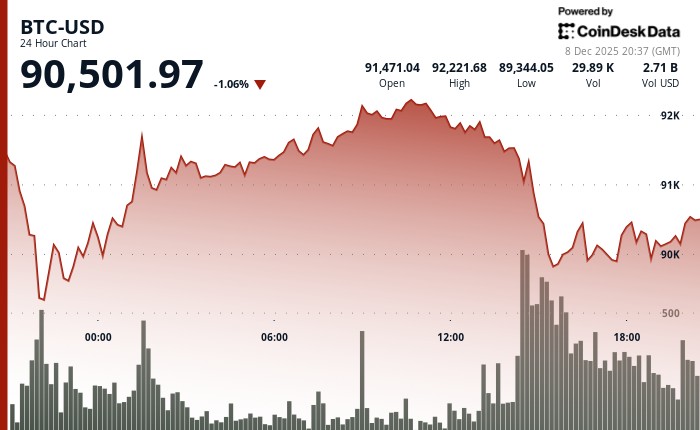
Bitcoin’s attempt to rally over the weekend quickly lost momentum as the world’s leading cryptocurrency settled into a holding pattern around the $90,000 mark on Monday. After briefly pushing higher during weekend trading, BTC retraced most of its gains in early U.S. trading hours, highlighting the current struggle to maintain upward momentum in the cryptocurrency markets. By the close of U.S. stock markets, Bitcoin was trading at approximately $90,500, representing a modest 1% decline over the previous 24 hours. This consolidation phase comes at a critical juncture for digital assets, as investors weigh multiple factors including upcoming Federal Reserve decisions, global bond market volatility, and concerning trends in crypto-specific market metrics.
The broader cryptocurrency landscape similarly struggled to find direction, with most altcoins failing to sustain meaningful rallies. Ethereum’s native token, ETH, demonstrated marginally better performance, slipping only slightly while improving its relative strength against Bitcoin to reach its best BTC/ETH ratio in over a month. Among the few standout performers were privacy-focused Zcash (ZEC) and the institutional-oriented Canton Network (CC), both managing double-digit percentage gains against the prevailing downtrend. However, these outliers couldn’t prevent the CoinDesk 20 Index, which tracks the broader crypto market, from declining 0.8% as investor sentiment remained cautious amid broader financial market uncertainty.
Global Bond Market Turbulence Creates Ripple Effects Across Asset Classes
While cryptocurrency price action remained subdued, significant disruption emerged in global bond markets, potentially setting the stage for increased volatility across all asset classes. Long-duration government bond yields spiked dramatically, with particular concern centered around Japanese bond market instability potentially triggering contagion effects internationally. The U.S. 10-year Treasury yield surged to 4.19%, reaching its highest level in approximately three months, while similar sell-offs occurred across United Kingdom and European government debt instruments. Perhaps most notably, the Japanese 10-year bond yield continued its climb toward the 2% threshold, a level not witnessed in the world’s third-largest economy for nearly two decades.
This bond market turbulence coincided with a downturn in U.S. equity markets, as the S&P 500 declined 0.5% and the technology-heavy Nasdaq Composite retreated 0.3%. The simultaneous weakness across traditional financial markets created a challenging environment for risk assets, including cryptocurrencies. Market participants are now closely monitoring this week’s Federal Reserve meeting, widely anticipated to be this year’s final monetary policy gathering. While consensus expectations firmly anticipate a 25 basis-point interest rate cut, investors will pay particular attention to the Fed’s forward guidance and any commentary regarding future liquidity measures that could introduce significant market volatility when announced Wednesday. As LMAX market strategist Joel Kruger noted, “Any easing in financial conditions or further weakening in the US dollar could provide tailwinds, while any hawkish surprise around the pace or extent of policy accommodation from the Federal Reserve could amplify downside pressure on crypto markets.”
Structural Weaknesses Emerge in Bitcoin’s Market Fundamentals
Despite Bitcoin’s recent recovery from November lows, analysts at Bitfinex have identified concerning structural weaknesses that suggest potential challenges ahead for the cryptocurrency. Their research highlights a troubling divergence between traditional equity markets and Bitcoin’s performance. While the S&P 500 continues trading near all-time highs, Bitcoin remains trapped in a sideways range, indicating relative weakness in the digital asset sector compared to conventional risk-on investments.
The Bitfinex report outlined multiple technical indicators reinforcing this bearish outlook. Perhaps most concerning is the persistent outflow trend from U.S.-listed spot Bitcoin ETFs, where investor behavior shows a clear pattern of selling into strength rather than accumulating positions. This behavior is confirmed by sharply negative Cumulative Volume Delta (CVD) readings across major cryptocurrency exchanges, suggesting selling pressure consistently overwhelms buying interest during price increases. Additionally, over seven million Bitcoin now sit at an unrealized loss, creating sentiment conditions remarkably similar to the extended consolidation period witnessed during the depths of the 2022 bear market. While monthly capital inflows remain technically positive at $8.69 billion (measured by Net Realized Cap Change), these figures represent a significant decline from peak inflow levels, providing only minimal protection against potential downside moves.
Market Fragility Increases as Year-End Approaches
The combination of weakening market fundamentals creates an increasingly precarious situation for Bitcoin and the broader cryptocurrency ecosystem as 2024 draws to a close. The Bitfinex analysis paints a particularly concerning picture regarding deteriorating spot demand for Bitcoin, which historically serves as the primary driver of sustainable price appreciation in digital asset markets. “With spot demand weakening, the market now faces a meaningfully lighter buy-side backdrop,” the Bitfinex report stated. “This reduces immediate support for price and increases sensitivity to external shocks, macro-driven volatility and any further tightening in financial conditions.”
This vulnerability comes at a particularly challenging moment as cryptocurrency markets must navigate both seasonal trading patterns that often introduce year-end volatility and significant macroeconomic uncertainty. Global financial markets remain on edge regarding multiple risk factors, including potential policy shifts from major central banks, persistent geopolitical tensions, and lingering concerns about economic growth trajectories across major economies. Within this context, Bitcoin’s inability to maintain momentum above psychological price thresholds like $100,000 has created growing uncertainty among market participants about near-term price direction.
Strategic Positioning Amid Conflicting Market Signals
As investors assess Bitcoin’s prospects heading into 2025, they face a complex array of conflicting signals that demand careful strategic consideration. The cryptocurrency’s current consolidation near $90,000 represents both a remarkable achievement compared to historical valuations and a potentially concerning failure to establish sustainable momentum above key psychological thresholds. While some technical analysts view the current range-bound trading as a necessary consolidation before another potential upleg, others interpret the same price action as distribution preceding a more substantial correction.
Against this backdrop of uncertainty, institutional positioning provides critical insight into market expectations. The persistent ETF outflows highlighted in the Bitfinex report suggest professional investors may be taking profits or reallocating capital toward other opportunities, potentially creating headwinds for Bitcoin price appreciation in the near term. However, these same institutional participants will likely monitor Wednesday’s Federal Reserve decision closely, potentially adjusting positioning based on monetary policy signals. Given the complex interplay between cryptocurrency-specific factors and broader financial market dynamics, investors should prepare for potentially heightened volatility across digital asset markets as 2024 concludes. Whether Bitcoin can overcome its current structural challenges likely depends on both improvements in internal market metrics like spot demand and a supportive macroeconomic environment that encourages risk-taking across global financial markets.