


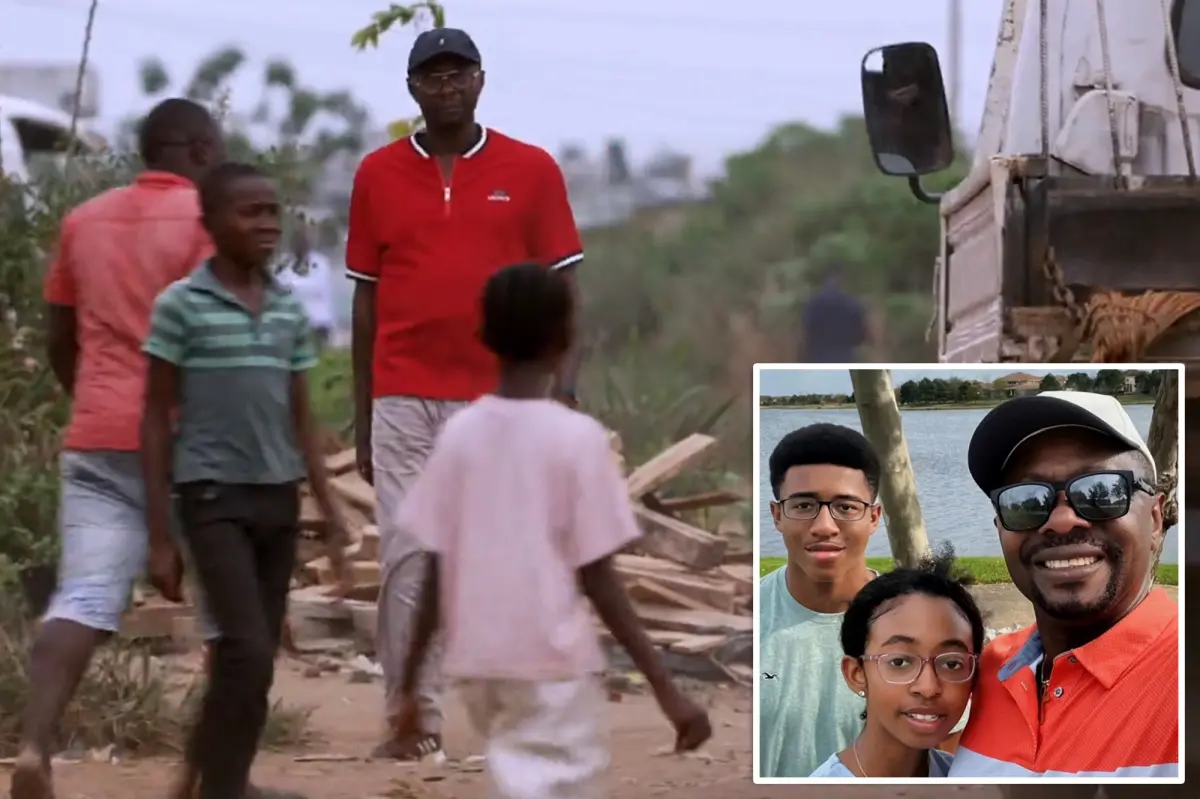
Few stories illustrate the chasm between immigration as it is lived and immigration as it is argued quite like that of Moussa Diawara. He is a married father of two, a Malian national who spent over a decade in the United States after overstaying a tourist visa. He is also, depending on whom you ask, either a victim of a heartless deportation system or a symbol of everything wrong with America’s asylum process. This summer, Diawara was deported not to Mali, his home country, but to Ghana, a third country that had agreed to take him. CBS News’s “60 Minutes” told his story with sympathy, describing him as a Texas dad who was ripped away from his family and, in a terrifying turn, forced out of Ghana and back into Mali, a country he said he had good reason to fear. Within days of that profile airing, the Trump administration’s Department of Homeland Security fired back with unusual fury. The agency claimed the broadcast had deliberately left out the most important fact of all: that Diawara’s asylum claim was based on his allegation that he is gay. Since Diawara is married to a woman and has two children with her, DHS officials said the entire application was an absurd fraud. And so a single human life became a kind of battlefield, where the future of immigration enforcement and the credibility of the media were fought over, while the man at the center remained hidden on another continent, trying to stay alive.
The CBS segment, as described in news reports, painted a portrait of a man who had built a life in Texas after arriving on a visitor visa more than a decade ago. He overstayed his visa, but he also applied for protection, claiming that he could not safely return to Mali. A judge ultimately issued a final order of removal in 2012, according to DHS, but Diawara remained in the United States for years afterward. To the people who knew him there, he was simply a husband and father, a member of a local community, the kind of person whose deportation might seem distant and abstract until it happens to someone across the street. When “60 Minutes” caught up with him in August, the image was a far cry from any suburban life he might have had in Texas. He was homeless, hiding in Mali, terrified for his safety, unable to return to the United States and unable to feel safe in the country of his birth. The show reported that after several weeks in Mali, he managed to escape with the help of local truck drivers who moved him across a border to another country, one he asked not to be named because he feared for his life. It is a harrowing narrative, and one that was clearly intended to make viewers question the cruelty of a system that would send a man like him into danger. But DHS was not watching in silence, and the agency believed the story was dangerously incomplete.
What the Trump administration objected to was not simply the sympathetic tone of the piece, but the omission of what it considered to be the most damaging fact in Diawara’s immigration file. DHS General Counsel James Percival took to X, the platform formerly known as Twitter, to accuse CBS of using Diawara as a poster child for wrongful deportations. Percival said that when he pulled Diawara’s file, he found the real reason Diawara claimed to fear Mali: not political persecution, not membership in a persecuted group, but a claim that he was gay. The department said that Diawara’s final removal order was issued by a judge in 2012, and that his asylum application stated that he would be persecuted for his homosexuality if he were sent back to his home country. The fact that he was married to a woman and had two children with her, DHS argued, made that claim laughable and fraudulent. The department posted pointedly that it had removed Diawara to a third country that provided diplomatic assurances for his safety, and that “60 Minutes” had left this “absurd bit of fraud” out of its so-called Texas dad segment. To DHS, this was not a case of an innocent man being punished. It was a case of a man who had gamed the immigration system for years, used a flimsy and fabricated claim to try to remain in the country, and now had convinced a major news organization to turn him into a martyr.
But once the asylum application itself came to light, the story became less simple, and more human. The words Diawara wrote are raw and, in some ways, agonizing. He wrote that since coming to the United States he had finally been able to express his feelings to men without embarrassment or reserve. He described himself as someone who, though born a boy, had female behaviors and feelings, and who was more comfortable being intimate with boys than with girls. These are not the words of a hypothetical person, and they were not written casually. They were written by a man trying to explain to an American judge why going back to Mali would put him in harm’s way. DHS looked at those same words and saw only fraud, because Diawara is married to a woman and has children. That reasoning, however, rests on a deeply narrow understanding of human sexuality. People can be bisexual. People can be gay and still marry someone of the opposite sex, especially when they come from cultures where being openly gay is dangerous, or even deadly. The pressure to appear straight, to marry, to have a family, can be overwhelming for people who are trying to survive in communities that would condemn them. A man can love his wife and children while also feeling attraction to men. A man can be a father and still fear being killed for something he has hidden his entire life. None of that absolves any fraud that might have occurred, but it does mean the government’s certainty about “absurd fraud” is not as straightforward as it claims. It is entirely possible to look at the same application and see not a con artist, but a deeply conflicted man who was afraid to say too much, and afraid to say too little, and who finally tried to tell his truth in the only way an asylum system would listen.
If we put the legal fight aside for a moment, what remains is a human story with no good ending. Moussa Diawara was returned to Ghana, a country he apparently had no connection to, and then, according to him and CBS, was placed on a plane by Ghanaian authorities and sent to Mali. Mali is the country he originally fled, the place he said would not be safe for him. There is something profoundly unsettling about that chain of events. Even if everything DHS says is true, even if Diawara fabricated his entire asylum claim, it is difficult to hear his words without feeling the weight of what it means to be stripped of every anchor in your life. He is a father, and his children are presumably in the United States, growing up without him. He is a husband, and his wife has been forced to face a future that she did not choose. He is a man in hiding, dependent on the kindness of strangers, asking not even to be named for fear that the government that deported him, or the government that received him, will decide his fate once more. Whatever the truth of his asylum claim, the situation is not something most people would choose, and it is not a punishment that fits the crime of overstaying a visa, unless the system has decided that proving a person’s identity is more important than understanding it. He may be a liar. He may be a fraud. But he is also a person who has now been made an example, and being made an example is a lonely and brutal thing.
In the end, the story of Moussa Diawara is not just about one man or one news segment. It is about the way immigration debates are conducted in America, with so little room for ambiguity. The Trump administration used his case to argue that the asylum system is overrun with people willing to say anything to stay in the country, and that the media is complicit in hiding the truth. CBS, by contrast, used his case to argue that the system is capable of sending vulnerable people to places where they may be killed, and that immigration enforcement has become too cruel to be trusted. Both of those things can be true at the same time. There are real people who abuse the asylum system, and there are also real people whose lives are destroyed when the system treats every claim as suspect. There is no way to know with complete certainty whether Diawara was telling the truth, and perhaps that uncertainty is the most important lesson of all. The law demands clear categories: citizen or immigrant, documented or undocumented, gay or straight, victim or fraud. But human beings are not always clear. A man can be a father and a husband and also feel attraction to other men. A man can overstay a visa and still have a genuine fear of returning home. A man can be dishonest about parts of his identity and still be telling the truth about the danger he faces. If America is ever going to fix its immigration system, it will have to find a way to hold these contradictions in mind at the same time. It will have to make room for mercy without losing accountability. It will have to remember that behind every file, every application, every court order, there is a person who bleeds and hides and hopes. Moussa Diawara is that person now. And whatever the final verdict on his case, the world he now inhabits is not one that should be wished on anyone.