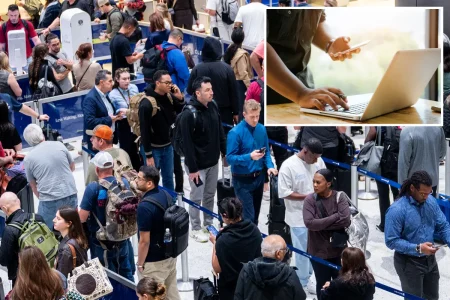


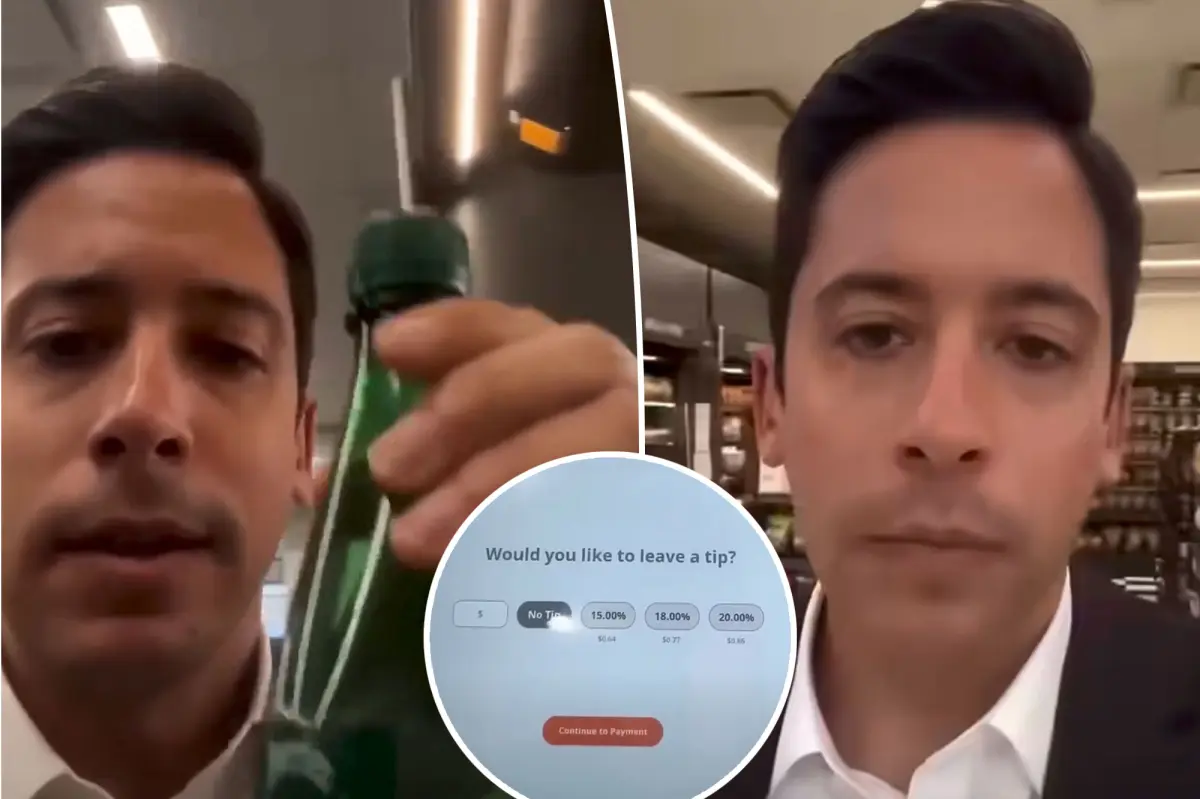
Few things can make a weary traveler feel more invisible than standing in front of a self-checkout kiosk at an airport, doing all the work yourself, and then being asked to tip. It used to be that gratuities were reserved for people who actually did something for you: carried your bags, brought your food, made your bed, or at least smiled at you while pouring a coffee. But in the strange new world of “robo-tipping,” even a machine has the nerve to put its virtual hand out. This exact scenario played out recently for Michael Knowles, an American conservative political commentator, who was traveling through an airport and decided to document the absurdity on his phone. He walked into a convenience shop, grabbed a bottle of Perrier sparkling water, and headed to the self-checkout station. There was no cashier, no sales associate, no human being in sight. He scanned the bottle, saw the price of $4.29—already an airport markup that would make anyone wince—and then the screen asked him the now familiar question: Would you like to leave a tip? Knowles turned the camera to his audience and summed up the ridiculousness perfectly: “I have not seen a single employee, I have scanned my own Perrier and now the robot wants me to tip it.” The video, titled “They expect me to tip a robot?” struck a nerve, and it wasn’t hard to see why. It captures the moment when tipping culture officially jumped the shark, moving from rewarding genuine service to simply extracting money from people who are already doing the work themselves. The average person may have no problem leaving a generous 20 percent after a nice meal, when a real waiter has refilled drinks, answered questions, and checked on the food. But somewhere along the way, that same social pressure has bled into every corner of commerce, including self-service stations where there is no server, no service, and frankly, no shame left.
Across social media, the video sparked a chorus of exasperation that felt almost cathartic. One user wrote, “I tip only humans,” which quickly became the unofficial mantra for everyone who has ever stared at a touchscreen and felt their kindness being weaponized. Another commenter joked, “I’d ask for a discount for doing its job,” and that punchline captures the deeper frustration: we are not just being asked to tip, we are being asked to pay for the privilege of doing the work ourselves. It is one thing to leave a few dollars for a barista who actually makes your latte or a server who brings your food. It is quite another to scan your own items, bag your own groceries, and then feel a pang of guilt when the screen glares back at you with preset percentages. That guilt is not an accident. The design of these payment systems is intentionally psychological. The buttons are big, the options are generous, and the “no tip” choice often feels like a rejection of someone’s livelihood, even when there is no one around to reject. We have been trained to associate tipping with being a decent person, so when a machine asks, our first instinct is to comply, even if our rational brain knows it makes no sense. This is the insidious genius of robo-tipping: it relies on our social conditioning, our desire to avoid awkwardness, and our fear of being judged by an invisible audience. But as more and more stores, airports, and fast food chains adopt these prompts, the spell is beginning to break. People are starting to realize that tipping has become less about generosity and more about corporate profit, and they are not happy about it.
Of course, not everyone saw the situation the same way. Some commenters rushed to defend the practice, pointing out that even if you don’t see an employee at the register, there are still human beings working behind the scenes. Someone stocked the shelves. Someone cleaned the store. Someone maintained the self-checkout system. Maybe, the argument goes, the tip doesn’t go to the robot at all; it goes to the low-wage workers who keep the operation running. That is a fair point, and it speaks to the real reason many of us hesitate to press “no tip.” We know that workers in convenience stores, airports, and fast food joints are often underpaid, and we want to help them. But here is the problem: the customer is being asked to subsidize wages that the employer should be paying, and there is absolutely no transparency about where the money ends up. Another commenter offered a more practical take, noting that these systems are universally programmed to ask the question, and that the easiest solution is to simply say no and move on. “Even if there was an employee you can say no,” they wrote. That advice sounds simple enough, but it ignores the emotional weight that these prompts carry. For many people, especially those who have worked in tipped positions, saying no feels like an act of cruelty, even when the request is absurd. The result is a growing sense of what experts call tipping fatigue, a weariness that comes from being constantly asked to open your wallet for services that used to be included, and for services that, in many cases, you are now providing yourself. This particular gratuity gouging is just the latest outrage, but it is far from an isolated incident.
Just a few weeks before Knowles’ video, another airport store found itself in the spotlight for exactly the same reason. Dr. Clay Moss, a longevity specialist, posted a TikTok showing a self-service payment terminal at an airport shop that automatically nudged him to tip. Moss was trying to purchase a bottle of water, which was already overpriced, when the screen prompted him to leave a gratuity of 10 percent, 15 percent, or 18 percent. There was no employee standing nearby, no one handing him the bottle, no one doing anything except watching the transaction happen. The water was in a refrigerator, he grabbed it himself, and the only service provided was by the machine that scanned his payment. Yet the system still asked him to tip, and not just a casual “maybe a dollar” option. It was an automatic tipping feature, seemingly preset to make him feel cheap if he didn’t choose at least 18 percent. Moss was stunned, and he took his frustration to TikTok, asking his followers two simple questions: Has tipping culture gotten out of hand, and who is the money actually going to? Those questions echoed the feelings of millions of travelers who have experienced the same thing. It is one thing to tip a bartender who makes a complicated cocktail or a valet who parks your car in the rain. It is another thing entirely to tip a kiosk for the privilege of paying an inflated price for a bottle of water. The absurdity of the situation is almost too perfect to describe, and yet it has become a routine part of modern travel.
This broader phenomenon is about more than just a few awkward moments at airport self-checkouts. It reflects a fundamental shift in how we think about labor, value, and responsibility. For years, the American economy has leaned heavily on tips to make up for low wages, especially in restaurants, retail, and other service industries. Employers have been able to pay their workers less because customers are expected to make up the difference. But now, with automation and self-service technology on the rise, the same logic is being applied to situations where there is no employee to reward. The machine does the work, the customer does the work, and somehow the tip still appears on the screen. It is almost as if the concept of tipping has become detached from actual service and morphed into a kind of optional tax on doing business. We are no longer tipping people for their labor; we are tipping corporations for the privilege of using their technology. That is why so many people are angry. It feels less like generosity and more like a shakedown, a carefully engineered guilt trip that takes advantage of our better instincts. We want to be kind. We want to support workers. But when the request comes from a robot, and when there is no clear connection between the tip and the person who might receive it, the whole transaction becomes hollow. It also raises a troubling question: if a robot is asking for a tip, and the tip goes to a human, why isn’t the employer simply paying that human a fair wage? The answer, of course, is because it is easier and more profitable to shift that cost onto the customer.
So what are we supposed to do about it? For now, the best advice seems to be the simplest: just say no. Not out of cruelty, but out of principle. If there is no human service being provided, there is no obligation to tip, and there is no reason to feel guilty about pressing the “no tip” button. If you want to support workers, support businesses that pay their employees fairly, and if you can’t find them, advocate for better labor laws and greater transparency in tipping. Leave tips for the people who actually serve you, not for payment terminals that are programmed to ask. And if you feel like being a little rebellious, take a page from the commenter who joked about asking for a discount for doing the machine’s job. The truth is, these prompts will keep appearing as long as we keep paying them. The moment we collectively stop feeling ashamed for refusing to tip a robot, the sooner these companies will get the message. We have to remember that a tip is not a donation, not a tax, and not a punishment. It is a reward for service, and no amount of clever software should make us forget that. The next time a self-checkout screen asks if you want to leave a gratuity, look it in the eye, or in the sensor, and smile as you press “no.” You are not being cheap. You are being sane. And if the robot wants a tip, maybe it should do something worth tipping for, like carrying your luggage or finding you a cheap flight. Until then, keep your money in your pocket, and let the machines do the asking while we humans do the deciding.