

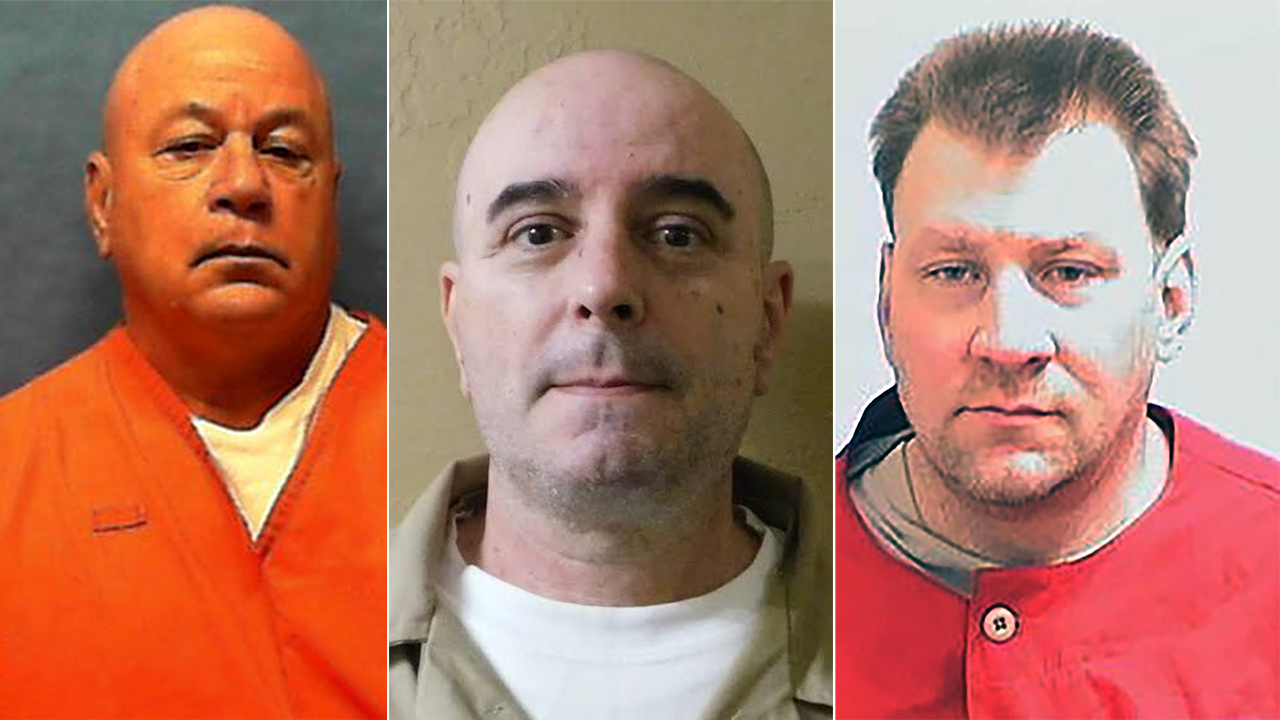
On a somber Thursday that underscored the deep divisions and ongoing debates surrounding capital punishment in America, three separate states carried out the ultimate penalty, executing three men within hours of one another. This marked only the second time this year that the nation witnessed a triple-execution day, a rare and jarring convergence of the justice system’s final act. The coordinated schedule, which saw Indiana, Florida, and Alabama put inmates to death on the same day, reignited conversations about the finality of the death penalty, the methods used to administer it, and the long, often agonizing journeys that lead to the execution chamber. The first such event this year had occurred in August, with Oklahoma, Tennessee, and Alabama conducting executions in close succession. Before that, one would have to look back to January 2010 to find a day when three men faced their deaths across the country. This rare confluence of events served as a stark reminder of the relentless pace of executions in certain states, even as others move to abolish the practice entirely.
The day began in the pre-dawn hours in Indiana, where the state carried out the execution of Jeffrey Weisheit, a 50-year-old man convicted of a crime of devastating cruelty. In 2010, Weisheit set fire to a house, killing his girlfriend’s two young children, eight-year-old Alyssa Lynch and her five-year-old brother Caleb, as the couple’s relationship was falling apart. He was pronounced dead at 12:45 a.m. at the Indiana State Prison in Michigan City, receiving a lethal injection that brought an end to a legal battle that had stretched on for over a decade. In the final days and hours leading up to his execution, his legal team had made desperate pleas for additional brain scans, arguing that his history of head injuries and significant mental health problems were mitigating factors that warranted further examination. However, Republican Governor Mike Braun denied these requests, as well as any appeal to commute the sentence to life in prison. The case also brought attention to the state’s procurement of execution drugs from a pharmacy that was facing a disciplinary hearing, raising concerns about the transparency and reliability of the drugs used. The Indiana Department of Correction, however, expressed confidence in their ability to carry out the execution humanely. Following the procedure, Governor Braun offered a brief statement, asserting that the case had been reviewed repeatedly in both state and federal courts, and that the sentence was carried out as ordered. Indiana Attorney General Todd Rokita framed the execution as providing long-awaited justice for the two innocent children whose lives were stolen in an act of unspeakable cruelty.
As the morning turned to afternoon, the focus shifted to the humid landscape of northern Florida, where the state prepared to execute 64-year-old Jesse Guardado. Guardado’s story was one of a life marked by addiction and a tragic betrayal of kindness. In 2004, he confessed to fatally stabbing 75-year-old Jackie Malone, a woman who had selflessly helped him find a job and a place to live. In a heart-wrenching turn, he repaid her generosity by killing her inside her own home and stealing her jewelry box, $80, and other items to fuel his drug habit. Guardado was pronounced dead at 6:13 p.m. following a lethal injection at Florida State Prison near Starke. His execution was part of a larger, accelerated trend in the Sunshine State, which has become the most active execution state in the nation in recent years. This latest execution matched last year’s staggering state record of 19 inmates put to death in a single year, a number that had not been seen since the death penalty was reinstated in 1976. This dramatic increase followed a series of death warrants signed by Republican Governor Ron DeSantis, signaling a clear and aggressive turn towards carrying out the penalties of the state’s most condemned prisoners. The state’s aggressive use of capital punishment has accounted for roughly 40% of all executions nationwide, a statistic that has drawn both praise from proponents of the death penalty and sharp criticism from its opponents, who point to the high potential for wrongful convictions and the immense cost of litigation.
The final execution of the day took place in Alabama, capping off the triple event with the story of Michael Taylor, a 54-year-old man who had spent nearly his entire adult life on death row. In 1991, at the age of just 19, Taylor, along with an accomplice, was convicted of the brutal murders of an older couple, Ivan and Lucille Moore, who were beaten to death with a metal bar during a robbery inside their own home. Authorities apprehended Taylor about an hour away in Birmingham, in possession of the victims’ Cadillac, a detail that cemented his guilt in the public eye. Taylor was executed by lethal injection, despite his attorneys’ objections to the method. He had previously requested execution by nitrogen gas, and his legal team had sought to preserve that choice, but a judge ruled against them. In the final statement released by his attorneys, they portrayed Taylor as a man transformed by his decades in prison, acknowledging the depth of the harm he caused and grieving for it for the rest of his life. They described him as a changed man, stating that his life was proof that God isn’t finished with any of us. Death penalty opponents had urged Republican Governor Kay Ivey to commute his sentence, arguing that his youth at the time of the crime—at 19, he was barely out of his teens—meant he was too immature to fully grasp the consequences of his actions. But the governor declined, issuing a statement that described his actions as “reprehensible,” recounting the horrifying details of how the couple had kindly opened their home to him, only to be repaid with violence and death. The victims’ family also expressed a mix of relief and frustration, thanking the attorney general’s office for closure but lamenting the 35-year wait for the sentence to be carried out, a period filled with delays and uncertainty.
These executions unfolded against a backdrop of intense national debate over the methods used to carry out the ultimate punishment. The renewed scrutiny of lethal injection procedures was given a poignant focus by a failed execution attempt in Tennessee, where death row inmate Christa Pike survived two doses of pentobarbital in late September and had to be rushed to a hospital. While she has since been returned to prison, the incident cast a long shadow over the procedures, raising serious ethical and practical questions about what constitutes a humane execution. The fact that three states could proceed with lethal injection on the same day, despite such a high-profile failure, underscores the fractured and contested nature of the practice. Each state has its own protocols, its own sources for the necessary drugs, and its own legal battles over those protocols. The difficulty in obtaining the necessary drugs has led some states to experiment with new methods, like nitrogen gas, and to shield the identities of their suppliers, leading to a lack of transparency that fuels further legal challenges. The events of Thursday served as a vivid illustration of the complex and often troubled machinery of state-sanctioned death, highlighting the tension between the desire for finality and the pursuit of a method that does not inflict unnecessary pain and suffering.
The very same day that these three men were put to death, a powerful counter-narrative emerged from the opposite end of the country. Democratic California Governor Gavin Newsom announced a momentous decision to seek commutation for all 548 death sentences in the Golden State, converting them to life without parole. This sweeping action, which would require a recommendation from the California Supreme Court for 382 of the commutations, was framed by the governor as a fundamental alignment of state policy with his core values. He stated that state-sanctioned killing is incompatible with California’s values, undermines the foundations of our legal system, and diminishes each of us. Newsom, who had previously put a moratorium on executions in the state in 2019, argued that within an imperfect legal system, the irreversible nature of the death penalty poses an unacceptable risk of executing an innocent person. His announcement on the same day as the triple execution was a starkly poetic juxtaposition, highlighting the profound ideological chasm that exists within the United States. On one side of the country, states are accelerating the pace of executions, seeing them as a necessary form of justice; on the other, a governor is using his executive power to dismantle the practice entirely, viewing it as a flawed and inhumane anachronism. The contrast could not have been more stark, offering a microcosm of the national schism on the issue.
In the final analysis, the events of that Thursday represent a profound moment of reckoning for the American justice system. For the families of the victims—Alyssa, Caleb, Jackie Malone, and Ivan and Lucille Moore—the executions brought a long-sought sense of closure, a final chapter to decades of pain and waiting. Their statements, filled with a mix of sorrow and relief, reflect the deeply human need for accountability and consequence in the face of unimaginable loss. For the executed men and their loved ones, it was the tragic culmination of lives marked by violence, mental illness, and, in some cases, genuine remorse and transformation. The day highlighted the stark realities of a system that continues to operate in the United States, even as global opinion increasingly turns against it. The juxtaposition of the nation’s busiest execution states with California’s move towards abolition lays bare a fundamental conflict over the very nature of justice, mercy, and the value of a human life. It forces a reflection on whether the death penalty is an act of righteous retribution or a deeply flawed, irreversible punishment that ultimately diminishes the society that employs it. As the needle delivered its fatal dose in three states, and as a governor in California signed documents to prevent future use of that needle, the nation was left to grapple with the haunting question of what true justice truly looks like in these divided United States.