

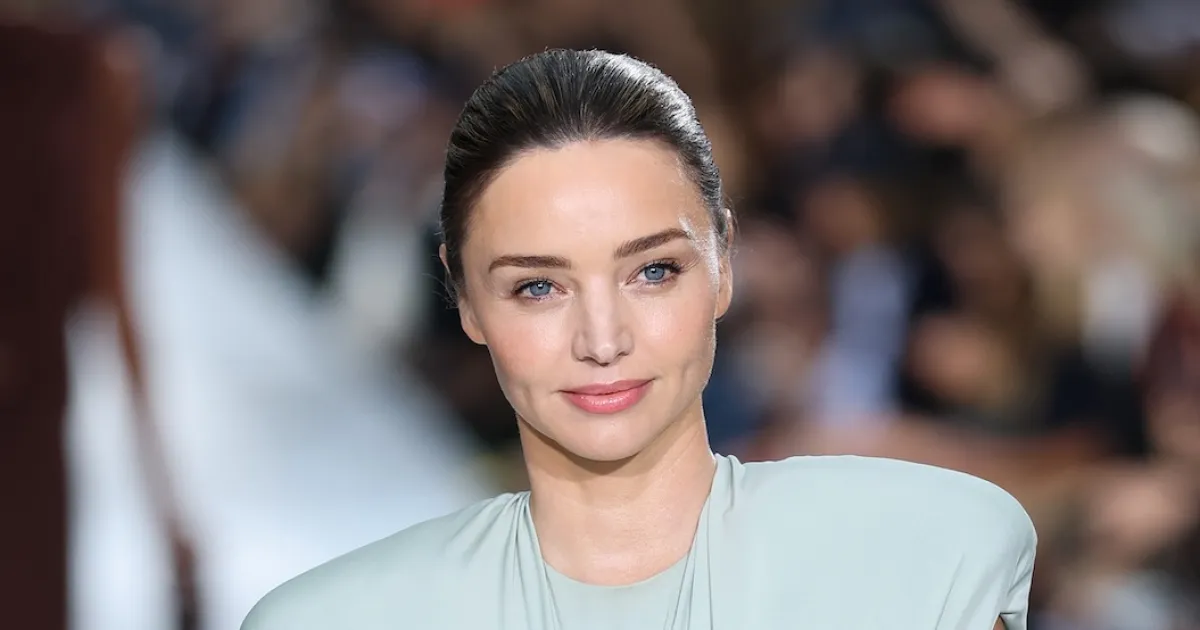
Miranda Kerr almost said yes. When the invitation arrived to appear in the 2026 Victoria’s Secret Fashion Show, the 43-year-old Australian model did not immediately dismiss it. In fact, she was genuinely tempted. On the Tuesday, November 3 episode of the “Not Skinny But Not Fat” podcast, Kerr told host Amanda Hirsch that she had seriously considered returning to the runway that helped make her a household name. “I was really, seriously considering it,” she admitted. The timing felt almost poetic. She had just walked for Stella McCartney and felt wonderful about the experience. “I felt really in alignment with where I was at, it felt very elegant and I love Stella,” she said. That sense of alignment made the Victoria’s Secret invitation feel less like a regression and more like a playful reunion with an old friend. After all, it had been twenty years since Kerr first stepped onto the VS runway, and the idea of returning for a nostalgic cameo had a certain charm. She thought about the fun memories, the playful energy, the glittering costumes, the backstage chaos, and the camaraderie among the Angels. “I thought of all the fun memories, and how playful it was and how it would be so cool … to get back out on the runway and give them a wink,” she recalled. “I got really excited.” Her friends and business associates were on board, encouraging her to seize the moment. It was easy to imagine the triumphant return: the music, the lights, the wings, the wink to her younger self. But as the excitement settled, something else began to surface. Kerr, who has spent years developing her mindfulness practice and building KORA Organics, started to feel uneasy. The more she tried to talk herself into the show, the more her body seemed to push back. It was a quiet but persistent signal, and she knew she had to pay attention. The invitation was not just a career opportunity; it was a conversation with her past, and the answer was not as simple as she had hoped.
At first, Kerr tried to meditate through the discomfort. She sat with her thoughts, attempting to ease the anxiety and reconnect with the excitement she had felt at the beginning. But no matter how deeply she breathed, the knot in her stomach would not go away. She was honest with herself about what the runway would actually feel like at this point in her life. “Everyone’s in their underwear, I’m in my underwear, I’m 43, I have four boys,” she said. The image was not one of shame or fear, but of misalignment. The woman who had once glided down the Victoria’s Secret runway in wings and heels was no longer the same person inside. She had evolved. Her life now revolved around her four sons—Flynn, 15, from her marriage to Orlando Bloom, and Hart, 8, Myles, 6, and Pierre, 2, with her husband, Snapchat co-founder Evan Spiegel. She was a mother, a wife, an entrepreneur, and a wellness advocate. The fantasy of the Victoria’s Secret Angel belonged to a younger version of herself, one who was hungry for the spotlight and eager to prove herself on the world’s most glamorous stages. That version of Miranda deserved to be celebrated, but she did not need to be resurrected. Kerr’s friends and business associates kept encouraging her, reminding her how iconic it would be. But the knot in her stomach remained, and she realized that external validation could not override her internal truth. The anxiety was not about being judged; it was about being inauthentic to herself. She had built a brand around natural beauty, mindfulness, and holistic wellness. Returning to the VS stage, while not wrong for anyone else, would have required her to perform a version of herself that no longer felt like home. As she recalled, “As much as I tried to meditate and ease it, it was still there.”
The only way to resolve the conflict, Kerr discovered, was to stop trying to make the decision feel comfortable and instead allow herself to feel what it was like to let go. She said, “The only way I could resolve it [was] to say, ‘OK, you’re not going to do the show. How do you feel now?’ [and] I felt the knot in my stomach release.” That release was her answer. It wasn’t about whether the show would have been fun or whether she could have done it. It was about whether doing it would have honored the person she had become. And the answer was no. Kerr acknowledged that she is at a different stage of her life. She loves the old photographs and the memories they hold, but she no longer feels connected to that image of herself. When podcast host Amanda Hirsch suggested that perhaps Kerr simply didn’t feel connected to that image anymore, Kerr responded, “Maybe. I’m at a different stage of my life … [but] I love all of those fun pictures.” There was no bitterness in her voice, no regret. She spoke about Victoria’s Secret with warmth and gratitude, the way one might speak about a beloved chapter in a book that has been closed. The decision to say no was not a rejection of the brand or of the women who walk its runway. It was a declaration of self-awareness. Kerr knew that if she had walked the show, she would have done it for the wrong reasons—for nostalgia, for other people’s excitement, for the thrill of proving she could still do it. And she had reached a point in her life where she no longer wanted to make major choices from a place of proving anything to anyone. The knot in her stomach was her intuition speaking, and she had learned to trust it.
Kerr made her decision public in the days before the show, and she did so with characteristic grace. On October 17, she shared a series of throwback photos from her early Victoria’s Secret runway days on Instagram, alongside a heartfelt caption that made it clear she was closing this chapter with love, not resentment. “20 years since my first @victoriassecret show,” she wrote. “Looking back with so much gratitude for the friendships, the magical memories and for everyone who made that chapter of my life so special.” She went on to explain that it meant a great deal to be invited back, especially in a year that marked two decades since her first show, but that she ultimately felt in her heart it was right to cherish the chapter as it was. “Sending so much love and light to everyone in this year’s show!” she added, punctuating the message with emojis of hearts, rainbows, and fairies. The post was a masterclass in how to say no without burning bridges. Kerr did not criticize the brand, the show, or the women who participate. She did not frame her decision as a moral stance or a critique of the industry. She simply acknowledged that some memories are too precious to be revisited, and that the meaning of a moment can be lost when you try to recreate it. The response from Victoria’s Secret was equally gracious. The brand commented on her post, writing, “Always an Angel to us.” It was a small but significant gesture, a recognition that Kerr would always be part of the Victoria’s Secret family, even if she chose not to walk its runway again. The exchange felt less like a farewell and more like a mutual release, two parties acknowledging that their relationship had evolved into something softer and more reflective.
To understand why this decision carried so much weight, it helps to remember how central Victoria’s Secret was to Kerr’s rise. Two decades ago, she stepped onto the event’s runway and became one of the most recognizable Angels of her era, known for her dimples, her radiant smile, and her ability to make even the most elaborate fantasy look effortless. But Kerr was always more than a runway model. She was building something else in the background, a beauty brand rooted in natural ingredients and holistic wellness. KORA Organics launched in 2009, and over the years it became a reflection of her values: clean, conscious, and grounded. As her career evolved, so did her identity. She married Orlando Bloom and had Flynn; later she married Evan Spiegel and had three more sons. Her days became filled with school runs, bedtime routines, and the quiet, unglamorous work of raising a family. The woman who once spent her nights in feather wings and rhinestone bodysuits now spends her energy on meditation, skincare, and creating a stable, loving home. That transformation is not a loss; it is a deepening. Kerr’s decision to decline the Victoria’s Secret invitation was not about being too old or too tired. It was about being too whole. She no longer needed the runway to define her. She had built a life that was rich in ways a fashion show could never capture, and she knew that stepping back into the fantasy would have felt like stepping out of her own reality. The invitation was flattering, and the nostalgia was real, but the life she had created in the years since her first show was the thing that deserved her full presence.
Kerr’s story is ultimately about the quiet power of listening to yourself. In a culture that constantly tells women to seize every opportunity, to stay relevant, to prove they can still compete, saying no can feel like a failure. But Kerr’s no was not a failure. It was a triumph of self-knowledge. She allowed herself to feel the excitement, to consider the possibility, to weigh the opinions of people she trusted, and then she checked in with her own body. The knot in her stomach was not a sign of weakness; it was a signal of truth. By honoring it, she modeled something rare and valuable: the ability to let go of a dream that no longer belongs to you, not because it was bad, but because it was already completed. There is a difference between remembering a beautiful moment and trying to live inside it again. Kerr chose to remember. She chose to let the memories remain memories, glowing and untouchable, rather than risk diluting them by attempting to recreate them in a body and a life that have moved forward. Her decision also speaks to a larger conversation about women, aging, and visibility. Too often, women are made to feel that their value diminishes as they get older, especially in industries built on youth and beauty. Kerr’s choice flips that narrative. She is not hiding from the spotlight; she is choosing where to shine it. She walked for Stella McCartney and felt aligned. She runs a successful business. She raises four boys. She has built a life that does not require the validation of a runway. And when the invitation came to return to Victoria’s Secret, she had the clarity to ask herself not “Can I do this?” but “Do I want to do this?” The answer was no, and that no was enough. In the end, Miranda Kerr did not walk the 2026 Victoria’s Secret Fashion Show. But she did something perhaps more meaningful: she walked away from it with grace, gratitude, and a heart at peace. And that, in its own way, is the most beautiful thing she could have done.