



Bitcoin Rebounds as Midterm Uncertainty Fades: Digital Assets Shrug Off a Political Shock
A Morning of Whiplash in the Crypto Market
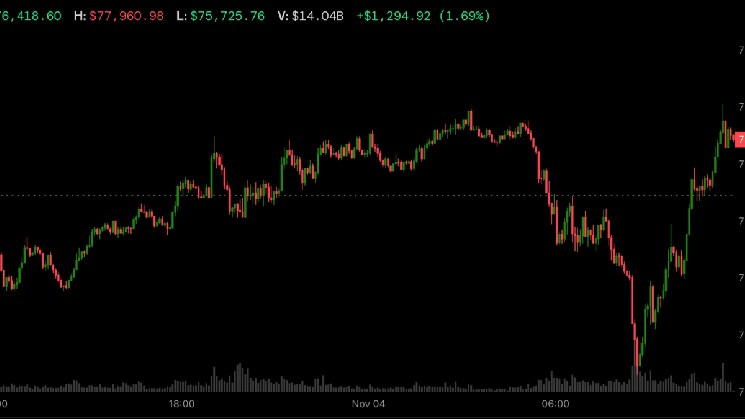
Bitcoin erased its early losses and was steaming higher Wednesday, as the thick cloud of uncertainty that had been hanging over the U.S. midterm elections finally began to disperse. The largest cryptocurrency fell hard in the early hours, slipping below $76,000 after initial reports indicated that Democrats were on track to win control of both chambers of Congress. For a market that had grown accustomed to a vocal pro-crypto ally in the White House, that news initially looked like a gut punch. President Donald Trump had made no secret of his support for digital assets, and a Democratic-controlled Congress was widely understood to be a more difficult environment for the industry’s legislative ambitions. But the sell-off did not last. Bitcoin staged a sharp V-shaped recovery, erasing its losses and climbing back into the green. By late morning, the cryptocurrency was trading roughly 0.5 percent higher on the day, hovering near $77,883.88 as traders recalibrated their expectations. What began as a politically charged panic ended as a textbook lesson in how quickly modern markets can move through fear and into clarity. The episode was a vivid reminder that few asset classes react to Washington’s every pulse quite like crypto.
The speed of the reversal was striking. A market that had spent weeks bracing for a messy election scenario was suddenly handed a definitive outcome, and traders responded accordingly. In the early hours, the narrative seemed simple: Democrats sweeping both chambers meant a more skeptical regulatory climate, tougher oversight hearings, and perhaps the stalling of a number of bills that the industry had eagerly supported. Yet within hours, the same market was climbing back, driven by the realization that a clear result, even an unwelcome one, is often more useful to traders than a prolonged state of limbo. The dip mattered, but so did the rebound. What made the move especially noticeable was not just the recovery itself, but the confidence behind it. This was not a weak bounce driven by bargain hunters; it was a broader repricing of political risk by a market that has become increasingly sophisticated in how it reads election outcomes. For institutional investors, the question has never been simply who wins or loses. It is what the new balance of power means for the rules of the road.
Why the Initial Panic Made Perfect Sense
To understand the early slide, it helps to remember how much political capital the crypto industry has invested in the current administration. Over the past year, Bitcoin and the wider digital asset ecosystem have evolved from a rebellious fringe into a mainstream financial force, complete with lobbying arms, political action committees, and a seat at the table in Washington. Trump, for his part, has leaned into that relationship, positioning himself as a champion of innovation and promising to protect the industry from what he describes as overzealous regulators. The prospect of a Democratic-controlled Congress threatened to upend that dynamic. Democratic lawmakers have, for the most part, been more skeptical of digital assets, raising alarms about consumer protection, financial stability, national security, and the environmental impact of energy-intensive mining operations. For many traders, the first election reports triggered an immediate and visceral response: if the Democrats were sweeping the Congress, the friendly policy runway that the industry had enjoyed could be shut down abruptly. The drop below $76,000 was not a rejection of blockchain technology. It was a rejection of the political scenario that was suddenly unfolding in real time.
Dick Lo, founder of TDX Strategies, captured the mood succinctly. “Bitcoin dropped initially in response to the Democratic sweep of the midterm elections, but has since recovered as a clear outcome resolves political uncertainty,” Lo told CoinDesk. His assessment echoed a sentiment that has become something of a mantra in modern financial markets: uncertainty is more painful than bad news. A known adversary, after all, can be planned for. A coin flip cannot. Lo’s point was simple but profound. The market’s initial decline was driven by the headline, not by a carefully reasoned analysis of every policy implication. It was an emotional reaction, the kind that has come to define crypto’s relationship with political drama. The recovery, by contrast, was rooted in the kind of sober, second-level thinking that professional investors are paid to do. Once the fog lifted, they realized that the world had not ended, the industry had not been banned, and Bitcoin was still standing.
Gridlock as a Market Stabilizer
Lo went on to explain why the Democratic win might not be the nightmare scenario that some traders initially feared. A Democratic-controlled Congress, he acknowledged, is generally viewed as less favourable for pro-crypto legislation. That much is hard to dispute. Democratic policy priorities have traditionally leaned toward oversight, investor protections, and stricter financial market regulations. The party has rarely spoken about digital assets with the same enthusiasm as Republican voices, and some of its most prominent members have called for greater scrutiny of the industry. But Lo also pointed to a crucial counterweight: divided government. With Trump in the White House and Democrats controlling both chambers of Congress, the federal government is entering a period in which the executive and legislative branches are constantly checking each other. That dynamic, he argued, makes major, market-unfriendly policy shifts unlikely. The legislative process becomes a battlefield of vetoes, filibusters, and procedural delays. In such an environment, sweeping changes are extraordinarily difficult to push through, regardless of which party is trying to make them.
For the cryptocurrency market, that gridlock is not necessarily bad news. Yes, it may frustrate those hoping for a comprehensive pro-crypto bill that would clarify the legal status of digital assets and open the door to broader institutional adoption. But it also protects the industry from sudden, drastic regulatory overhauls. A divided government acts like a speed bump on the road of legislative ambition. It prevents both good and bad bills from having a smooth ride. The market, in turn, can breathe a little easier. Traders know that the chances of a hostile bill reaching the president’s desk and becoming law are significantly lower when the House and the Senate are controlled by the opposition. The same structural friction that slows down progress also slows down harm. For an industry that has learned to live with regulatory ambiguity, that is an acceptable trade. And for investors, it is a reason to keep their risk models on, rather than hitting the panic button.
Trump’s Executive Toolkit: Orders and the Veto Pen
Lo was careful to stress that President Trump retains significant authority even in the face of a Democratic Congress. “Still, President Trump can govern through executive orders while leveraging his veto authority to counter Democratic bills,” he said. This is a critical point, because it highlights the asymmetry of power in the American political system. A president does not need Congress to act on every front. Executive orders allow the White House to direct federal agencies, reshape regulatory priorities, and set the tone for enforcement without a single vote on Capitol Hill. For the crypto market, that opens up a range of possibilities. Trump could use executive action to encourage federal banking regulators to treat digital asset firms more fairly, to push federal agencies to coordinate on blockchain policy, or to direct the government to examine ways to integrate digital assets into the broader financial system. None of those steps would require legislative approval.
At the same time, the veto pen serves as a powerful defensive tool. If the Democratic-controlled Congress succeeds in passing legislation that the industry considers harmful, the president can simply refuse to sign it. Overturning a veto requires a two-thirds majority in both chambers, a high bar that is rarely reached in a politically divided country. This combination — executive orders on the offensive side and veto protection on the defensive side — gives the market a cushion against the most disruptive scenarios. It may not deliver the clean legal framework that many crypto advocates dream of, but it can block the regulatory nightmares that keep compliance officers up at night. The result, as Lo suggested, is a political environment where the industry can survive and even thrive, albeit in a slower and more complicated fashion than it might have hoped. For traders, that was enough to justify stepping back into the market. The panic faded because the fundamentals of survival were still in place.
Paradigm’s View from the Institutional Bridge
Nicolas Quatravaux, head of EMEA at Paradigm, the leading institutional liquidity network in crypto derivatives, made a similar point. His agreement with Lo carries particular weight because Paradigm sits at the center of the institutional crypto ecosystem. The firm provides the infrastructure that allows large financial players to trade derivatives with confidence, providing liquidity and risk management tools that were once available only in traditional markets. When a senior figure in that world says the market’s recovery is anchored in political clarity rather than short-term noise, it tells you something important about the direction of the industry. Institutional investors are not known for making emotional decisions. They analyze, they hedge, and they act only when the structural environment is clear enough to support a trade. Quatravaux’s comments suggest that, from the institutional perspective, the election outcome, while not ideal, was far from catastrophic. It was simply something to be priced in and moved past.
The alignment between Lo and Quatravaux also points to a broader shift in the crypto ecosystem. In earlier election cycles, a political setback could trigger a prolonged sell-off, with retail investors driving a wave of panic and mainstream media predicting the end of the digital asset experiment. This time, the market took a hit, recovered, and moved forward within the span of a few hours. That is the behavior of a maturing asset class. Whether Bitcoin is trading in New York, London, or Singapore, the forces that govern its price are becoming increasingly similar to the forces that govern traditional assets: interest rates, inflation, liquidity, and geopolitical stability. Washington still matters, but it no longer matters in the same way. A midterm election is no longer an existential threat. It is just another data point in a very long and volatile story.
The Road Ahead: Clarity, Momentum, and Bitcoin’s Next Move
By the time the dust settled, the story of the day was not the initial drop but the recovery that followed. Bitcoin’s ability to shake off the political scare and trade higher was a testament to the confidence that has slowly been building around the asset class. The midterms, at least for now, are behind us. The market has absorbed the news, adjusted its models, and returned its focus to the factors that are likely to drive prices in the months ahead. Inflation remains a top concern. The Federal Reserve’s monetary policy decisions will have a direct impact on liquidity and risk appetite, far outweighing the influence of any congressional committee hearing. Corporate adoption, too, will continue to shape the narrative, as will the development of blockchain infrastructure and the broader integration of digital assets into traditional finance. The political climate is just one piece of the puzzle, and Wednesday’s trading session proved that the market is capable of keeping that piece in proportion.
The lesson from Wednesday is not that elections don’t matter. They do, and they always will. But the crypto market is no longer a child that needs to be told what to think. It is an adult participant in the global economy, capable of processing information, discounting noise, and moving on. The V-shaped recovery was more than a technical pattern on a chart. It was a statement of resilience. It said that the industry can withstand political shocks, whether they come from the left or the right, without losing sight of the long-term potential of blockchain technology. Bitcoin entered the post-midterm era with its losses reclaimed and its confidence intact. There will be more battles to come, more regulatory disputes, and more moments of uncertainty. But if Wednesday is any guide, the market is ready for them. And that, perhaps, is the most important story of all.