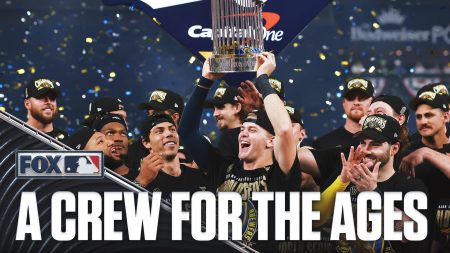



Baseball fans, exhale. The World Series is officially in the books, and the Milwaukee Brewers are champions for the first time in franchise history. That sentence is still strange to type, and if you’re a Brewers fan, you’re probably still walking around with a permanent grin, replaying the final out in your head and wondering if it was all a dream. But the baseball calendar waits for no one. As much as we’d love to keep basking in the glow of October, the hot stove season is already here, and it’s heating up fast. With Nov. 2 officially kicking off free agency, the rumor mill is spinning quicker than a fresh two-seamer, and the league is bracing for a winter full of bold moves and eye-popping contracts. Big names like two-time Cy Young ace Tarik Skubal and Japanese slugger Teruaki Sato are expected to command top dollar, and you can already hear the cash registers ringing in the distance. But before the biggest fish sign, the quieter moves are setting the table. On Friday, Oct. 30, the transaction wire was busy: veteran starter Sonny Gray officially became a free agent, Bo Bichette made a massive financial decision about his future with the Mets, and the Atlanta Braves locked in two of their most important players in Ronald Acuña Jr. and Ozzie Albies. It’s a lot to digest, so let’s take a deep breath and walk through what it all means, because these early decisions often shape the rest of the offseason more than the splashy headlines that follow.
Let’s start with Sonny Gray, because his situation is a perfect example of how strange and wonderful baseball’s winter can be. The veteran right-hander is now a free agent after his previous club decided not to keep him at his current price, instead paying him a $10 million buyout just to walk away. That might sound like an absurd amount of money to spend on a goodbye, but in the grand scheme of baseball’s financial weirdness, it’s the cost of doing business. Gray may be entering his age-37 season, but he’s not pitching like someone who’s ready to slow down. In fact, he just put together one of the best years of his career. He led Major League Baseball with 18 wins, and his 2.72 ERA was the eighth-best among all qualified pitchers. It was also his lowest ERA since his All-Star campaign back in 2015, which tells you just how impressive his 2025 season really was. Even more valuable than the numbers? His durability. Gray has thrown more than 160 innings and made at least 28 starts in each of the last four seasons. In an era where starting pitchers are treated like fragile artifacts and teams are terrified of overworking anyone, that kind of reliability is worth its weight in gold. So yes, he’s older, and yes, there’s some risk. But Gray has proven time and again that he can pitch at a high level, and any contender looking for a steady veteran to anchor the rotation should have him near the top of their list. The buyout stings a little for the team that let him go, but for Gray, it’s just the beginning of an exciting new chapter. He’s not done yet, and he knows it.
Over in New York, Bo Bichette has made his choice, and it’s a decision that will ripple through the entire offseason. The 28-year-old infielder is keeping his contract with the Mets, exercising his player option for a $42 million salary in 2027. This was a huge moment for the Mets and for Bichette, because declining the option would have made him a free agent again, free to test the open market and see if another team was willing to pay even more. But Bichette looked at the uncertain landscape of free agency, looked at the guaranteed money sitting right in front of him, and decided that staying in New York was the right move. It’s easy to understand why. His contract, signed back in January, is a three-year, $126 million deal that includes a $40 million signing bonus, a $2 million salary for 2026, and $42 million player options for both 2027 and 2028. By opting in for 2027, he’s guaranteeing himself another massive payday while also giving himself another year to prove he’s worth every penny. His first season in New York was solid but not spectacular. He hit .260 with 18 home runs and 78 RBIs for a Mets team that was ultimately disappointing, especially given the expectations surrounding the franchise. Those numbers were a noticeable drop from his 2025 season, when he hit .311 with 18 homers and 94 RBIs and helped the Toronto Blue Jays win the American League pennant. Part of that decline might be due to his new role, because Bichette, a two-time All-Star shortstop during his time in Toronto, spent most of his time in New York playing third base. That’s because Francisco Lindor has shortstop locked down, and moving across the diamond is harder than most fans realize. It changes your footwork, your throwing angles, your reads, everything. But Bichette is still young, still immensely talented, and now he’s got a full season of experience in his new surroundings. The Mets are betting he’ll bounce back, and Bichette is betting on himself, which is exactly the kind of confidence you want from a player making $42 million.
Meanwhile, in Atlanta, the Braves are making sure their core stays intact, and honestly, it’s hard to imagine a more sensible way to start the offseason. On Thursday, the team exercised Ronald Acuña Jr.’s $17 million option and also picked up a $7 million option on second baseman Ozzie Albies. For Acuña, this is another chapter in a long and complicated relationship with the Braves’ front office, one that has worked out beautifully for Atlanta. He signed an eight-year, $100 million contract back in 2019, a deal that has become one of the most team-friendly contracts in all of baseball. That agreement included a 2027 option with a $10 million buyout and a $17 million option for 2028 with no buyout. By exercising that $17 million option for 2028, the Braves are keeping one of the most electric players in the game in Atlanta for at least another season. Acuña is a five-time All-Star and the 2023 National League MVP, and when he’s healthy, he’s the kind of player who can change a game with his bat, his legs, and his arm. He’s the type of superstar who makes you buy a ticket just to watch him take batting practice. Albies, meanwhile, has been a steady and beloved presence in Atlanta since signing his own bargain deal in 2019: seven years, $35 million, with $7 million options for both 2026 and 2027. Picking up that option was a complete no-brainer. At that price, Albies provides incredible value, and his energy in the clubhouse and on the field is infectious. Together, Acuña and Albies represent the heart of the Braves’ lineup and the soul of the team. These moves might not make the same headlines as a blockbuster free-agent signing, but they matter just as much. The Braves are signaling that they’re not tearing things down. They’re not rebuilding. They’re doubling down on the core that has made them contenders, and that’s a message that should excite every Braves fan.
Taken together, these moves tell us a lot about the state of baseball heading into the winter. Sonny Gray’s availability immediately changes the pitching market, giving contenders a chance to add a proven veteran without having to surrender prospects in a trade. Bo Bichette’s decision to stay in New York takes one of the biggest potential free-agent names off the board, which means teams looking for infield help will have to look elsewhere, perhaps by trade or by pivoting to other targets. And the Braves’ decision to keep Acuña and Albies is a reminder that not every great team is built through free agency. Sometimes, the smartest moves are the ones that keep your own players from leaving in the first place. But the big splash is still coming, and everyone knows it. Tarik Skubal, with his two Cy Young Awards and electric stuff, is going to be the subject of an intense bidding war. Teruaki Sato, the Japanese slugger with the kind of raw power that makes scouts drool, is going to be courted like a rock star. The free-agent market officially opens on Nov. 2, and by the time it does, every team in baseball will have a plan, a budget, and a list of targets. The Brewers’ World Series win has changed the psychological landscape too. If Milwaukee can finally get over the hump, then why not your team? Expect front offices to be a little more aggressive, a little more willing to take risks, and a little less patient with mediocrity. The hot stove is already warm, and it’s only going to get hotter as the calendar flips to November and the rumors start flying.
So what should we make of all this? For fans, it’s a chance to dream. The offseason is that magical time when every team is undefeated, when every signing looks like a stroke of genius, and when every rumor feels like it could be the one that puts your team over the top. The Brewers are still celebrating their first ever World Series, and they absolutely should be. That’s a moment that fans in Milwaukee have waited a lifetime for, and no amount of hot stove news should distract from it. But for the other 29 teams, the work has already begun. Sonny Gray is a free agent, ready to find a new home and prove he can still pitch at an elite level. Bo Bichette is staying in New York, determined to help the Mets bounce back from a disappointing season and show that his bat still plays at a high level. Ronald Acuña Jr. and Ozzie Albies are staying in Atlanta, where the Braves are keeping their competitive window wide open. The next few weeks will be a blur of signings, trades, and speculation, and there will be surprises, disappointments, and more than a few moves that make us scratch our heads. But that’s the beauty of baseball’s winter. It’s a reminder that hope springs eternal, and that even the most unlikely champions can dream. The Associated Press contributed to this report, but the excitement is all ours. So grab a warm drink, keep your phone close, and enjoy the show. The hot stove is officially on, and this winter is going to be one to remember.