

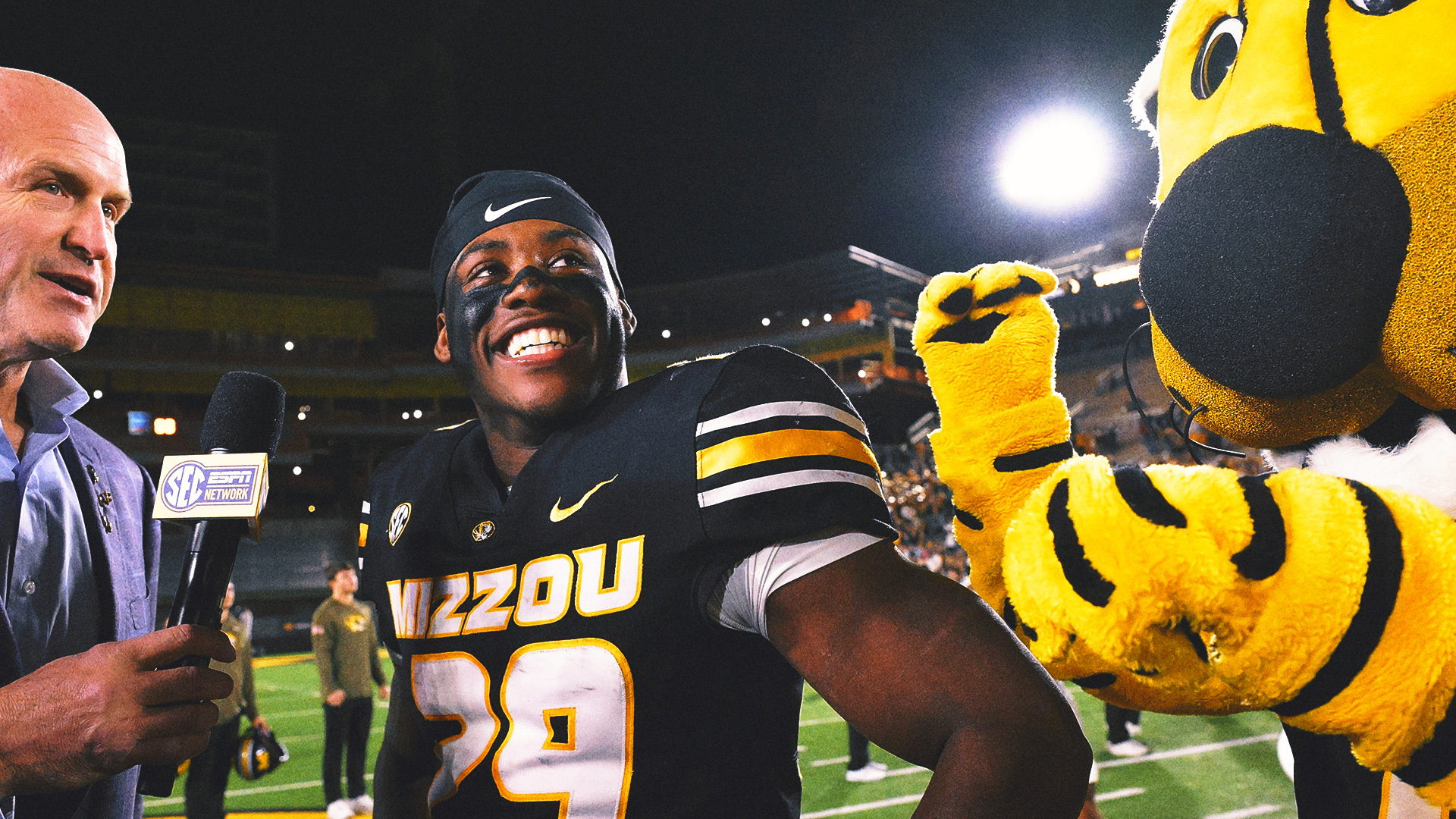
The story of Ahmad Hardy’s season has never been just about football. It began with a moment that no athlete ever wants to face: a gunshot wound over the offseason, a sudden and violent interruption to a life that had been moving at the speed of a touchdown run. In the weeks that followed, there were no victory laps, no highlight reels, no roaring crowds. There was only uncertainty. Missouri fans wondered if they would ever see their star running back burst through a hole again. Coaches spoke carefully about his recovery. Hardy himself stayed quiet, working in the shadows, doing the kind of unglamorous work that does not show up on a stat sheet. And then, on Thursday afternoon, the answer finally arrived. According to a report from ESPN, Hardy will make his season debut on Saturday against the Arkansas Razorbacks. He will not start. He may not play a full complement of snaps. But he will be on the field, in uniform, ready to run. That alone is a victory that no scoreboard can measure.
There is something deeply human about the way Missouri has chosen to bring Hardy back. The Tigers have decided not to rush him. Jamal Roberts will remain the starting running back, a decision that shows respect not only for Roberts’ own contributions but also for the delicate nature of Hardy’s recovery. Hardy is expected to handle a handful of carries, gradually being reintroduced to the speed and violence of SEC football. It is a cautious approach, and yet it is also an exciting one. With Roberts and Hardy sharing the backfield, Missouri now boasts one of the most formidable running back rooms in college football. Defenses will have to prepare for two completely different styles, two runners who can break a game open at any moment. But beyond the tactical advantage, there is something more meaningful here. The coaching staff is telling Hardy that he matters more as a person than as a piece of an offense. They are telling the locker room that health comes first, that a player’s long-term future is more important than a single Saturday afternoon. That kind of trust is not built in a playbook. It is built in the quiet hours of rehab, in the conversations that never make the news, in the shared understanding that the road back from dark places is rarely straight.
To understand why Hardy’s return means so much, it helps to remember just how far he has come in a relatively short time. He transferred from UL Monroe to Missouri in 2024, and what could have been a difficult adjustment to the SEC looked effortless instead. Hardy did not merely survive the jump to one of college football’s toughest conferences; he thrived. Last season, he carried the ball 256 times for 1,649 yards, averaging an astonishing 6.4 yards per carry. He scored 16 touchdowns. He put together one of the most memorable performances of the season when he rushed for 300 yards and three touchdowns in a 49-27 win over Mississippi State. Those are numbers that jump off the page, but they only tell part of the story. Hardy runs with a rare combination of patience and explosiveness, letting blocks develop, waiting for the smallest crack, and then accelerating through it as if the defenders are running in slow motion. He has a way of making the impossible look routine, of turning a simple handoff into a moment that brings an entire stadium to its feet. It is no surprise that he was already being talked about as a top prospect for the 2027 NFL Draft, with the kind of vision and balance that scouts dream about. Yet all of that talent was almost placed on hold indefinitely after a single moment of violence in the offseason.
The recovery from a gunshot wound is not like recovering from a sprained ankle or a pulled hamstring. There is no clear timeline, no reliable formula for healing. The body has to rebuild itself, and the mind has to wrestle with questions that no player should ever have to answer. Hardy likely spent long, lonely hours in treatment rooms and training facilities, pushing his body through exercises that must have felt impossible some days. He had to relearn how to trust his own strength, how to move without fear, how to separate the physical injury from the emotional weight it carries. There were probably mornings when he woke up and wondered if he would ever be the same runner again. There were probably nights when the end zone felt more like a distant memory than a destination. But Hardy kept going. He leaned on the people around him, the trainers who never stopped believing, the teammates who never let him feel alone, the family and friends who reminded him that his identity was never defined solely by what he did between the white lines. That kind of support is invisible in the box score, but it is everything. It is the reason he is not just walking again, but preparing to play football at the highest level. It is the reason that, when he takes the field on Saturday, every step will mean something deeper than yardage.
What makes this moment even more remarkable is that Hardy still has his whole future ahead of him. He has two years of eligibility remaining, which means he has time to make one of the biggest decisions of his life. Naming himself for the NFL Draft would not be a surprise; he is projected as one of the top running backs in the country, with the kind of potential first-round grade that can change a family’s history forever. But after everything he has been through, returning to school for another season might offer him something even more valuable: a full year to prove he is not just back, but better than ever. It would allow him to show scouts that the gunshot wound did not cost him a single ounce of his explosiveness. It would give him time to build even more film, to demonstrate that he can carry a heavy workload, to remind everyone that the player who tore up the SEC last season is still there, waiting to break loose. And because he is so young, Hardy does not have to rush. He can stand at the crossroads of his career with the rarest luxury in sports: time. That is a strange gift to emerge from such a difficult experience, but it is real. He has earned the chance to choose his own path, to weigh the risks and rewards, to decide whether he is ready to chase his professional dreams now or take one more ride with the Tigers.
On Saturday, when Missouri takes on Arkansas, there will be plenty of storylines to follow. There will be the conference implications, the rivalry emotions, the usual chaos of a college football afternoon in the SEC. But for a certain set of fans, for the people who have followed Ahmad Hardy’s journey, the most important moment will come when he gets his first carry. It might not happen right away. It might not be a long run or a touchdown. But at some point, the ball will find him, and the stadium will hold its breath. A defender will come into the gap, and Hardy will plant his foot, cut, and accelerate. In that split second, all the months of uncertainty, all the pain, all the quiet work in empty gyms, will dissolve into the pure and simple joy of a player doing what he loves. We watch sports for moments like this. We watch because they remind us that the human spirit is stubborn, that healing is possible, that a terrible chapter can become the opening of a new one. Ahmad Hardy does not need to rush for 300 yards on Saturday to make his return a success. He has already accomplished something far greater. He made it back. And in a world where so much is uncertain, that is worth celebrating.