

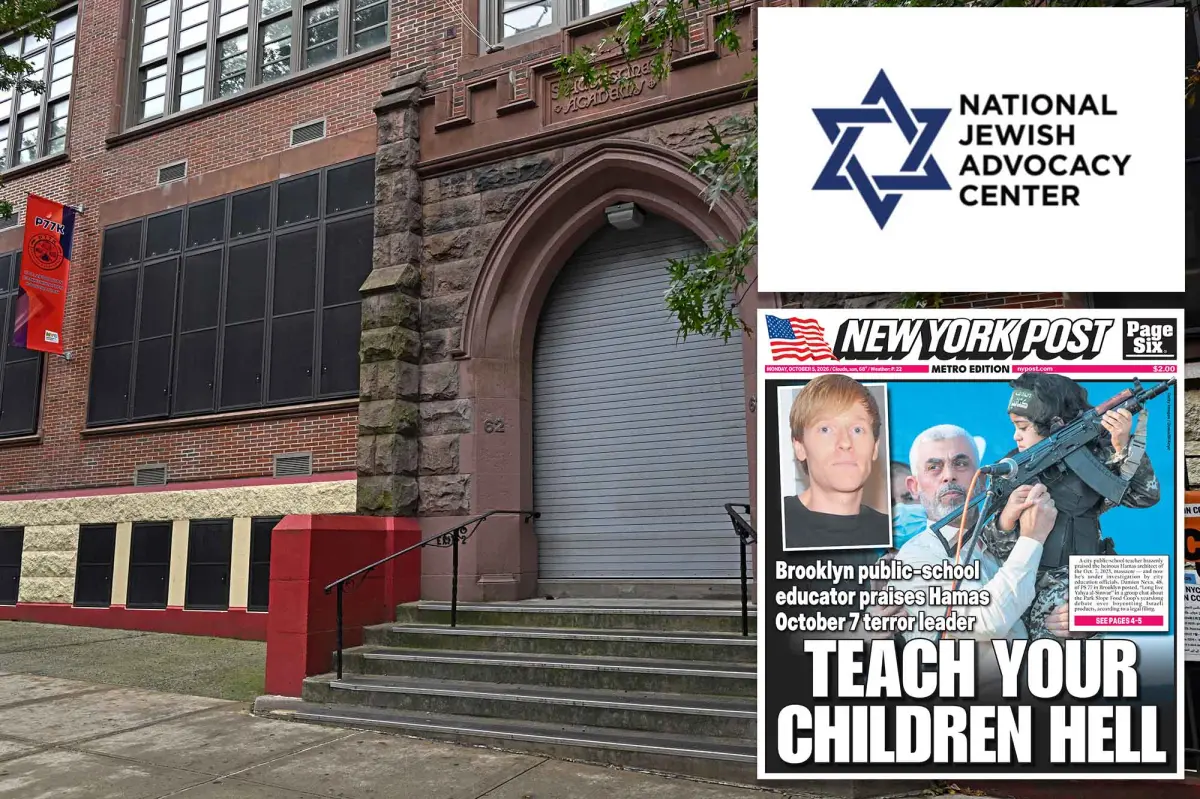
Inside New York City’s public schools, a quiet but devastating exodus is taking place. It is not happening because of test scores or school closures, though those matter. It is happening because many Jewish families say they no longer feel safe sending their children into classrooms where hatred has been allowed to grow. The National Jewish Advocacy Center has now asked the Trump administration’s Justice Department to investigate the city Department of Education over this crisis. The request, filed Monday with Assistant Attorney General Harmeet Dhillon, who leads the Civil Rights Division, comes after a series of New York Post reports beginning in the aftermath of the Oct. 7, 2023 terror attacks on Israel. For more than two years, Jewish parents have watched with alarm as antisemitic incidents surfaced in schools across the city. They have heard stories about teachers making inflammatory comments, students targeting Jewish classmates, and a system that seemed unwilling or unable to stop it. The result is visible in enrollment data: Jewish day schools and yeshivas are growing while public school numbers are falling. But behind those cold statistics are real families making painful choices. They are choosing between the education their tax dollars already pay for and the safety of their children’s hearts and minds. They are choosing between staying to fight an overwhelming problem and leaving to protect their kids from further harm.
The complaint filed by the National Jewish Advocacy Center is more than a list of grievances. It is an offer of proof. According to the letter, parents of Jewish children who attend or were driven from the city’s public schools are prepared to be interviewed by federal investigators, and so are Jewish employees of the Department of Education. That willingness matters because it signals that this is not a rumor or a political talking point. It is a lived reality for people who will sit down and describe, in detail, what happened to them and to their children. The Justice Department is not starting from scratch. There are already two federal probes into the city’s public school system. In April, the Trump administration’s Education Department opened a civil rights investigation into the DOE concerning a group called NYC Educators for Palestine. That group, made up of educators, was accused of organizing lessons “focused on ‘Palestine, Zionism, and Resistance’” — lessons that critics say crossed the line from politics to anti-Jewish indoctrination. At the time, Kimberly Richey, the Education Department’s assistant secretary for civil rights, made a statement that captured the issue in one sentence: “No child should be taught by his or her teachers to hate their peers.” Those words resonate deeply with parents who feel that exactly what Richey warned against has become routine. In addition to that probe, a separate federal civil rights investigation into the DOE under a “shared ancestry” legal theory has been underway since November 2023. The fact that these investigations already exist suggests that the concerns raised by the new complaint are not isolated or exaggerated. Yet they also highlight how slow the wheels of justice can move when children are being harmed in the meantime.
The new letter points to specific incidents that illustrate the problem in vivid, alarming detail. It cites a report by United Jewish Teachers, a group of Jewish educators employed by the city’s public schools, which claimed in August that there had been at least 250 antisemitic and anti-Israel incidents in schools since Oct. 7, 2023. That number is not just a tally. Each incident is a moment in which a student was made to feel less than human, a moment when a teacher crossed a professional and moral line, a moment when the promise of public education collapsed into something unrecognizable. One case that has drawn particular attention is that of Damien Neva, a teacher at PS 77 in Park Slope, Brooklyn. According to a legal filing, Neva brazenly posted in a 2024 Signal group chat, “Long live Yahya al-Sinwar.” Al-Sinwar was the Hamas leader who orchestrated the Oct. 7 massacre — a terrorist responsible for the murders of Israelis and the kidnapping of civilians. For a teacher to celebrate such a person is not just offensive; it is a direct betrayal of the trust placed in educators. Then there is George Trim, a social studies teacher at IS 181 in Bath Beach, Brooklyn. Trim was reportedly disciplined for telling students that Larry Silverstein, the owner of the World Trade Center, knew in advance that the Sept. 11, 2001 attacks were coming and did nothing to stop them. That kind of anti-Jewish conspiracy theory, delivered by an educator to young people, does enormous damage. It plants seeds of suspicion and hatred in minds that should be opened to knowledge, not poisoned by prejudice.
The consequences of these incidents are measurable in attendance records and enrollment numbers. The letter notes that enrollment in Jewish day schools and yeshivas in New York State rose by 3,115 students in the 2025-26 school year. In New York City alone, the increase was 1,587 students. Meanwhile, nonpublic enrollment overall fell. What is happening is not a general shift toward private schools — it is a specific move away from public schools by Jewish families. The numbers tell a story that no statement of support from city officials can erase. Behind each enrolled student at a yeshiva or Jewish day school, there is likely a parent who made a difficult calculation. That parent may have asked themselves: Can I send my child back to a school where a teacher glorified a terrorist? Can I force my child to sit in a class where the Holocaust is discussed as if it were ancient history and then walk through a hallway where a classmate mutters something about Jews? For many families, the answer is no. They are choosing to sacrifice financially, to stretch budgets, to commute farther, and to prioritize safety over convenience. They are making these choices not because they want to isolate their children from the world, but because the world has shown that it will not always protect their children from hatred. The increase in Jewish day school enrollment is a vote of no confidence in the New York City public school system, and it is a vote that has been cast loudly and clearly.
Mark Goldfederr, the CEO of the National Jewish Advocacy Center, has made it clear that this is not a moment for half measures. He said the Justice Department’s power is needed to clamp down on Jew-hatred. His language is direct because the situation, in his view, is urgent. The department has responded, at least in general terms. A spokesperson said, “The Department takes allegations of antisemitism seriously and is committed to enforcing federal civil rights laws that protect students from discrimination.” That statement is reassuring in its wording, but it leaves many questions unanswered. Will the department actually subpoena records? Will it interview the parents and employees who have volunteered to speak? Will it use its authority to impose consequences on the Department of Education if violations are found? The commitment to investigate is only meaningful if it leads to action. For parents who have already left the public schools, the investigation may come too late. For those still inside, it offers a glimmer of hope that someone in Washington is willing to stand up for them. But there is also a quiet fear that this could become another report that sits on a shelf, another process that drags on for years, another promise that fades into bureaucratic silence. Goldfederr’s plea reflects the exhaustion of a community that has repeatedly said the same thing: protect our children. The Justice Department has the legal tools to do exactly that, but it must choose to use them with seriousness and speed.
In the end, the most telling response may be the one that did not come. The city Department of Education and the office of Mayor Zohran Mamdani did not immediately respond to a request for comment. That silence speaks volumes. When a federal civil rights complaint names a city agency as a place where antisemitism has flourished, a response is not optional. The families involved deserve more than radio silence. They deserve an acknowledgment of their pain, a statement of what will be done, and a commitment to change. The lack of any public reaction from the city suggests that either officials do not understand the severity of the crisis or they hope it will fade from the news cycle. For Jewish parents, that silence is painfully familiar. It echoes the experience of filing a complaint with a school principal and hearing nothing. It echoes the experience of calling a district office and being transferred from one voicemail to another. The National Jewish Advocacy Center has now taken the issue to the federal level, but the ultimate responsibility lies not only with Washington. It lies with the city that claims to welcome all children and to value diversity, tolerance, and inclusion. Those words ring hollow if they do not protect Jewish students from hatred in their own classrooms. The investigation requested by the advocacy center is a test of whether civil rights laws truly apply to everyone. It is also a test of whether New York City is willing to look at itself honestly and do the hard work of rooting out antisemitism from its schools. Until that happens, the exodus will continue, and every empty desk in a public school classroom will be a reminder of a promise that was broken.