


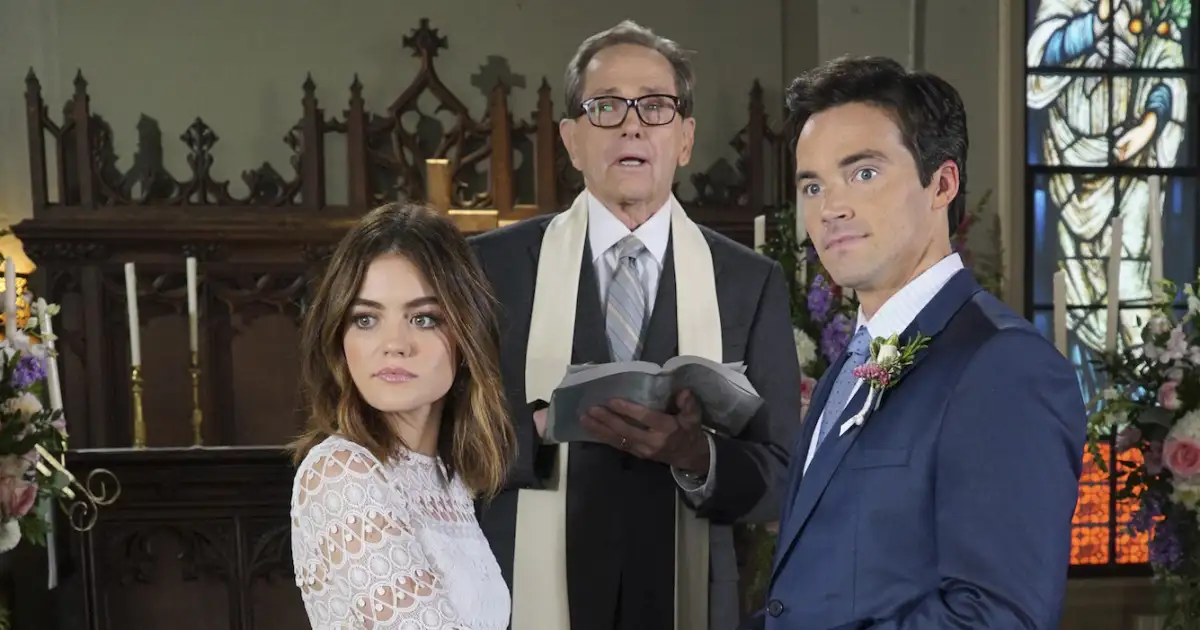
There is a strange thing about growing up with a television show. The characters become familiar, almost like friends, and the moments between them stay with us in ways we do not always understand. For a generation of viewers, Aria Montgomery and Ezra Fitz from Pretty Little Liars were exactly that kind of couple. Their first meeting was electric, charged with the kind of tension that made the show impossible to switch off. It was romantic, dangerous, and deeply exciting, at least at the time. So when Lucy Hale and Ian Harding, the actors who played those characters, decided to recreate that first scene and post it online, it is easy to see why they might have expected a wave of nostalgic excitement. Hale, now 37, uploaded a video on Saturday, October 24, showing Harding, 40, lifting her up in a careful, frame-by-frame recreation of the moment Aria and Ezra first locked eyes in the high school classroom that launched their tangled love story. Her caption was playful and warm: “A little older and wiser but the same two idiots!” She then teased their upcoming holiday film, 12 Dates of Christmas, promising fans that information was coming very soon. It all felt light and celebratory, a reunion between two old friends who had shared something special. But the comments section quickly told a different story. The backlash was immediate and forceful, and it centered on one uncomfortable truth: Aria and Ezra, as a couple, did not age well. Their romance was not a beautiful taboo. It was a relationship between a teenage girl and her adult teacher, and many people were not willing to let that slide just because the actors were smiling in a nostalgic video.
The criticism was not born out of nowhere. In the years since Pretty Little Liars ended in 2017, the cultural conversation around on-screen relationships, especially those involving power imbalances, has shifted dramatically. Ezra was a high school English teacher, and Aria was his student, a teenager when their relationship began. What once felt like a thrilling secret was now, to many eyes, a textbook example of grooming and predatory behavior. The show had framed it as a romance, complete with literary references, stolen glances, and a soundtrack that told viewers to swoon. But the sharpened lens of a more aware audience saw something else entirely. Hale did not ignore the backlash. In a follow-up video posted the next day, Sunday, October 25, she addressed it head-on with the kind of honesty and composure that is rare in celebrity crisis management. She admitted that she was seeing the comments, and she did not defend the relationship between Aria and Ezra. “I just want to say that two realities can be very true,” she said. “It’s very obvious that Aria and Ezra is problematic and it did not age well. And that can be very true.” But she went on to explain that the video was never meant to promote or glamorize that relationship. It was about something else entirely: the friendship between two young actors who met as teenagers and became close almost immediately. They have known each other for nearly twenty years. The video, in her telling, was not an endorsement of an inappropriate romance, but a celebration of a real and lasting friendship. In making that distinction, Hale was asking audiences to hold two complicated truths at once: that the fictional relationship deserved criticism, and that the real relationship between the actors deserved celebration.
That kind of nuance is difficult to maintain in a world that often demands simple moral judgments. And yet Hale has been remarkably consistent in her willingness to sit with the discomfort. In a recent interview with The Hollywood Reporter, she reflected on how her own understanding of the storyline has changed over the years. She was only 19 when she was cast as Aria, a young woman barely out of her own teenage years, stepping into a role that would define her career. At the time, she said, she was not thinking about the larger themes or the social implications of a teacher falling for his student. She was just grateful to have been cast in a television show. She was excited, hopeful, and focused on the work. But now, as a woman in her late thirties, she sees the story differently. It “hits differently,” she said. She thinks more carefully about the messages in the roles she chooses to play. And yet, notably, she does not express regret. She still stands by Aria and Ezra’s love story, describing it as a forbidden romance that drew a lot of people in. That may seem contradictory, but it is also deeply human. She is not asking anyone to agree with her. She is simply acknowledging that her relationship to the character and the story is complicated, shaped by her own history and by the people who loved the show for reasons that were never entirely about the ethics of the central romance. It was about mystery, friendship, danger, and the strange comfort of a fictional world that helped so many feel less alone.
Ian Harding, who played Ezra, has similarly wrestled with the legacy of the storyline, and his perspective adds another layer to the conversation. In the same interview, he acknowledged that the relationship was “deeply problematic” and “certainly not great at the time.” He did not try to pretend otherwise. He recognized that society has progressed, and with that progress has come a clearer understanding of how “wildly inappropriate” the dynamic was. But he also spoke about the experience of playing Ezra with genuine affection and care. As an actor, he explained, you have to advocate for the character you are playing, no matter how flawed they are. You have to find the humanity in them. He noted that the relationship between Ezra and Aria was always meant to be “purposely taboo,” a deliberate choice by the writers to play into a fantasy rather than to model healthy behavior. He even acknowledged his own teacher fantasy from high school, but he was careful to argue that depicting something on television does not mean condoning it. The show was a thriller, full of twists and horror and heightened drama, and the romance was just one piece of that puzzle. What seemed to give him some peace, looking back, was the belief that the relationship between Ezra and Aria, despite its deeply improper beginning, became a kind of safe haven in the storm of the show’s chaos. There was plenty of pain and horror everywhere else, but their connection, at least in the fictional world they inhabited, seemed to bring them both happiness. It was a strange justification, perhaps, but a sincere one. He loved those characters, and he could not bring himself to reduce them to a single moral failing.
The heart of this entire story is not really about whether Aria and Ezra should be celebrated. It is about how we hold both joy and criticism in the same hand without letting either one cancel out the other. Lucy Hale and Ian Harding are not the characters they played. They were young people trying to build careers, navigating the strange and often brutal pressures of teen stardom, and finding in each other a friendship that has lasted decades. When they recreate a scene, they are not saying that the romance was healthy or admirable. They are saying, look how far we have come. Look at what we survived. Look at the bond that was formed in that strange, intense, life-altering experience. The backlash against them, however understandable, sometimes forgets that the people in front of the camera are more than the roles they played. They are also the products of an industry that handed them complicated material and asked them to make it work. This does not mean the criticism is wrong. It is entirely fair to ask why television so often romanticized age-gap relationships, especially those involving authority figures and minors. It is fair to wonder about the messages that were sent to young audiences who watched and learned to see such dynamics as romantic. But it is also fair for actors to have complicated feelings about the work they did, especially when they did it at an age when they were barely adults themselves. Hale and Harding are carrying both of those truths in public, with grace, humor, and a willingness to talk about it openly. That deserves recognition, not just because they are celebrities, but because it is a genuinely difficult thing to do.
In the end, this small controversy is just one chapter in a much larger cultural story about how we look back at the media we once loved. We are learning to ask harder questions about the shows, movies, and books that shaped us, and we are learning to acknowledge the harm in them without always throwing away the love. The video that sparked this conversation was meant to promote a new holiday film, 12 Dates of Christmas, which reunites Hale and Harding in a far less complicated context. There is something fitting about that. They have moved on. They have grown up. They have found new ways to work together and new stories to tell. They are no longer teenagers, and the world is no longer the same as it was when Pretty Little Liars first aired. The show will always be tangled up in its problems, and Aria and Ezra will always be a subject of debate. But Lucy Hale’s response reminds us that people are not their worst mistakes, and that a story can be both problematic and personally meaningful at the same time. As she put it, two realities can be very true. The same can be said for the show, for the actors, and for the fans who grew up watching them. We can acknowledge the harm in what we once loved without pretending that the joy was not real. We can be older and wiser, as Hale said in her caption, without condemning the version of ourselves that loved something imperfect. That, perhaps, is the most human response of all.