


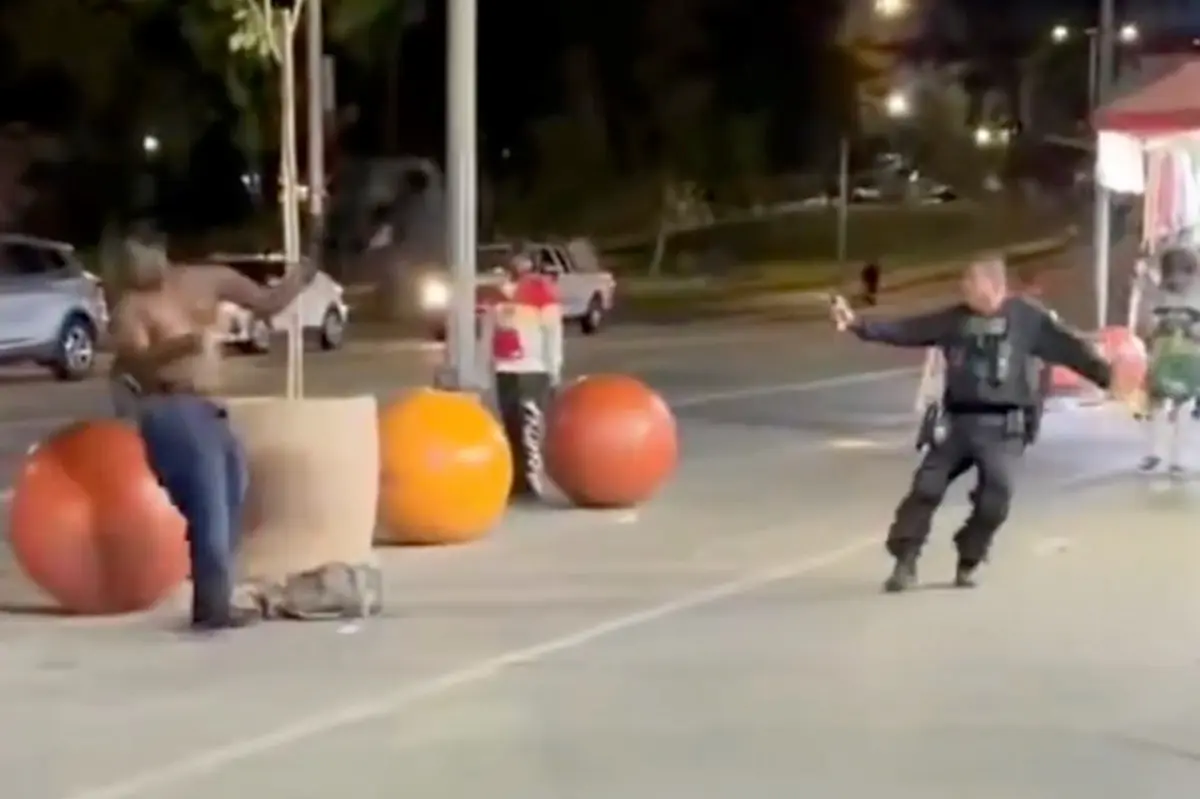
It was supposed to be an ordinary Sunday night in Los Angeles, the kind of evening that most people would spend at home, maybe watching a movie, maybe getting ready for the week ahead. But for Republican gubernatorial hopeful Steve Hilton, an ordinary night in LA was anything but calm. As his camera crew rolled in an area he called “fentanyl alley,” the former Fox News host found himself in the middle of raw, unfiltered chaos. A shirtless man, wild-eyed and unpredictable, was locked in a violent struggle with a security guard just feet away from where Hilton stood. The man seemed unstoppable, thrashing and swinging, while the guard tried desperately to subdue him. Hilton, rather than stepping back or turning off the camera, used the moment to make a point. “We’ve just been filming in fentanyl alley,” he said, his voice carrying a mix of horror and frustration. “No city should have a fentanyl alley. No city should have this kind of chaos. We got to have a change in California.” The video, posted to his X account, was accompanied by a blunt caption: “This is the kind of chaos everywhere.” For Hilton, this wasn’t just a random street fight; it was a symbol of everything broken in California, a visceral, ugly reminder that the state’s problems have become impossible to ignore, even for a political candidate trying to film a campaign video.
The scene in Los Angeles is one that many Californians recognize, even if they haven’t seen it with their own eyes. They’ve heard the stories about tent encampments sprawling along freeways, about sidewalks turned into open-air drug markets, about people lost to addiction and mental illness with nowhere to turn. Hilton’s video, though graphic and unsettling, spoke to a deep sense of grievance that has been building for years. He didn’t need to explain what the shirtless man was fighting for or why the security guard was there. The image told its own story. And Hilton, who has made clearing homeless encampments a central pillar of his campaign, saw it as undeniable evidence that the state’s current approach is failing. His plan is aggressive and, to some, controversial. He has pledged to clear every homeless encampment in California by the end of next year, a promise that seems almost impossible given the scale of the crisis. But Hilton insists that it can be done, and he says he will not wait around for excuses. In his first month as governor, he says, he will sit down with mayors and county leaders from across the state and set public deadlines. Local leaders would have until Labor Day 2027 to make significant progress, and the final deadline would be Dec. 31, 2027, after which no encampment would be allowed to remain. For Hilton, this isn’t a bureaucratic issue; it’s a moral one. He talks about the chaos he saw on that Sunday night not as an isolated incident, but as a warning of what happens when leaders refuse to act, when compassion is mistaken for a failure to enforce basic standards of decency and safety. His critics might call his plan harsh or unrealistic, but to many voters who are tired of living in fear, it sounds like leadership.
Yet Hilton isn’t just running on a message of anger and law-and-order. He wants to show Californians what the future could look like if he gets his way, and he’s using the latest technology to do it. On the same Sunday that he filmed the fight in fentanyl alley, Hilton released an AI-generated campaign ad that painted a strikingly different picture of the state. The ad, which he described as a vision of California two years into a hypothetical Hilton administration, opens with a transformed Skid Row. Gone are the tents and the despair. In their place, Hilton imagines a luxurious destination reminiscent of Rodeo Drive, complete with cherry blossoms drifting through the air and fine dining establishments lining the streets. It’s a jarring image, almost surreal in its optimism, but that’s the point. The ad also shows the Third Street Promenade in Santa Monica, once a vibrant shopping district and now a struggling shadow of its former self, bustling with shoppers again. Families are back on the road, gas prices have fallen dramatically to $3 a gallon, and there is a sense of normalcy and prosperity that has been missing for years. In Hilton’s telling, even the iconic California bullet train, which he calls a “failed promise,” gets a new lease on life. The project, long plagued by cost overruns and delays, becomes part of a brighter future rather than an endless source of frustration. The contrast between the two videos is deliberate and powerful. One shows a present that feels hopeless, while the other presents a future that feels almost too good to be true. But Hilton isn’t embarrassed by the optimism. In fact, he seems to think that dreaming big is exactly what California needs. After years of headlines about homelessness, crime, and unaffordability, he wants to give people something to believe in, even if that dream has to be generated by artificial intelligence.
Beyond the ads and the dramatic street footage, Hilton has a long list of policy promises that he hopes will appeal to everyday Californians struggling to make ends meet. He has proposed making the first $150,000 of income completely tax-free, a move that would put more money into the pockets of working families immediately. He has also promised to cut electricity bills in half, tackling the state’s notoriously high energy costs that have become a burden for both homeowners and small businesses. Gas prices, which have made California a punchline for years, would be brought down to $3 a gallon, a target that seems almost unthinkable given the current cost of fuel. And then there’s the California Department of Motor Vehicles, the agency that has become synonymous with long lines, confusing paperwork, and bureaucratic inefficiency. Hilton wants to abolish it entirely, and while he hasn’t spelled out exactly how a new system would work, the promise resonates with anyone who has spent an afternoon waiting for a driver’s license renewal. Earlier in the week, he also vowed to suspend California’s carbon market, calling it “a disaster of a program.” That stance puts him at odds with the state’s environmental establishment, but Hilton argues that the program is driving up costs for consumers without delivering meaningful results. For Hilton, these policies are not just a grab bag of campaign pledges; they reflect a broader philosophy that the government has become too big, too expensive, and too out of touch with the people it is supposed to serve. He seems to understand that many voters don’t care about ideological labels or political alliances. They care about whether they can afford groceries, whether they can fill up their cars, whether they can keep their lights on, and whether they can go for a walk without stepping over someone struggling in the street. His message is simple: California can do better, and he knows how to make it happen.
Of course, Hilton is not running in a vacuum. The fight to succeed Governor Gavin Newsom is shaping up to be one of the most consequential elections in California’s recent history, and Hilton is facing Democratic candidate Xavier Becerra, a seasoned politician with deep roots in the state’s establishment. The contrast between the two men could not be sharper. Becerra represents continuity, an experienced hand who promises build on California’s progressive legacy. Hilton, by contrast, is something else entirely. He is a former British political adviser, an outsider to California’s political scene, and a candidate who seems to relish pushing buttons and breaking conventions. His background as a Fox News host has made him a familiar face to conservative audiences, but he is trying to expand his appeal beyond the Republican base by focusing on issues that cross party lines. Homelessness, public safety, and the cost of living are problems that affect everyone, regardless of how they voted in the last election. Hilton’s willingness to walk through fentanyl alley, rather than study it from a distance, shows that he is willing to see the state’s problems up close. And his use of AI and social media suggests a campaign that is willing to embrace the future, even as its message is rooted in a nostalgic vision of what California used to be. The election, scheduled for Nov. 3, will ultimately be a test of how far frustration has gone and whether voters believe that a radical break from the status quo is worth the risk. Hilton is betting that they do. He is betting that Californians are tired of hearing the same excuses, tired of waiting for solutions that never come, and tired of accepting chaos as a normal part of daily life. He wants to be the candidate who finally says the quiet part out loud: that California’s crisis is not inevitable, that it can be fixed, and that it starts with refusing to look away.
In the end, the image of Steve Hilton standing in fentanyl alley, watching a shirtless man fight a security guard, may be the defining metaphor of this campaign. It is not a polished campaign ad or a carefully crafted policy paper. It is raw, messy, and deeply unsettling, but that is exactly what makes it so human. We live in an era when political leaders often seem detached from the struggles of ordinary people, speaking in vague platitudes and focusing on poll-tested messages. Hilton’s video was none of those things. It was an honest, unfiltered snapshot of a city in crisis, captured at ground level. Some might say that Hilton was exploiting a moment of suffering for political gain, and there is certainly a cynical reading to be made. But there is also something undeniably compelling about a politician who puts himself in the middle of the action and demands change. “No city should have a fentanyl alley,” Hilton said, and that simple sentence, born out of a chaotic Sunday night, captures the frustration of millions. Whether Hilton can win the governorship and deliver on his ambitious promises remains to be seen. The deadlines he has set for clearing encampments, the tax cuts he wants to enact, and the bureaucratic agencies he wants to eliminate are all easier said than done. But his campaign has struck a nerve because it speaks to a fundamental human desire for safety, prosperity, and normalcy. We all want to live in a place where we can walk down the street without feeling like we are in a war zone. We all want to believe that the future can be better than the present. Hilton is offering that belief, wrapped in a mixture of anger and hope. Whether voters accept his vision will ultimately determine whether California chooses to double down on the politics of the past or embrace the possibility of a radically different future. For now, the image remains: a man, a camera, and a city in chaos, waiting for someone to make things right.