


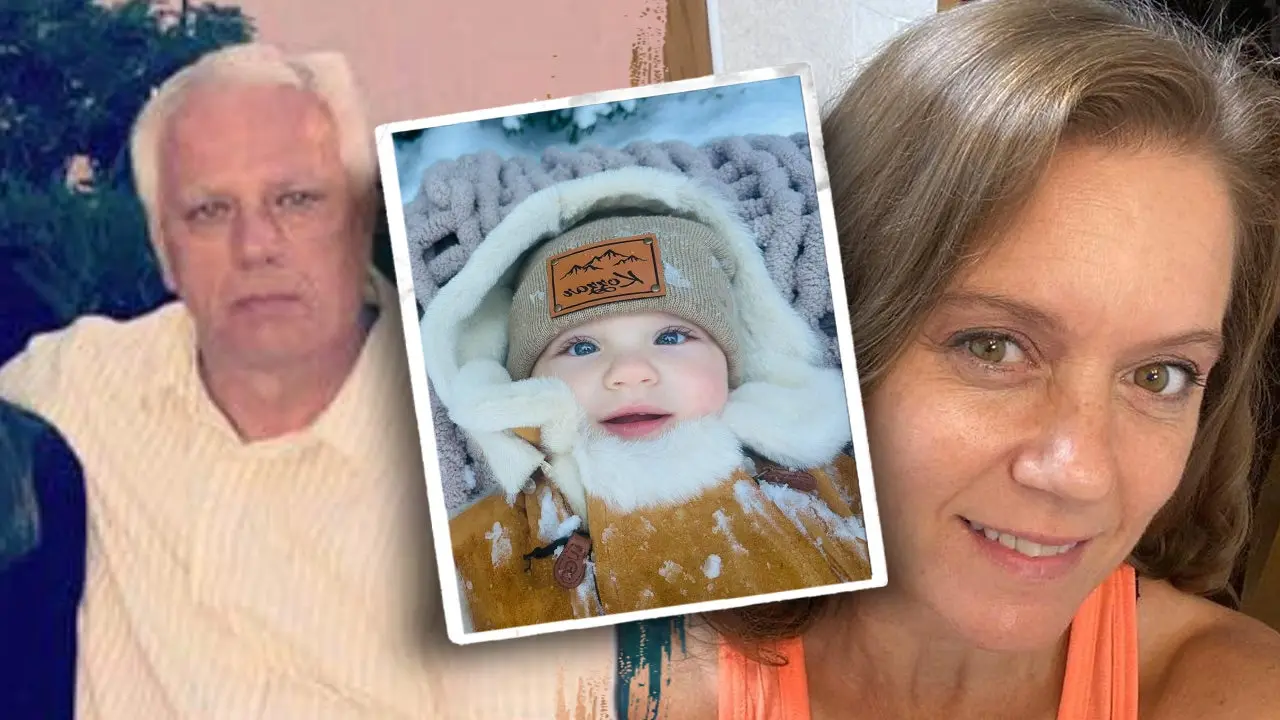
The town of Gnadenhutten, Ohio, is not the kind of place where tragedy arrives with warnings. It is a small, close-knit community in Tuscarawas County, the kind of town where neighbors look out for one another, where the streets are quiet, and where the biggest news usually involves a local fundraiser or a high school ballgame. But on a recent Wednesday morning, that quiet was shattered by a single, faint cry for help. According to the Tuscarawas County Sheriff’s Office, deputies received a 911 call from a home on Cherry Street. When dispatchers attempted to call the number back, someone picked up and softly whispered the word “help.” It was the kind of call that suggests desperation, urgency, and fear—but also a voice that was barely there, perhaps too weak or too terrified to say more. That whisper guided first responders to a scene no one could have prepared for. Inside the residence, deputies discovered the bodies of three people: a 22-month-old boy, his grandmother, and his grandfather, all dead from apparent gunshot wounds. The names released by the coroner’s office have left the community reeling—little Kozzar Lotut, just shy of his second birthday; Melissa Campbell, 51, a registered nurse who spent her career caring for others; and Gale Sanders, 67, a grandfather who, along with Melissa, had taken on the important and loving role of raising Kozzar. Sheriff Orvis L. Campbell told reporters that the evidence is “definitely leaning towards a murder-suicide” and that the events “happened within the home.” But such a clinical phrase does little to capture the heartbreak of a home that held a baby, his guardians, and the shattered remnants of a family’s dreams.
The victims were not just statistics or names on a police report. Kozzar was a 22-month-old child who, according to Sheriff Campbell, had “medical disabilities” and was being cared for by his grandparents. The love required to care for a child with special needs is immense—it takes patience, dedication, sacrifice, and an unshakable devotion that goes beyond ordinary caregiving. Melissa Campbell and Gale Sanders had assumed that responsibility, opening their home on Cherry Street to the little boy. Melissa, in particular, appeared to embody compassion in her professional life. She worked as a registered nurse at New Philadelphia Health Care Center, a facility that provides care for elderly and vulnerable residents. It is impossible not to think about the irony and tragedy of a woman who spent her days tending to the sick and the weak, only to meet such a violent and sudden end alongside the grandson she loved. For a small town, the death of a caregiver and her husband is already a shock; the death of their grandson makes it nearly unbearable. Children are supposed to be protected by the adults around them. Grandparents are supposed to be the safe harbor, the generation that shields the youngest from harm, that offers unconditional love and the wisdom that comes from having lived long enough to know what really matters. In that home on Cherry Street, that promise was broken in the most unimaginable way. And while no one outside the family can fully comprehend what led to that moment, the absence left behind will be felt for years—not just in the hallways of the sheriff’s office or the coroner’s lab, but in the hearts of everyone who knew them.
The details surrounding the discovery of their bodies have added an extra layer of grief and confusion. The initial 911 call was difficult to trace, according to authorities. The caller had dialed and hung up, leaving dispatchers with no clear location and no clear indication of what had happened. But they kept trying, calling back again and again. When someone finally answered and spoke that single, haunting word—“help”—dispatchers knew this was not a prank. It was a signal, perhaps the last ounce of energy from someone inside a nightmare. Through painstaking investigative work, deputies were able to trace the call to the home on Cherry Street. When they arrived, they were met by the child’s great-grandmother, who opened the door and allowed investigators inside. One can only imagine the scene: the great-grandmother standing at the doorway, perhaps in a state of shock, trying to process how the morning had turned so dark, and then leading the deputies into the room where her daughter, or daughter-in-law, and her beloved family now lay silent. The bodies of the three victims were transported to the Tuscarawas County Coroner’s Office for autopsies, where the manner and cause of death are still listed as “pending.” That official language means that for now, the final explanations remain locked in the evidence, waiting to be carefully examined by pathologists and investigators. The Sheriff’s Office stated that additional information will be released as it becomes available and as appropriate, but for a community that demands answers, the waiting is the hardest part. There are questions that autopsies may never answer: Why did this happen? Could anything have been done to stop it? How does a family overcome a loss this profound?
In the days since the discovery, Gnadenhutten has been forced to confront the fragility of life in a way that nothing in the town’s recent history could have prepared it for. This is a community that has weathered hard times before—its name itself evokes the Moravian missionaries who settled there in the eighteenth century, and the town has been through its share of historical heartbreak. But the death of a child resonates in a way that is uniquely agonizing. Parents in the town are holding their own children a little closer. Neighbors are looking at each other with worried eyes, wondering if there were signs they should have noticed, moments of despair that were hidden behind closed doors. The fact that Melissa Campbell was a nurse only intensifies the tragedy, because nurses are seen as healers, as the people who save lives and bring comfort in the worst moments. To know that she died in her own home, the place where she should have been safest, is a betrayal of that image. New Philadelphia Health Care Center, where she worked, is operated by American Medical Administrators, and the facility has not immediately responded to public inquiries. But the quiet that surrounds the tragedy is not unusual; in small towns, grief often manifests as a kind of stunned silence, a collective holding of breath. Businesses may still open, and mail may still be delivered, but everything feels different. The Cherry Street home, once the site of birthdays and bedtime stories, of medical appointments and morning routines, now stands as a place of sorrow. It will be remembered by the community not just as a crime scene, but as the place where a baby’s life was cut short, where a family was extinguished in a single flash of violence, and where a great-grandmother’s world collapsed around her.
Murder-suicides are among the most difficult tragedies to comprehend because they involve not only death but betrayal—the betrayal of trust, of love, of the fundamental responsibility that family members owe to one another. Experts have long noted that domestic violence, financial strain, mental illness, and extreme isolation can all play roles in such tragedies, yet they rarely explain them fully. If the sheriff’s preliminary assessment holds true, this case will be added to a growing and grim list of family annihilation events that have plagued the nation. According to organizations that track such incidents, murder-suicides account for a small but devastating percentage of violent deaths, and they often leave no survivors to tell the full story. What is left are questions, and sometimes those questions must be faced by the very people who were closest to the victims. In this case, there may be a family member who carries the unbearable weight of having lost a daughter, a son, a nephew, a cousin. The great-grandmother who opened the door to investigators is now, presumably, a woman without a grandchild in her daily life, without the small smiles of a toddler with medical disabilities, without the steady presence of relatives who helped make her own life fuller. There is no way to measure that loss. All that the community and the investigative team can do is proceed with care, with dignity, and with the understanding that every piece of evidence represents a human story. The Tuscarawas County Sheriff’s Office is continuing its investigation, and Fox News Digital has reached out to the appropriate agencies and facilities for further comment. But the public must also remember that behind those updates and autopsies are real people who have lost everything.
As the investigation moves forward, the memory of Kozzar, Melissa, and Gale deserves more than just the label of a murder-suicide. They were a family. They had a home. They had routines and rituals, inside jokes and shared meals. Melissa Campbell was a woman who had chosen a career rooted in helping others, someone who likely spent her shifts comforting frightened patients and supporting their families. Gale Sanders was a grandfather, a man who may have spent his afternoons playing quietly with Kozzar, watching over him with the patience that grandparents possess and that parents sometimes lose. And Kozzar was an innocent child—22 months old, with a whole lifetime of firsts ahead of him: first steps, first words, first days of school, first friendships. His life, though short, was meaningful because he was loved by a grandmother and grandfather who devoted themselves to his care, including the care that came with his medical disabilities. It is impossible to know what happened in those final moments, and it is not our role as outsiders to assign blame or to pretend to understand the complexities of a family’s private struggles. What we can do is honor the victims by remembering that this is not merely a crime story; it is a human tragedy. It is a reminder that even the most ordinary homes can hold hidden pain. It is a call to check on the people we love, to ask if they are okay, and to take seriously the signs of distress that are often hidden behind a smile or a closed door. In the end, the whisper of the word “help” is what brought the world into that home. It was a final plea that could not save them, but it should remind all of us that help is something we can offer before it is too late. The little town of Gnadenhutten will mourn for a long time, but in that mourning, there is the hope that the lives and stories of Kozzar, Melissa, and Gale will not be forgotten.