


1.
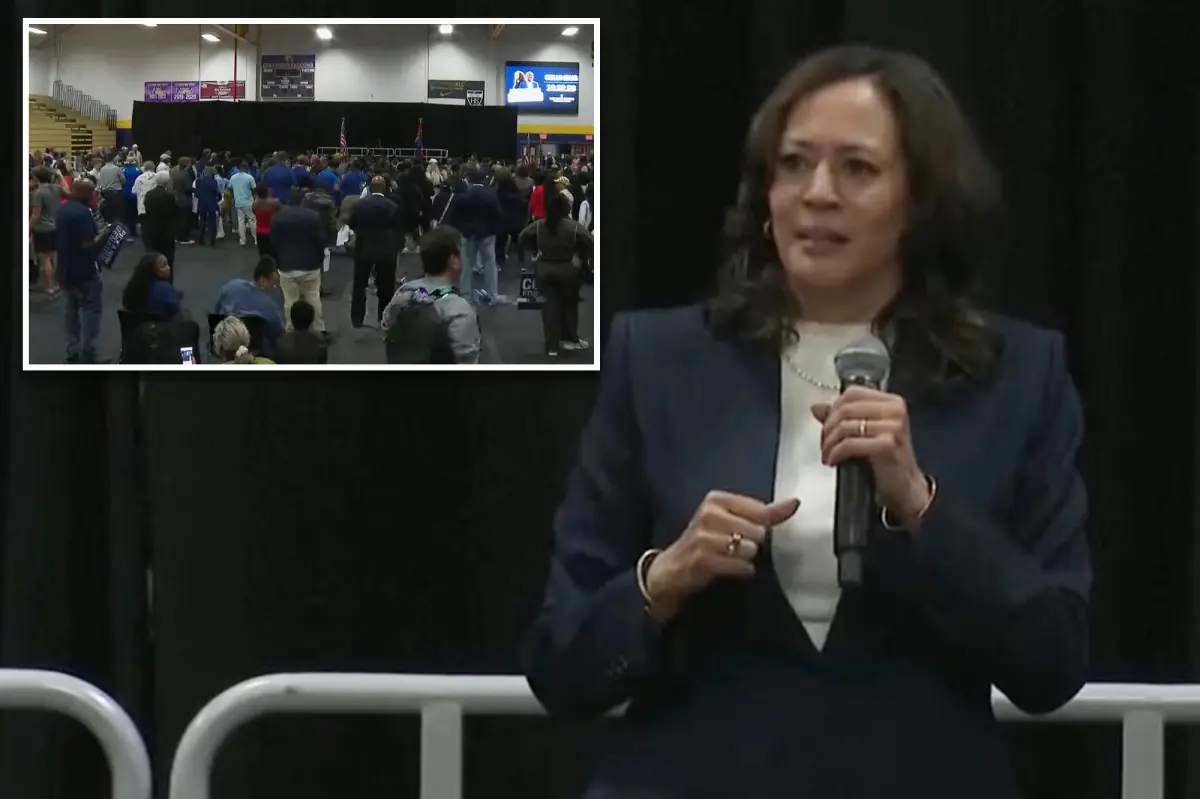
The gymnasium at Columbus High School in Mississippi was never going to be a natural showcase for presidential-level political firepower. The bleachers were partially empty, the fluorescent lights hummed overhead, and the air carried that unmistakable musty smell of polished wood, adolescence, and fading campaign dreams. Yet there stood Kamala Harris, former vice president and once the Democratic Party’s most prominent standard-bearer, summoned to inject energy into a long-shot Senate race. The occasion was a rally for Scott Colom, a district attorney trying to unseat Republican incumbent Cindy Hyde-Smith. On paper, it made sense: Colom needed national attention, and Harris needed a reason to remain in the public eye after her bruising 2024 loss. But inside that cavernous gym, with clusters of supporters scattered instead of a roaring crowd, the mismatch between ambition and reality was impossible to ignore. Harris, ever poised in her tailored suit and practiced smile, stepped up to the microphone ready to deliver inspiration. The audience, though appreciative, was not electrified. They were curious, perhaps politely hopeful, but not yet ready to raise the roof. This is the backdrop against which a speech meant to motivate young people turned into an awkward, much-analyzed moment—one that would be clipped, shared, and scrutinized long after the rally ended. What happened next reminded everyone that even the most experienced politicians can stumble when the room feels cold, the words won’t cooperate, and the distance between message and messenger suddenly yawns open.
2.
Harris launched into what she clearly intended as a stirring anecdote about mentorship, resilience, and the importance of refusing to let others define your potential. “You know, I mentor a lot of young people, and I talk to them sometimes and part of the advice I give them is, you know, never let someone else with limited ability to see your capacity be a limitation on your ambition,” she said. The sentence rolled out in that characteristic Harris cadence—long, meandering, full of qualifiers—and it landed with a thud. There was no burst of applause, no nodding heads suddenly animated, no standing ovation. Instead, a muffled silence filled the gym. Harris, visibly stunned by the tepid response, decided to double down. Perhaps she thought the crowd hadn’t heard her. Perhaps she believed the words themselves were the problem, not the delivery. Or perhaps she simply felt, as many speakers do, that repeating an important line might rescue it from indifference. “Let me repeat that: Never let anybody else’s, somebody else’s limited ability to see your capacity to be a limitation on your ambition,” she said, her voice rising with urgency. This time, there was a smattering of applause, but it felt forced—a charitable reaction, not a genuine breakthrough. The moment had already become a little awkward, the kind of cringe that anyone who has ever spoken in public recognizes: the moment when you realize the magic isn’t happening, the audience isn’t with you, and no amount of repetition can bridge the gap.
3.
What made the moment particularly painful was not the silence itself, but the way Harris kept trying to explain what she meant, piling more abstract language on top of the original tangled thought. “That’s their limitation. That’s not our limitation. That’s their limitation,” she continued, as if repeating an incantation could summon clarity. Then came the even more nebulous flourish: “We are not limited in our ambition and desire and ability to see what is possible and what can be.” It was classic Harris—the kind of word salad that critics have long mocked and supporters have defended as thoughtful, nuanced speech. But on that afternoon, with the gym half-empty and the political stakes low, it felt less like wisdom and more like a speaker struggling to find the exit of her own sentence. The phrase “limited ability to see your capacity” had twisted itself into a grammatical pretzel, and no amount of enthusiastic amplification could untangle it. Her supporters would argue that the underlying message was noble: don’t let other people’s narrow perceptions hold you back. And that message was undeniably there, buried beneath clauses like a treasure under three feet of mud. But for the average listener, the takeaway was not the motivational core; it was the struggle itself. The moment crystallized a broader perception that has dogged Harris since her first national campaign—that she can sound sophisticated and hollow at the same time, her words big but her connection uncertain. She was trying desperately to inspire young voters, to remind them that their horizons are boundless, but the delivery undermined the content at every turn.
4.
The most interesting figure in the whole episode, however, was not Harris but the man who invited her: Scott Colom. A state district attorney in a heavily Republican state, Colom is the kind of candidate Democrats rarely spotlight—young, personable, and willing to challenge an entrenched incumbent in unfriendly territory. His decision to bring Harris to Mississippi raised eyebrows from the moment it was announced. Even at the rally, he admitted as much, recalling that people had asked him point-blank: “Why would you do that?” It was a fair question. Harris’s national approval ratings remain underwater, her 2024 presidential campaign ended in defeat, and in the South, she carries heavy baggage for many swing voters. Yet Colom’s answer was disarmingly simple: “Why not?” That phrase, delivered with a shrug and a smile, revealed the calculus of a long-shot candidate who knows he has little to lose. In Mississippi, any Democrat faces an uphill battle against a Republican incumbent. Colom wasn’t expecting Harris to transform the race overnight; he was hoping for a spark, a burst of media coverage, a chance to remind national donors that Mississippi has a credible Democratic candidate at all. And in that sense, the rally was a success—not because of the speech, but because it generated exactly the kind of attention that political underdogs crave. The awkward moments, the viral clips, the punditry about Harris’s “word salad”—all of it put Colom’s name in headlines he would never have earned on his own. In politics, as in life, there is no such thing as bad publicity, especially when you are running against the institutional weight of a senior Republican incumbent.
5.
But beneath the strategy and the inevitable mockery, there was something human about Harris’s stumbling moment that deserves a gentler lens. Public speaking is hard. Speaking in front of a half-hearted crowd is harder. Speaking with the world watching, waiting for you to fail, is hardest of all. Harris has spent years under that microscope, and every misstep has been magnified, every tangled sentence treated as proof of intellectual inadequacy. Yet on that stage in Columbus, she was doing what every campaigner does: trying, failing, correcting, and trying again. Her message, however clumsily phrased, was aimed squarely at young people who have been told they can’t accomplish their dreams because they don’t fit someone else’s mold. She was talking to the kid in the back row who wonders if politics is for them, who worries that their zip code or their skin color or their family history will inevitably limit them. She was telling them that the limitation isn’t real, that it lives in the eyes of the beholder, not in the heart of the hopeful. The fact that she garbled the syntax does not erase the sincerity of the sentiment. It does humanize her, though. It reminds us that confidence and vulnerability often coexist, that even former vice presidents can feel the sting of a silent room, and that resilience is not about delivering a perfect line but about having the guts to repeat yourself when the first attempt falls flat. That may be the truest lesson of all—not the lesson about ambition, but the lesson about perseverance.
6.
In the end, the Mississippi rally was a small moment in a long political season, but it captured something essential about American politics in this moment. Harris is now a former candidate, a figure whose future is uncertain. Colom is a long-shot Senate contender in a state that hasn’t elected a Democrat statewide in years. Hyde-Smith remains the favorite, and the odds are long that anything said in that high school gym will change the outcome. Yet the rally mattered in the way all campaigns matter: it was an attempt to build something despite the odds. Harris’s awkward speech became an internet punchline, but it also demonstrated the loneliness of the stump—the pressure to sound profound, the risk of sounding foolish, and the courage it takes to speak at all. Colom’s “Why not?” was the quiet heart of the event, a reminder that political ambition is often a gamble against conventional wisdom. And Harris’s repetition of her own sentence, her insistence on being understood, was not just a fumble; it was a small act of defiance. She could have moved on, accepted the silence, and let the moment pass. Instead, she chose to stand there, insist that her words mattered, and try again. That is not a perfect speech, but it is a profoundly human one. And in a world that demands polished performances and flawless soundbites, perhaps the most inspiring thing a politician can do is be visibly imperfect—and refuse to give up. The gym may not have been full, the applause may have been tepid, and the sentence may have been a mess. But somewhere in that room, there was a young person who heard not the muddle, but the message: their ambition is their own, no one else gets to define it, and the only real limitation is the one you accept. That is worth repeating.