


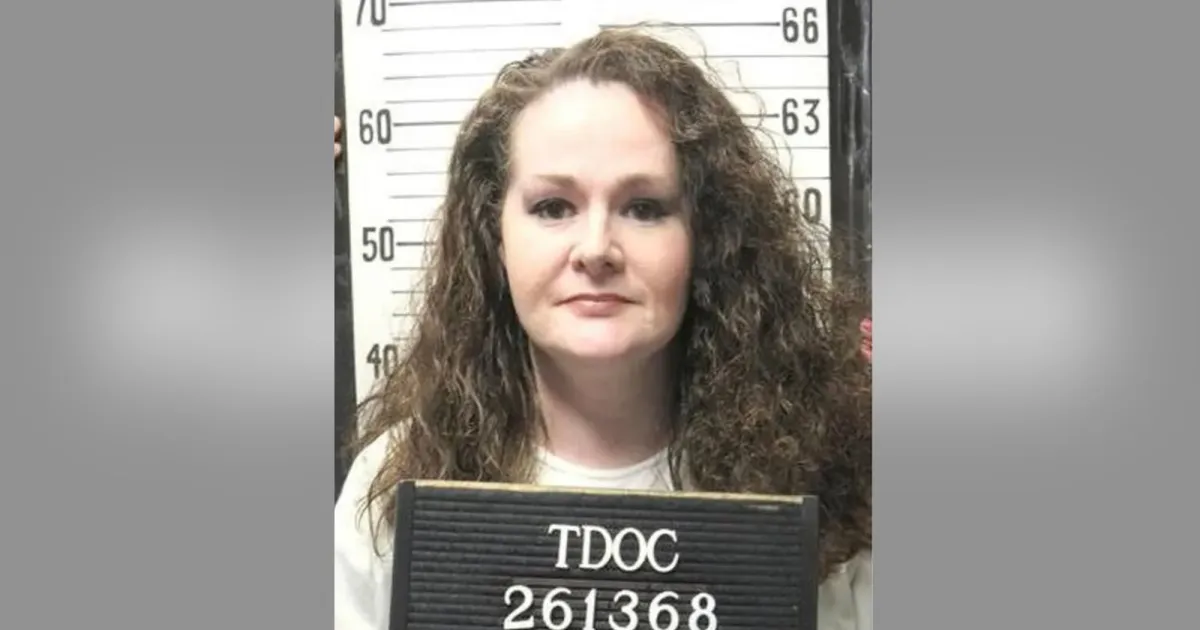
In a quiet but profound development, Christa Pike, the only woman on death row in Tennessee, is beginning to find her voice again. The 50-year-old convicted murderer, who survived a botched execution attempt in late September, is now reportedly able to speak in full sentences and is walking more independently, according to her attorney, who shared the update on October 21. For anyone who has followed Pike’s case over the decades, the news is both striking and deeply unsettling. Here is a woman who was sentenced to die for a horrific crime committed when she was just a teenager, and yet she now finds herself in a strange limbo—alive, healing, and gradually regaining basic human functions after the state tried to kill her and failed. The images that emerge from the news are stark: a prison hospital room, medical monitors, attorneys speaking in measured tones about their client’s fragile recovery. It is a reminder that behind the legal abstractions of “death row” and “execution protocols” are real bodies, real minds, and real experiences of terror and pain. Pike’s ability to communicate again may seem like a small thing, but in the context of what she endured, it represents a kind of rebirth—not as a free person, but as someone who has been forced to confront her own mortality in the most visceral way imaginable.
The botched execution itself took place on September 30 at Riverbend Maximum Security Prison in Nashville. In an attempt to carry out her death sentence, the state administered two doses of pentobarbital, a barbiturate commonly used in lethal injections. But something went terribly wrong. Pike survived the injections and was rushed to a local hospital, where she remained for several weeks before being discharged earlier this month. The failed procedure has been described by witnesses and officials as a “mess,” and it has thrown Tennessee’s entire execution process into doubt. Pike, who was convicted in 1996 for the murder of her classmate Colleen Slemmer, has been on death row for nearly three decades. She was just 19 when she committed the crime, a fact that has long fueled debate about youthful culpability and the death penalty. But for Slemmer’s family, the pain has been lifelong. Colleen was a young woman with her whole life ahead of her, and her mother, May Martinez, attended the attempted execution—a decision that only underscores the unimaginable complexity of this case. Martinez later described the scene to NBC News as a “mess,” her words dripping with frustration and sorrow. For her, justice has been elusive, and now even the final moment of that justice has been swallowed by confusion and bureaucratic failure.
In the weeks since the failed execution, Pike’s recovery has been slow but steady. She was discharged from the hospital earlier in October and is back at the prison, where she continues to receive medical care. Her legal team has expressed gratitude toward the first responders and medical staff who treated her, calling their efforts a source of comfort in “extraordinary circumstances.” In a statement to The New York Times, her attorneys said, “She is grateful to the first responders and her medical team for their care in these extraordinary circumstances. She is continuing to receive medical care at the prison, and we will continue to track her recovery.” It is a strange and almost surreal thing to imagine: a woman who was moments from death, thanking the people who kept her alive, while the legal system that sentenced her to die figures out what to do next. Her attorneys have also revealed that Pike is dealing with profound psychological trauma as a result of the experience. In a separate statement to People, they said, “Christa is dealing with the profound psychological trauma of having survived a failed execution, including the terror, pain, and uncertainty of believing she was about to die. We cannot yet know the full emotional and psychological toll of that experience or how long it will take her to begin to heal.” Those words are chilling in their honesty. They remind us that an execution is not simply a legal procedure; it is an event that comes with devastating emotional weight, for the person facing death, for their lawyers, for the victim’s family, and for everyone who participates.
The political fallout from the botched execution has been immediate and significant. Tennessee Governor Bill Lee, a Republican who has generally supported capital punishment, halted all executions in the state the day after the incident. In an official statement, Lee said he had ordered “a comprehensive, third-party review to determine exactly what occurred.” He went on to acknowledge the gravity of the state’s responsibility, saying, “Carrying out a lawfully imposed sentence is among the state’s most serious responsibilities, and the people of Tennessee expect it to be done in a manner that is not only legal and constitutional but is effective.” His words were measured, but the subtext was clear: the state had failed. The system had broken at the very moment it needed to be most reliable. For critics of the death penalty, the botched execution of Christa Pike is not just an anomaly; it is evidence of a deeper, fundamental problem with capital punishment itself. When the state puts itself in the position of ending a human life, it must do so with absolute precision and humanity. The fact that it can fail so spectacularly—leaving a condemned woman conscious, terrified, and suffering—raises unsettling questions about whether the death penalty can ever be administered justly. Lee’s decision to order a review was a necessary step, but for many, it felt too little, too late. The damage had already been done, both to Pike and to the credibility of Tennessee’s legal system.
For Pike herself, survival may be only the beginning of a new kind of ordeal. Her attorneys have been candid about the psychological and emotional fallout of the failed execution. They describe her as living with the “terror, pain, and uncertainty” of believing she was about to die—an experience so extreme that it defies easy explanation. She is not the same woman she was before the execution date was set; no one could be. The legal team also noted that Pike “continues to express concern for others, particularly the family of her victim Colleen Slemmer.” That detail is striking, even disorienting. A woman who has spent nearly three decades on death row for a brutal murder is now worried about the family of the person she killed. It may be a sign of genuine remorse, or it may be a survival instinct, a way of making meaning out of unimaginable circumstances. Either way, it adds another layer of complexity to an already tragic story. The victim’s family, meanwhile, is left in a painful limbo of their own. May Martinez attended the execution, bracing herself for a moment of closure that never came. Instead, she watched the state fumble through a process that was supposed to bring some measure of justice for her daughter. For her, the botched execution was not just a procedural failure; it was a reopening of wounds that have never fully healed.
The most unsettling question now is what comes next. It is not yet known whether the state of Tennessee will attempt to execute Pike again. Her attorney, Luke Ihnen, told CNN that “the state has made no promises that Ms. Pike will not be subject to a future execution.” That single sentence carries a weight of uncertainty. Pike remains on death row, her legal status unchanged, while the state conducts its review and deliberates over its next move. If the execution is rescheduled, the entire ordeal will begin again—the dates, the appeals, the final hours, the walk to the death chamber. If it is not, Pike will spend the rest of her life in prison, forever marked by the day she was supposed to die. In human terms, this is a story about the fragility of life and the strange, often cruel ways that justice is pursued. Christa Pike committed a terrible crime, and no amount of trauma now can undo the harm she caused. But she is also a human being, and the botched execution has made her a symbol of something larger: the inherent risk of capital punishment, the possibility of error and cruelty, and the uncomfortable truth that the systems we build to deliver justice are only as reliable as the people who run them. As Pike continues to recover, speaking in full sentences and taking shaky steps across a prison floor, the world watches—and waits—to see what Tennessee will do with her life.