


Winter travel has long been synonymous with sun-soaked escapes, but there is a quieter, stranger, and far more magical corner of Europe that invites you to lean into the cold rather than run from it. Across the continent, a handful of hotels are built not from concrete and timber, but from the very elements of winter itself: ice carved from frozen rivers, snow compacted into walls, and sculptures that shimmer like glass under the pale polar sun. These are the ice hotels and igloo villages that rise each season, offering guests a night inside a living winter fairy tale. What makes them so extraordinary is not just the ethereal beauty of sleeping in a room that glows with crystalline light, but the entire ritual that surrounds the stay. The adventure begins long before check-in, when teams of artists and builders venture out onto frozen lakes and snow-covered fields to harvest the materials that will become your bedroom. Depending on the property, enormous blocks of ice are cut from rivers, or fresh snow is gathered and shaped into domes, corridors, and caverns. It is a form of architecture that is both ancient and startlingly modern, and every winter it is reborn, only to melt away again with the returning warmth. For those willing to brave subzero temperatures in exchange for a once-in-a-lifetime experience, these hotels offer something increasingly rare: a chance to feel small, awed, and utterly present in the natural world.
In northern Norway, above the Arctic Circle, sits Snowhotel 365, a place that refuses to let winter disappear with the season. Located at Snow Resort Kirkenes, this extraordinary property is open all year round, which means even in the middle of July you can step out of the midnight sun and into a chilly wonderland. Each room is hand-carved by international ice sculptors, making every single stay unique; no two rooms have ever been identical, and the artists return regularly to reshape and reimagine the spaces. The indoor temperature hovers around minus four degrees Celsius, but the experience is far from brutal. Guests are given thermal sleeping bags designed for extreme cold, and the resort provides access to a heated lounge, sauna, and showers, so you can warm your bones after a night under the ice. In fact, the stay is all-inclusive, featuring breakfast and a three-course dinner, which means the only thing you need to worry about is how long to linger in the sauna before curling up in your icy cocoon. What makes Snowhotel 365 particularly fascinating is its relationship with time and transformation. Each year, approximately thirty tonnes of ice and fresh snow are used to preserve and renew the structure, and as the old snow slowly compresses into solid ice, the walls, ceilings, and sculptures develop new textures and shapes. It is a living, breathing structure that changes with the weather, the seasons, and the hands of the artists who tend to it. For travelers who have always dreamed of seeing the Northern Lights but never wanted to limit themselves to winter months, this hotel offers the best of both worlds: the magic of snow in any season, wrapped in the comfort of modern Arctic hospitality.
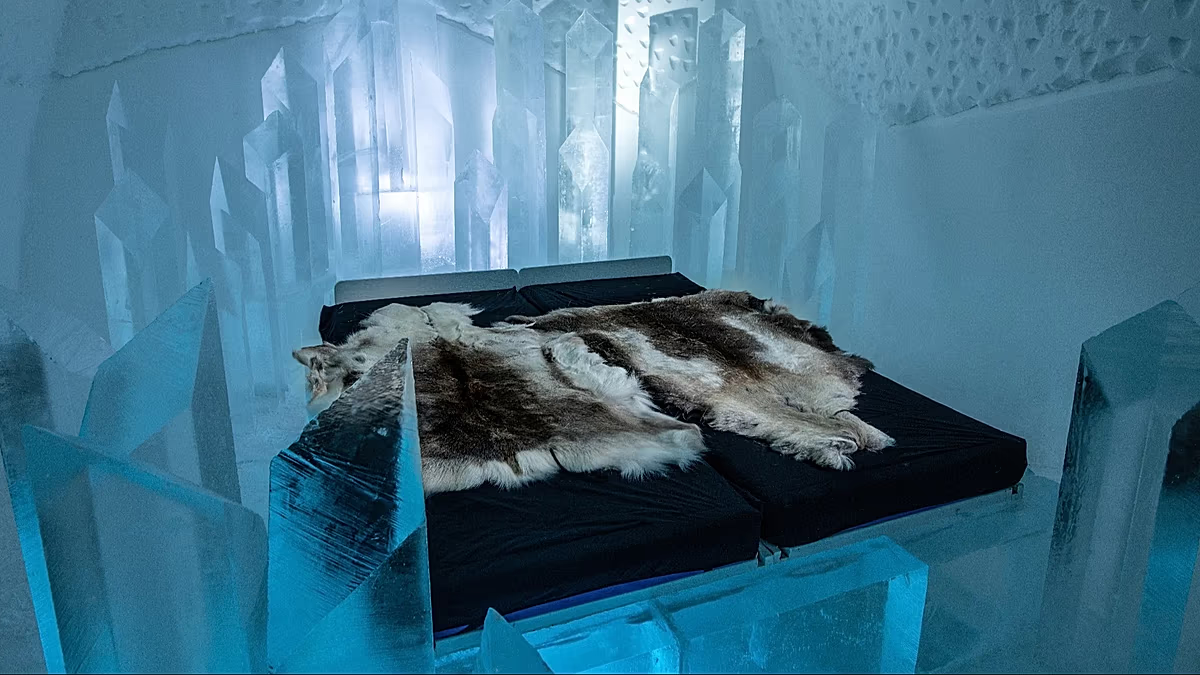
Further east, in Swedish Lapland, the legendary ICEHOTEL in Jukkasjärvi has been redefining frostbitten luxury since its earliest experimental days. Each winter, as the Torne River freezes solid, artists and sculptors from around the globe converge on this remote village to build the hotel anew. The result is a sprawling complex of temporary rooms and art suites, available from December until the ice melts back into the river in April. For five glorious months, guests can sleep in spaces that are less like hotel rooms and more like immersive art installations, each one designed by a different creative mind. Some suites are ethereal and minimalist, with walls that glow like frosted glass; others are intricate and whimsical, carved into shapes that resemble forests, waves, or dreamlike creatures. The temperature inside the ice rooms hovers around minus five degrees Celsius, but every bed is fitted with reindeer hide blankets and expedition-grade sleeping bags, so the cold becomes a backdrop rather than a threat. Dining at ICEHOTEL is an equal adventure. The property offers an “ice menu” where dishes are served on plates carved from the very river below, adding a poetic layer to every meal. There is something deeply humbling about eating a beautifully plated local delicacy from a plate that will eventually return to the water from which it came. This is not just a place to sleep; it is a meditation on impermanence, a celebration of the brief, brilliant window when water becomes architecture and light becomes sculpture. For artists and dreamers alike, ICEHOTEL remains the archetypal ice hotel, a place where the boundary between nature and human creativity dissolves entirely.
In Finland, the Arctic SnowHotel in Rovaniemi offers a slightly different version of the same enchantment, set in the capital of Finnish Lapland. From mid-December until the end of March, the grounds are buried under snow, and the rivers and lakes have frozen over, creating the perfect conditions for the hotel to open its doors. What makes this property special is its scale and its family-friendly spirit. Since 2008, a fresh hotel has been sculpted every year, containing twenty rooms that can accommodate up to seventy guests. You can choose a cozy double suite designed for two, or a larger family room that sleeps up to six, making it one of the more accessible ice hotels for those traveling with children. But the experiences extend far beyond the bedrooms. At the Ice Restaurant, meals are served on plates made of ice, and the Ice Chapel offers a breathtaking setting for anyone seeking a moment of peace, spirituality, or even a truly unforgettable wedding ceremony. One of the most delightful touches, however, is the hotel’s resident “Northern Lights Watcher.” This dedicated staff member keeps a constant eye on the sky, ready to alert guests the moment the auroras begin to dance overhead. This means you can sleep without FOMO, knowing that someone else is doing the watching for you. When the green and violet ribbons of light sweep across the heavens, you will not miss them. There is something deeply comforting about that arrangement, as if the hotel itself is a guardian of both comfort and wonder. Between sipping warm drinks by the fire, sliding into your thermal sleeping bag, and stepping out into the frozen night to witness one of nature’s greatest spectacles, the Arctic SnowHotel feels less like accommodation and more like a gateway to the sublime.
But the magic does not end in Finland. In Alta, Norway, Sorrisniva Igloo Hotel stakes its claim as the world’s northernmost igloo hotel, and it is nothing short of spectacular. Here, the construction process is a feat of sheer scale: each year, the team harvests ice from the Sierravannet mountain lake, using roughly 250 tonnes of ice and a staggering 7,000 cubic metres of snow to build the entire complex under a specially chosen theme. Guests are welcome from 20 December until the end of March, with both rooms and suites on offer. Because the theme changes every winter, no two seasons are ever alike; internationally recognized ice sculptors treat the suites as their canvas, carving furniture, decorative details, and entire scenes directly into the frozen walls. For adventure travelers, Sorrisniva is also a paradise of winter activity. You can go snowmobiling across the vast Finnmark plateau, chase the Northern Lights across the open tundra, strap on snowshoes for a silent trek, or let a team of eager huskies pull you through the snowy wilderness. After a day filled with adrenaline and cold air, returning to the igloo feels like stepping into a different world, one where the only sound is the creak of ice and the soft whisper of snow falling outside. Meanwhile, in the heart of the Swiss Alps, Iglu-Dorf Zermatt offers a more alpine take on the frozen overnight stay. Rebuilt each winter at an altitude of 2,700 metres on the ski slopes above the car-free resort, this remote mountain village of hand-carved igloos is connected by snow corridors, creating a sense of intimacy and adventure. From 19 December to 4 April, guests can sleep in these rounded chambers, where temperatures hover right around freezing. During the day, the outdoor terrace becomes a shared dining space, where the centerpiece is Swiss cheese fondue, accompanied by other snacks and hot and cold beverages. There is nothing quite like sitting outside in the thin mountain air, a gooey pot of melted cheese between friends, surrounded by peaks that rise like frozen waves.
Taken together, these icy retreats represent something far greater than novelty accommodation. They are a celebration of winter’s beauty, a collaboration between human hands and the forces of nature, and a reminder that travel does not always have to be about comfort and convenience. These hotels ask you to trade a little warmth for a lot of wonder, to embrace the chill as part of the experience rather than an obstacle to it. They remind us that the cold can be not just bearable, but genuinely invigorating, especially when you know that a sauna, a hot meal, and a thermal sleeping bag await. Beyond the headline properties in Norway, Sweden, Finland, and Switzerland, the same tradition continues elsewhere: the Swiss igloo villages of Davos and Gstaad, the German Iglu-Dorf on the Zugspitze, and the Austrian village at Kühtai near Innsbruck all offer their own variations on the frozen stay. Whether you are celebrating a milestone, chasing the auroras, or simply looking for a story to tell for the rest of your life, these winter sanctuaries offer an unforgettable journey into the heart of the season. They are not just places to sleep; they are places to dream, to feel, and to reconnect with something ancient and elemental. So this winter, when the temperature drops and most people turn their gaze toward the tropics, consider going the other way. Bundle up, brave the ice, and discover why the coolest holiday destinations in Europe are actually the coldest ones of all.