

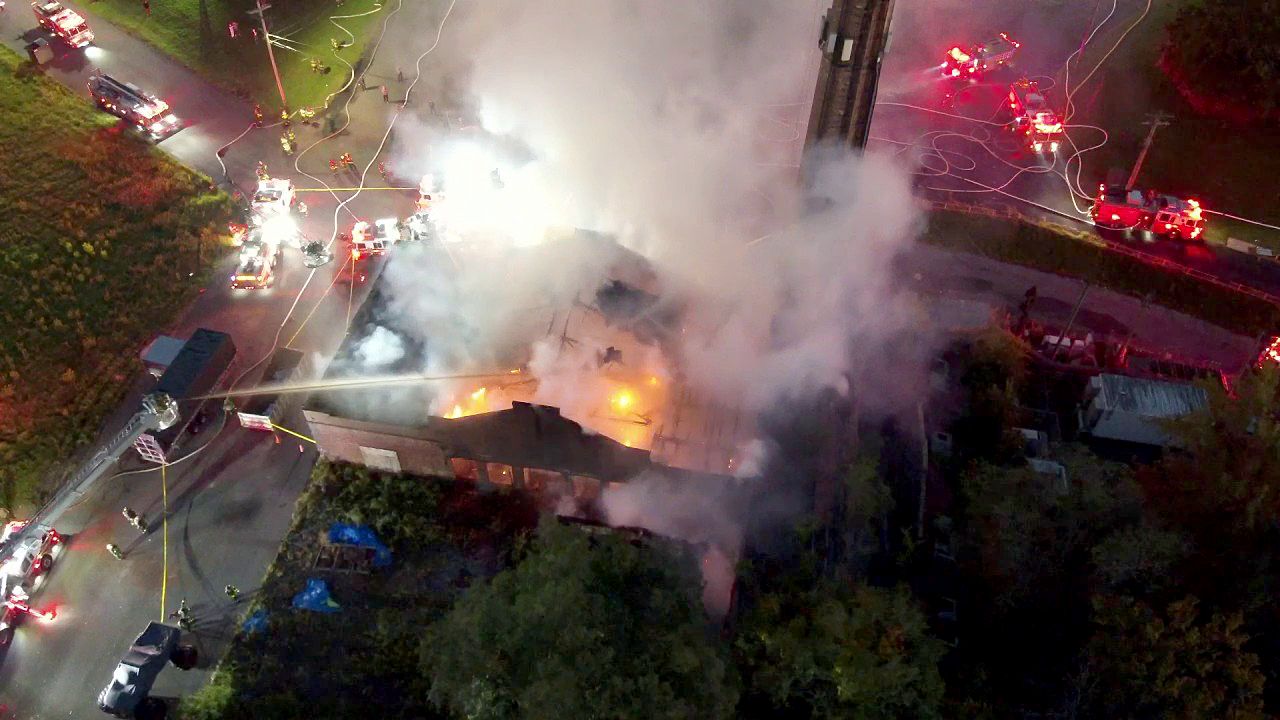
On a windy Saturday evening, when the streets of Staten Island were beginning to quiet and families were settling in for the night, the sky over Hylan Boulevard turned an alarming shade of orange. Smoke began to curl above the rooftops, and then came the sirens—dozens of them, slicing through the dusk and echoing off the old buildings. A four-alarm fire had broken out in a vacant warehouse at 6581 Hylan Boulevard, a building that had sat empty for five years, and by the time the first engines arrived around 5:45 p.m., the flames were already tearing through the structure with a hunger that seemed to grow with every gust of wind. What made the moment so fraught, however, was not just the size of the fire. It was the location. The warehouse sat on the grounds of Mount Loretto, a property that includes two schools and the historic Old Church of St. Joachim and St. Anne, the striking sanctuary made famous by its appearance in The Godfather. In the 1972 film, the church served as the backdrop for one of cinema’s most unforgettable sequences: the baptism of Michael Corleone, intercut with the violent consolidation of his power. To see that beloved landmark standing in the shadow of a raging inferno was a sight that must have stopped hearts. The wind seemed to mock every siren, carrying the smell of smoke across the island and sending leaves and debris swirling through the streets. More than 200 firefighters and EMS personnel raced to the scene, not merely to battle a warehouse blaze but to defend a piece of cultural and spiritual heritage from being swallowed whole. The stakes were immense, and everyone on the scene knew it. This was not just another fire in an abandoned building; this was a test of what a community values, and a reminder that the past is always more fragile than we imagine.
From the moment the first units arrived, it was clear that this would be a fight fought from the outside, not the inside. “Upon arrival, units encountered heavy fire throughout the building and immediately went into a defensive operation,” FDNY chief of operations Kevin Woods told reporters at a press conference that evening. There was no thought of sending firefighters deep into the warehouse to locate a seat of the fire; the entire structure was already involved, and the roof was beginning to groan under the strain. Instead, the strategy was to surround the blaze, deprive it of fuel, and protect the buildings around it. Crews set up multiple large-caliber stream tower ladders, sending enormous arcs of water over the flames, while handlines were stretched across the property to knock down any fire that crept too close. It was a coordinated dance of men, machines, and water, conducted against a backdrop of crackling timber and heat so intense that it could be felt from across the street. At some point, the roof gave way with a thunderous roar, collapsing into the belly of the warehouse and sending a column of sparks and debris into the night sky. Woods described “heavy, heavy damage” to the structure, and a collapse zone was established around the building to keep firefighters safe. The warehouse was lost, but the operation was far from over. The wind was carrying embers, and every one of them was a tiny threat to the church, the schools, and the surrounding neighborhood. Firefighters had to be both aggressive and disciplined, pushing forward when they could and holding back when the fire demanded respect. They moved with a calm urgency that comes from years of training, but even the most experienced among them understood that a single shift in the wind could turn a close call into a catastrophe.
The warehouse at 6581 Hylan Boulevard had been vacant for five years, a silent, forgotten structure that most people probably drove past without a second thought. But on Saturday night, its abandonment made it all the more dangerous. Vacant buildings can hide all manner of hazards—unexpected structural weaknesses, years of accumulated debris, no working sprinklers—and this one was located in a place that made those hazards particularly unforgiving. The Mount Loretto grounds are not just an empty stretch of land; they are a living part of Staten Island’s history, home to schools, open space, and the Old Church of St. Joachim and St. Anne. The church is an architectural gem, with an ornate façade that looks like it was lifted from another era, which in a sense it was. When Francis Ford Coppola chose it as a location for The Godfather, he gave it a permanent place in popular culture. In the film’s climactic sequence, the camera moves between the interior of the church, where Al Pacino’s Michael Corleone stands as a godfather before the altar, and the outside world, where his enemies are being executed in cold blood. The church’s exterior, with its imposing doors and aged stone, became a visual shorthand for the marriage of the sacred and the profane. But the church’s own history is just as dramatic as any movie scene. In 1973, a devastating fire swept through the building, largely destroying it. Only the façade survived, a ghostly shell of what had once been a beloved sanctuary. The community refused to let it go. They rebuilt the church, and three years later it reopened, rising from its own ashes. To see that same church threatened again, by another fire, was a bitter irony that was not lost on anyone who knew its story. It was as if history was trying to repeat itself, and the only thing standing between the past and a second tragedy was the courage of the firefighters.
Throughout the evening, the firefighters’ greatest enemy was not the flames themselves but the wind. It was a wild, blustery night, the kind that turns a single spark into a wildfire and sends burning fragments sailing for blocks. Time and again, crews spotted glowing embers landing on rooftops, in trees, and on dry grass near the church and schools, and time and again they pounced on them before they could catch. It was exhausting, nerve-wracking work, a constant state of alert that required everyone to think not just about the main fire but about a dozen possible secondary fires. “It’s very windy out here tonight. Our units did a great job with many of the flying embers, preventing additional structures from going on fire,” Woods said, and the relief in his voice was unmistakable. The defensive operation continued for hours, a relentless bombardment of water from tower ladders and handlines, while the wind howled and the warehouse crumbled. Firefighters moved with a kind of grim efficiency, their faces streaked with soot and sweat, their radios crackling with orders and updates. They knew what was on the line. Every time the wind shifted, so did their positions. Every time a new ember appeared, someone was there to stomp it out or drown it. By around 8:30 p.m., the fire was declared under control. The warehouse, or what was left of it, was a ruined, smoldering shell, its roof gone and its walls charred. But the church was standing. The schools were standing. The neighborhood was intact. The cost of the battle was remarkably small: one firefighter suffered a minor burn to his leg, an injury that would heal, but which served as a reminder of how close the evening had come to tragedy. For a four-alarm fire on a windy night, with a collapsed roof and flying embers, the outcome was about as good as anyone could have hoped.
For the people of Staten Island, and indeed for anyone who has ever been moved by The Godfather, the Old Church of St. Joachim and St. Anne is a treasure that transcends its cinematic fame. It is a place where real life has unfolded for generations—where children have been baptized, couples have been married, and families have said goodbye to their loved ones. It is a landmark that has watched the community grow and change, a stone witness to the quiet rhythms of faith and daily life. Its appearance in a famous film gave it a kind of celebrity, but its true value lies in its permanence. That permanence was shattered once before, in 1973, when fire destroyed the church and left only the façade standing. The rebuilding that followed was an act of collective will, a decision by the community that some things are too important to lose. When the church reopened three years later, it carried with it the memory of its survival, a testament to resilience that became part of its very stones. On Saturday night, as the warehouse burned and the wind carried embers toward the sanctuary, that resilience was tested again. The anxiety was real, and so was the relief when the firefighters emerged victorious. To lose the church twice would have been a cruel blow, a wound to the cultural soul of the city. Instead, the church remains, its façade unbroken, a symbol of everything that can be preserved when a community and its first responders refuse to give up. It also serves as a reminder that the stories we love are never just fiction. They live in real places, and those places need real protectors. The Godfather may be a movie, but the church is not a set. It is a living piece of history, and on that windy night, history came within a few yards of ending.
In the days to come, the investigation into the fire will continue. The Fire Marshal’s office will sift through the ashes of the warehouse, looking for a cause, trying to answer the question that always follows such events: how did this start? There may be no easy answer. Fires in vacant buildings are notoriously difficult to explain, and the evidence may be too charred to reveal its secrets. But for now, the immediate chapter has closed. The smoke has cleared, the sirens have faded, and the neighborhood is left to process what happened. In the morning light, residents will see the scarred remains of the warehouse, a reminder of how close they came to losing something irreplaceable. They will also see the church, still standing, still beautiful, still there. The close call is a powerful reminder of the fragility of our shared heritage. History is not guaranteed. A fire, a storm, a moment of neglect can erase what took decades or centuries to build. But the evening also reminded us of something else: the extraordinary dedication of the men and women who answer the call when disaster strikes. The firefighters who battled this blaze did not just protect a building. They protected a repository of memory, a house of worship, a piece of American cinema, and a source of identity for an entire community. They did so with skill, courage, and an unflinching commitment to the idea that some things are worth saving. That is a story that deserves to be told, not just in headlines, but in the grateful hearts of everyone who can still look up and see the old church standing against the sky. It is a story of near-loss and narrow escape, of wind and embers and the people who refused to let them win. And it is a story that will be remembered in Staten Island for a long, long time.