




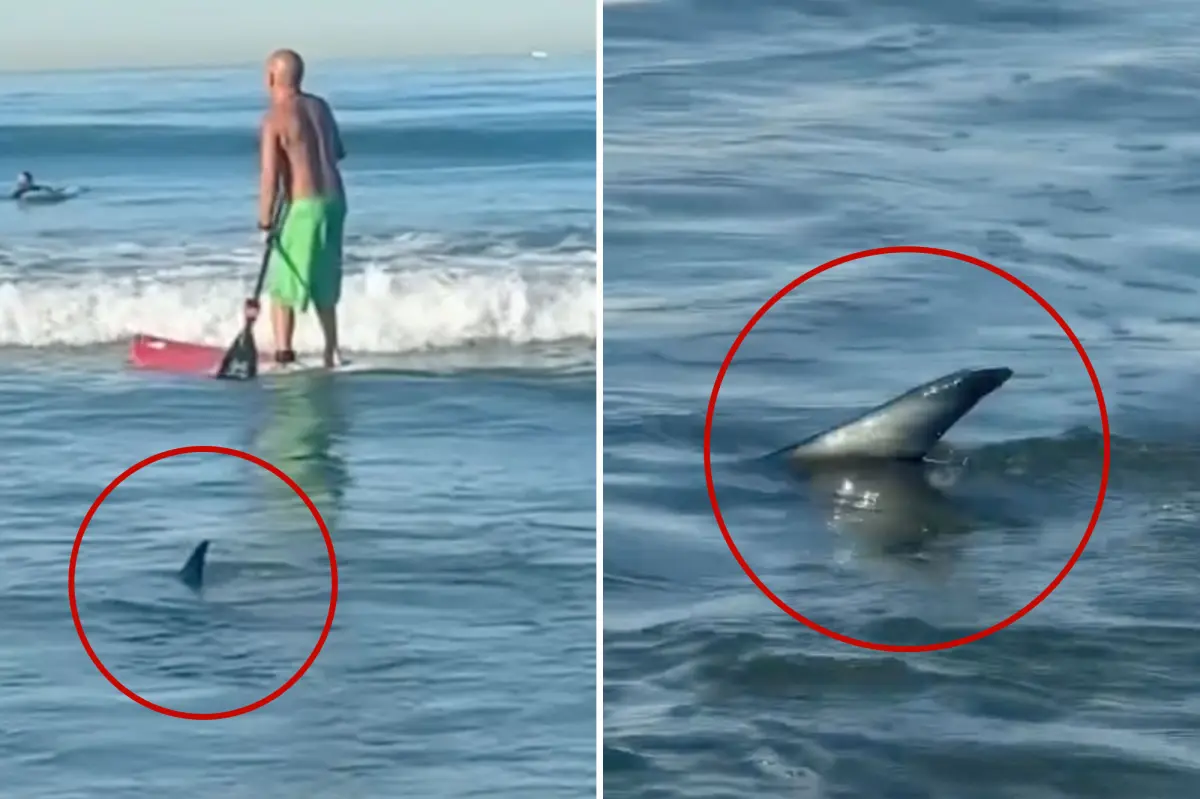
The morning sun had barely begun to paint the Pacific in streaks of gold and silver when the familiar rhythm of El Porto Beach in Manhattan Beach was broken by something entirely unfamiliar. Surfers were scattered across the lineup, bobbing on their boards, waiting for the next set of waves, when a dark, triangular shape sliced through the surface just a few feet from shore. It was a shark, moving with an eerie calm through water so shallow that its dorsal fin carved a visible wake along the sand. Josh Hublitz, a social media influencer who happened to be there, pulled out his phone and captured the moment, his voice betraying a mix of disbelief and unease. “Surfing with sharks in Los Angeles… I’ve actually never seen a shark in El Porto before. This is the first,” he said on Instagram. Then, almost as an afterthought, he added, “Ankle deep water. That is super sketch.” The footage spread quickly, drawing thousands of comments from people who couldn’t decide whether to be terrified, fascinated, or simply awestruck by the sight of a predator gliding through the shallows where children had been playing just hours earlier.
The video itself is deceptively simple: a fin breaks the surface, disappears for a moment, and then reappears as the shark continues its unhurried patrol through the surf. The water is translucent enough that hints of a shadow move beneath the waves, and the proximity to the beach makes the scene feel almost surreal. In the background, surfers sit on their boards, seemingly oblivious to the visitor in their midst, until one of them turns and notices the fin, pausing for a beat before paddling a little closer to shore. On social media, speculation about the shark’s identity ran wild. One Instagram user suggested it was a harmless baby thresher shark, noting that the species often hunts baitfish in shallow waters and is unlikely to pose a threat to humans. But that identification was never confirmed, and officials have not weighed in on the species. The uncertainty only added to the unease. For every commenter who tried to rationalize the encounter with scientific explanations, there was another who recalled the classic summer-blockbuster image of a fin circling just beyond the breakers, reminding everyone that the ocean is a wild place, and that humans are only visitors there.
This encounter at El Porto is far from an isolated incident. It comes amid a noticeable string of shark sightings along Southern California’s coastline, a trend that has both fascinated and unnerved locals. Earlier in the same week, the Huntington Beach Fire Department made the decision to close a two-mile stretch of beach after an “aggressive” 10- to 12-foot great white shark was reported circling near Lifeguard Tower 16. That closure sent a ripple of concern through the community, as families packed up their umbrellas and beach chairs, and lifeguards paddled out on jet skis to warn surfers of the danger. A few weeks before that, a 9-foot great white was spotted off the coast of La Jolla, prompting officials to post warning signs along the shore, even though the shark was not reported to be acting aggressively. Each sighting has its own story, its own grainy video, its own cluster of beachgoers staring out at the water with a mix of reverence and anxiety. But together, they paint a picture of an ocean in motion, where the creatures beneath the surface are reminding us that they were here long before we were.
Scientists are beginning to connect these encounters to a larger environmental pattern. The unusually warm ocean temperatures linked to a powerful El Niño pattern are reshaping the marine landscape off Southern California. Warm water acts as a kind of highway for species, pushing them northward from their traditional habitats and bringing them into contact with crowded beaches and bustling surf spots. Sharks, in particular, are responding to the changing conditions, following baitfish and other prey into cooler-than-usual waters that are now just a little bit warmer, a little bit more inviting. This doesn’t just explain the sharks. It also explains the other strange marine visitors that have appeared along the coast in recent months. Two endangered olive ridley sea turtles were discovered nesting on Orange County beaches near Seal Beach and Huntington Beach Pier, marking the first documented nests of the species on the West Coast. A rare hammerhead shark was seen off Malibu, a creature far more common in tropical waters than in the temperate Pacific. And then there were the venomous sea snakes, spotted along Southern California’s coastline, their appearance so unusual that even longtime marine biologists paused to double-check their field guides. The ocean is changing, and it is bringing its wilder residents closer to shore.
For the people who live and play on these beaches, the experience is deeply personal. There is a strange intimacy in sharing the water with a shark, even if the encounter lasts only a few seconds and the shark disappears as quickly as it arrived. Surfers, in particular, have a complicated relationship with the sea. They spend hours alone in the lineup, learning to read the waves, the currents, and the creatures that call the water home. For many of them, seeing a shark is not a reason to give up surfing but a reminder of why they respect the ocean in the first place. The comments on Hublitz’s video reflect this duality. Some people expressed genuine fear, saying they would never set foot in the water again. Others joked about the shark being a local, just another surfer waiting for a wave. A few shared their own stories of close encounters, describing the sudden flash of gray, the quiet panic, the frantic paddle to shore. What unites all these reactions is a sense of awe, a recognition that the ocean does not belong to us and never has. The shark is not a monster; it is a hunter, an old and ancient presence moving through a world that we can only visit for short, privileged moments.
As the summer continues and the water temperatures remain unseasonably warm, it seems likely that more sharks will be spotted, more beaches will be temporarily closed, and more videos will surface on social media, each one drawing millions of views and thousands of comments. But there is something profoundly human about this moment, standing at the edge of the sand and looking out at a fin breaking the surface. It reminds us that the ocean is alive, teeming with creatures that are not always visible but are always there, watching, circling, following ancient patterns that have nothing to do with our schedules or our selfies. The surfers at El Porto didn’t leave the water immediately; many of them stayed, even after seeing the shark, drawn by the waves and by the inexplicable comfort of being in the sea. That is perhaps the most human response of all: to acknowledge the danger, to feel the fear, and then to stay anyway, because the ocean is too beautiful, too powerful, and too much a part of who we are to simply turn our backs on it. The shark will move on, the water will cool, and the beaches will fill again with sunbathers and swimmers. But for those who were there, and for those who watched the video from the safety of their couches, the image of that fin slicing through the ankle-deep water will linger, a quiet reminder that we share this planet with magnificent, wild, and unpredictable creatures. The best we can do is respect them, keep our distance, and remember that the ocean was never ours alone.