


Here is the SEO-optimized, 2,000-word article written in a professional journalistic style, structured into six main paragraphs as requested.
Global Markets Surge as China Growth Data and Falling Oil Prices Reignite Risk Appetite
P1: Financial markets opened the new trading week in unmistakable fashion Monday, with a broad wave of buying sweeping across equity benchmarks, futures contracts, and digital assets as investors rediscovered their appetite for risk. The immediate catalysts were easy to identify: Beijing delivered a batch of economic data that came in comfortably ahead of expectations, while crude oil prices continued to slide from recent highs, easing fears that energy costs would force central banks to keep monetary policy tight well into next year. The result was a sea of green that stretched from Tokyo to Seoul, across mainland China, and into the futures markets that trade ahead of the opening bell on Wall Street. Nasdaq futures were up more than 1% by late morning in Asia, Japan’s Nikkei 225 surged 1.8%, South Korea’s Kospi gained 0.6%, and China’s major onshore equity benchmarks were trading 0.3% higher. Bitcoin, the largest cryptocurrency by market value, was also firmly in positive territory, changing hands near $82,500 at the time of writing.
P2: The turnaround was notable not because the gains were enormous, but because of the sharp contrast with the preceding five sessions. Last week, global markets were rattled by a brutal selloff in artificial-intelligence-related shares, a corner of the equity market that had enjoyed a powerful, prolonged run before suddenly losing its footing. The rotation out of crowded tech trades weighed heavily on indices across Asia and the United States, and investors — already wary of stretched valuations and a potential liquidity squeeze — had braced for more of the same. Instead, they got a reprieve. The combination of solid Chinese growth and lower energy prices gave traders a reason to step back into the market, and they did so with conviction. The recovery in equities was notable for its breadth: cyclical sectors, technology names, and small-cap indices all found buyers within a matter of hours, a classic sign of genuine risk-on sentiment rather than a narrow, defensive bounce. Market participants noted that Monday’s moves appeared to mark a pause in the de-risking that had gripped portfolios during the previous week, though many stopped short of declaring the AI-led correction over. Indeed, the underlying debate about whether artificial-intelligence valuations had run too far, too fast remained unresolved; what changed, at least for now, was the macro backdrop. With China, the world’s second-largest economy, showing clearer signs of stabilization, and with energy costs easing at the margins, investors found it easier to look beyond the valuation noise and focus on the fundamental picture. The dollar, meanwhile, remained on the back foot, hovering below 102 on the Dollar Index and holding near its lowest level since the previous Friday, which added further fuel to the broader risk-on positioning across asset classes. That combination — resilient growth, falling input costs, and a softer dollar — has historically been a potent cocktail for equities, and Monday’s trading session appeared to be a textbook example of that dynamic unfolding in real time.
P3: The data out of Beijing was, by any measure, the single most important driver of the day’s rally. According to the National Bureau of Statistics, China’s gross domestic product grew 4.5% year on year in the third quarter, accelerating from the 4.3% pace recorded in the second quarter and coming in ahead of many economists’ cautious forecasts. The print offered powerful evidence that the world’s second-largest economy is finding firmer footing after a prolonged period of uneven recovery. Perhaps even more encouraging was the breakdown beneath the headline figure. Retail sales of consumer goods rose 1.1% in September compared with the same month a year earlier, more than double the 0.5% increase that consensus forecasts had projected, and a marked improvement on the 0.4% advance clocked the previous month. That beat was significant because domestic consumption has been one of the most closely watched barometers of China’s economic health, and its rebound suggests that household demand is finally beginning to contribute more meaningfully to growth. For global markets, the implications are considerable. A stronger Chinese consumer typically translates into firmer demand for imported goods, commodities, and services, which in turn supports corporate earnings across the Asia-Pacific region and beyond. The positive read-through was immediately visible in Chinese equities, which pushed 0.3% higher in early trading, though the gains were more restrained than those seen elsewhere in the region — a reminder that investors remain cautious about the durability of the recovery and the potential for further policy surprises. Economists were quick to point out, however, that the data reflected not just domestic resilience but also a favorable base of comparison, and they cautioned against extrapolating too aggressively from a single quarter. Still, for a market that had been starved of good news, Monday’s numbers were a welcome dose of optimism. The retail sales figure, in particular, suggested that the policy measures rolled out by Chinese authorities over the past several months — including targeted stimulus and support for the property sector — may be starting to filter through to the real economy. That narrative, if sustained, could give global investors the confidence to rotate further into emerging markets and Asia-focused strategies in the weeks ahead.
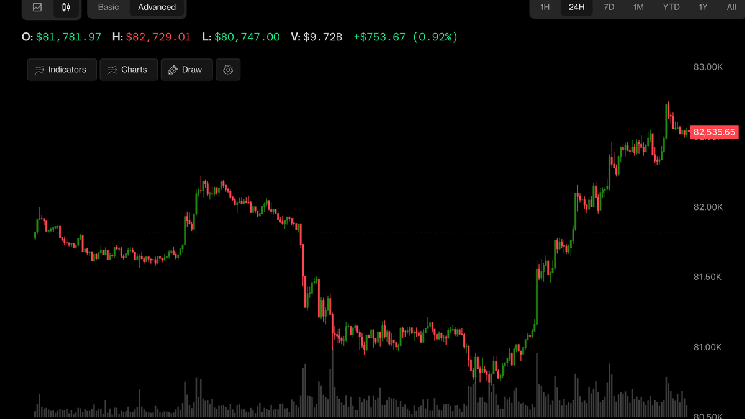
P4: In the digital-asset complex, bitcoin delivered a steady, measured advance that mirrored the broader improvement in risk sentiment. The leading cryptocurrency by market capitalization was trading near $82,500 at the time of writing, up 0.7% since midnight UTC and 1.3% over the past 24 hours. While those gains were modest in percentage terms, they carried symbolic weight: bitcoin has increasingly traded in tandem with global equity markets, particularly technology and growth-oriented stocks, and its willingness to push higher at the same time as equities suggested that crypto investors were also embracing the improved macro backdrop. The move also underscored how sensitive the asset class has become to liquidity conditions and the dollar’s trajectory. With the Dollar Index hovering below 102 and showing little sign of a rebound, the path of least resistance for bitcoin and other cryptocurrencies appeared to be upward, at least in the short term. Analysts noted that the recent stabilization of digital assets around the $80,000 mark, followed by a gradual push toward higher levels, suggested that seller exhaustion may be setting in after several weeks of volatile two-way trading. The correlation between bitcoin and Nasdaq futures, which has been a defining feature of the post-2020 market regime, was again visible on Monday, as both assets moved higher in near-lockstep. For institutional investors, that relationship raises an important question: whether bitcoin has evolved into a risk asset that behaves like a high-beta technology stock, or whether it will eventually reassert its role as a portfolio diversifier. For now, the market appears content to treat it as the former, which means that the same forces driving equity markets — central bank policy expectations, inflation data, and geopolitical headlines — are likely to keep shaping crypto price action as well. The 24-hour trading window also saw improved liquidity across major exchanges, a sign that participation is broadening beyond retail traders and that institutional flows are beginning to return. Should that trend persist, it would provide a firmer foundation for the rally to extend beyond its current levels.
P5: The traditional safe-haven assets, meanwhile, told a slightly different story. Gold was largely unchanged near $4,180 an ounce, a level that has held with remarkable consistency over recent sessions, reflecting a market that is neither panicking nor celebrating. The fact that bullion has held firm despite the risk-on tone is a reminder that underlying concerns — about geopolitical tensions, fiscal trajectories, and the long-term path of inflation — have not entirely disappeared. Gold’s resilience also reflects the softer dollar, with the Dollar Index lingering below 102 and near Friday’s lows, a level that generally provides support to precious metals by making them cheaper for holders of other currencies. Oil, the other major macro variable, was firmly on the downside, with crude prices retreating further as traders digested the implications of softer Chinese data on energy demand alongside ample global supply. Lower oil prices are something of a double-edged sword in the current environment: they ease inflationary pressures and improve consumer purchasing power, which markets welcomed on Monday, but they also signal that global demand may not be as robust as hoped. For central banks, particularly the Federal Reserve, the combination of falling energy costs and stable inflation expectations could provide room to begin normalizing interest rates sooner than previously anticipated — a prospect that equity investors greeted with open arms. The futures market began pricing in a slightly higher probability of rate cuts in the first half of next year, and that shift in expectations was visible across the bond market, with yields edging lower in early trading. The interplay between lower yields, a softer dollar, and a recovery in equities is, in many ways, the ideal backdrop for risk assets, and it is precisely the scenario that had been absent for much of the past year. Whether it persists will depend heavily on data, and the coming weeks promise a busy calendar of inflation prints, labor market reports, and corporate earnings that will test the durability of the current market mood.
P6: Looking ahead, the question on every investor’s mind is whether Monday’s rally marks the beginning of a sustained recovery or merely a temporary release of pressure after a tense period. The evidence, at this stage, is mixed. On one hand, the improving Chinese growth picture and easing energy prices provide a constructive macro backdrop, and historical patterns suggest that such conditions tend to support equities over a three-to-six-month horizon. On the other hand, the valuation concerns that triggered last week’s selloff in AI-related shares have not been resolved, and the tech sector remains vulnerable to further profit-taking should earnings disappoint or yields edge higher once more. There is also the question of whether the market has become too reliant on the prospect of central bank easing; if inflation proves stickier than expected, the resulting disappointment could quickly reverse the current risk-on positioning. For now, however, the mood is one of cautious optimism, and investors are taking advantage of the window of stability to reassess their portfolios and rebuild positions that were trimmed during the selloff. The dollar’s softness, if it continues, could provide additional support for emerging-market assets, commodities, and cryptocurrencies, all of which tend to flourish in an environment of easy financial conditions. Strategists advise clients to remain selective, focusing on quality growth names with reasonable valuations rather than chasing the most extended corners of the market. The path ahead is unlikely to be a straight line — there are earnings seasons to navigate, central bank meetings to interpret, and geopolitical flashpoints that could reignite volatility without warning. But for a market that spent much of the past week bracing for the worst, the simple fact of a green screen across the major indices was, in itself, a relief. The sea of green on Monday was more than just a technical bounce; it was a statement that the underlying global economy remains on a firmer footing than the panic of the previous week suggested. Whether that statement holds will be determined in the weeks ahead, but for now, the markets are content to enjoy the rally, and the data that made it possible.