


A Brother’s Fight: The Long Road Home from Hamas Captivity
The video that shattered the world’s peace arrived like a nightmare made visible, its images burning themselves into the consciousness of millions who watched in horror and then, inevitably, moved on with their lives. A young man, so emaciated that his bones pressed against his skin like a skeleton’s final declaration, stood in what appeared to be a shallow grave, clutching a shovel with trembling, weakened hands. His body had been reduced to something barely human, stripped of the vitality and strength that should have belonged to a man his age. For most viewers, it was a horrifying glimpse into the darkness of Hamas captivity, a brief moment of collective grief that faded as screens switched off and daily routines resumed. But for Ilay David, that video was not a distant tragedy or a fleeting news story—it was his older brother Evyatar, and the helplessness he felt while watching from his home in Israel was a wound that would not heal. Every instinct within him screamed to protect his brother, to reach through the screen, to grab the shovel from those failing hands and wrap his arms around a body that seemed to be disappearing before his eyes. Instead, all he could do was watch, frozen in a paralysis of love and terror, as his brother struggled to lift a tool that should have been light, in a place no human being should ever have to stand.
In the days that followed, the David family refused to surrender to despair, channeling their anguish into a desperate campaign to save Evyatar’s life. Their appeal reached the pages of this newspaper, with Evyatar’s gaunt face appearing on the cover beneath a headline that captured the world’s collective shame: “STARVED OF HUMANITY.” Ilay had spent nearly two years traveling wherever hope might lead him, speaking in television studios and public squares, standing before members of Congress and inside the corridors of the White House, knocking on doors that often remained closed but occasionally creaked open just enough to keep his faith alive. He told anyone who would listen about Evyatar, not as a statistic or a negotiating chip, but as a human being whose life had been unjustly stolen from him. He spoke of his brother’s love of music, his gift for making people laugh, the entire future that was waiting for him if only the world would act. “I was trying to save my little brother’s life, but I was also trying to hold myself together,” Ilay confessed, acknowledging the deep personal cost of his advocacy. Every speech, every meeting, every tearful plea was an act of love and desperation, a refusal to let the world become comfortable with leaving a young man to wither away in darkness while diplomats debated and time slipped mercilessly away.
The experience of captivity had transformed Evyatar in ways that even his own brother could not have anticipated. When Hamas released that devastating video, Ilay saw for the first time what his brother had become—a shadow of the person he had once known, his eyes still holding a flicker of the soul within, but his body telling a story of starvation and suffering that words could never fully convey. Evyatar later recounted the terrible irony of his situation: as his captors led him toward the spot where he would be forced to dig his own grave, he passed a room where the smell of tea and cake drifted through the air, where his guards sat eating while he walked beside them in a state of profound starvation. He remembered thinking that he had become a skeleton walking past men with food who had decided he did not deserve any of it. When they handed him a shovel and pointed to a narrow pit, he began to dig despite his body having almost no strength left, driven only by the knowledge that a gunman watched his every movement. It was a scene from the deepest circles of human cruelty, a calculated act of psychological torture designed to break not just his body but his spirit, to make him participate in his own destruction while those who had caused his suffering looked on.
Then, on October 13, 2025, the impossible happened, and the brothers were finally reunited. Ilay described the moment as a collision of emotions too vast for language—all the fear he had carried for more than two years suddenly meeting a joy he had never before known, creating an explosion of feeling that left him breathless. There was Evyatar, not as a face on a poster or a figure on a screen, but standing before him in physical reality, touchable and real, his voice audible in the air. “My little brother had come home,” Ilay said, and even now, those simple words carry the weight of an entire family’s prayers answered. But both brothers understood that freedom was not the end of their journey—it was, in many ways, only the beginning. Evyatar found himself struggling with the strange experience of being treated as though he had returned from the dead, when in truth, he had been alive every single second of his captivity, fighting for survival with every breath he took. The psychological scars remained fresh, with nights when closing his eyes would transport him back to the tunnel, back to the young man holding a shovel, back to the darkness that had threatened to consume him. He had to learn that recovery was not a destination but a process, a daily act of reclaiming his life through simple pleasures: eating meals with his family, listening to music, laughing with his brother and sister, discovering that life had continued to wait for him even when he had doubted he would ever return to it.
The brothers came to recognize that they could never go back to being the people they were before October 7, that the experience of captivity and the fight to survive it had fundamentally changed them in ways both painful and profound. Evyatar credited his brother’s relentless advocacy with keeping hope alive even when his captors tried to convince him that the world had forgotten him, that Israel had abandoned its sons. Only after his release did he begin to understand the true scope of Ilay’s campaign, how his brother had set aside his own life to travel the world speaking his name, knocking on doors, refusing to let the world become indifferent to his fate. The love that had carried them through the darkness remained, but so did the awareness of what had been stolen and what could never be restored. And yet, even in the midst of this complex emotional healing, a moment of pure, uncomplicated joy emerged that perfectly captured their resilience and hope.
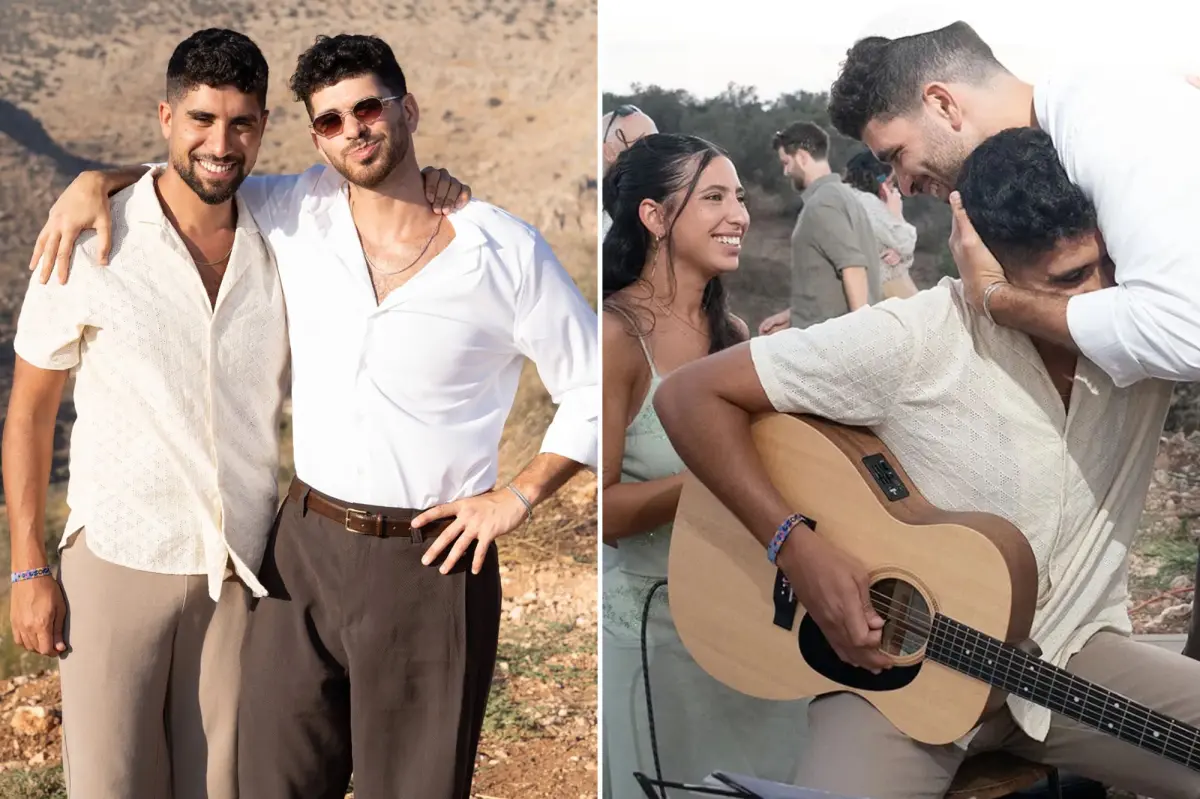
That moment came at Ilay’s wedding on August 6, when the young man whom Hamas had forced to dig his own grave stood beside his brother with a guitar in his hands, playing him down the aisle as he went to be married. Surrounded by family and friends, surrounded by music and laughter and the full embrace of life itself, Evyatar stood not as a victim defined by his suffering, but as a survivor celebrating a new beginning. It is this image that the brothers want the world to remember—not the grave that Hamas forced Evyatar to dig, but the life they failed to take from him; not two brothers separated by the cruelty of captivity, but two brothers walking forward together into a future they once feared they would never see. Their story is a testament to the endurance of the human spirit, the power of familial love, and the understanding that even the darkest chapter cannot extinguish the light of hope, as long as there are those who refuse to stop fighting and those who refuse to let themselves be defined by their wounds alone.