


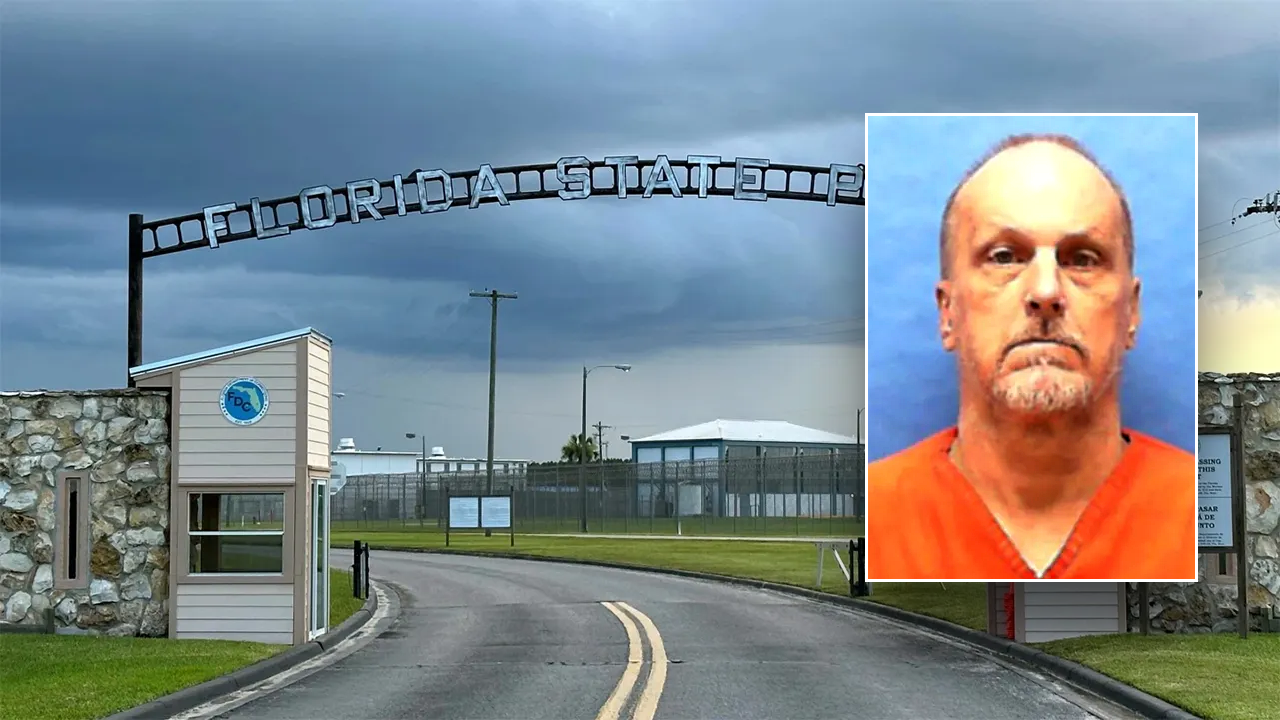
At Florida State Prison, on a Tuesday morning that had been marked on calendars for months, James Robertson got the ending he had engineered for himself. The 63-year-old was wheeled into the execution chamber, strapped to a gurney, and asked if he wanted to offer any final words before the state took his life. His response was as plain as the gray walls around him: “Nah, I’m straight.” There were no dramatic pronouncements, no last-minute pleas, no apologies to the family of the man he had killed. The warden gave the signal, and the three-drug injection began its work—first a sedative to quiet the mind, then a paralytic to still the body, and finally a drug to stop the heart. About ten minutes later, a doctor pronounced him dead. For a case rooted in such cold calculation, the execution itself felt almost quiet, almost ordinary. Robertson had committed murder in 2008 for one reason: he wanted to be sentenced to death. He strangled his cellmate, Frank Hart, while Hart lay sleeping, then pleaded guilty, waived all appeals, and told investigators that he had killed Hart because he would rather face the execution chamber than live out the rest of his days in prison. It was a horrifyingly simple transaction in his mind—one life traded for another, with the state as his unwilling partner. And in the end, he got what he wanted. But the silence in that chamber was not peace, and Robertson’s death did not settle the debt he owed. It only made more permanent the loss that Frank Hart’s family had already been carrying for years.
Frank Hart was more than a footnote in James Robertson’s plan, though it would be easy to forget that in the retelling of this strange and grim story. Hart was fifty-one years old when he died in 2008, just eight days before he was scheduled to be released from prison. He had been behind bars since 2003, serving time for a sexual battery conviction, and he was close to starting over. His daughter, Rebecca Hart, has spent the years since his death trying to remind the world that her father was a human being with a story of his own—not simply a means to an end for a man who wanted to die. Standing outside the prison after Robertson’s execution, she spoke with a grief that had not faded. “When someone you love is taken from you in such a violent way, the world keeps moving, even when a part of yours feels like it has stopped,” she said. “Other people go on with their lives, but you carry your loss into every tomorrow.” Those words hung in the air long after Robertson’s body had been removed from the chamber. For all the legal arguments about the death penalty, for all the debates about deterrence and justice, there is no way to make a daughter whole again. Hart was killed while he was at his most vulnerable, asleep in his cell, unaware that the man who shared his space had decided that Hart’s life would be the price of his own escape from prison. Robertson did not know Hart’s dreams or his fears or the family waiting for him. He only saw a way out. And when the state executed Robertson on Tuesday, it did not give Frank Hart back to his family. It simply closed the book on one man’s life while leaving another man’s loved ones still turning the pages of their grief.
To understand Robertson, one has to look at the decades that led him to that cell. He was only seventeen years old when he first entered the Florida prison system in 1980, sentenced for burglary and assault. He was little more than a teenager when the gates clanged shut behind him, and the years that followed did not soften him. Additional convictions for escape, battery, and weapons offenses stretched his sentence further and further, and by the time he reached middle age, he had spent more than half his life behind bars. Prison was not a temporary interruption; it was the only life he knew. In 2008, after twenty-eight years of confinement, Robertson looked ahead and saw nothing but more walls, more rules, more days bleeding into one another. He decided that death was preferable. It is a tragic and disturbing logic, but it is not entirely incomprehensible—a man so worn down by the system that he would rather be executed than continue to breathe inside it. Robertson’s method was unforgivable: he took an innocent man’s life to achieve his own end. But the state’s response was also a heavy thing to witness. Florida officials insisted that Robertson’s execution was carried out humanely and with dignity. Jordan Kirkland, a state Department of Corrections spokesperson, told reporters that Florida has a sound lethal injection process and protocol, and that the state would make sure the procedure was as dignified as possible. The contrast with Tennessee’s recent botched execution of Christa Pike, who survived two doses of pentobarbital and had to be rushed to a hospital, hung over the proceedings. Florida wanted to show that it could kill with precision, without mistakes. And it did. But for all the clinical language of sedatives and paralytics, the reality is that the state deliberately ended a human life—and it did so at the request of the man himself, a request made possible by the murder of someone who never had a say in any of it.
The same day that Robertson was scheduled to die, Florida had initially planned a second execution. But that plan fell apart in the final days, and the contrast between the two cases is a reminder of how complicated and uneven the machinery of capital punishment can be. William Lee Thompson, 74, had been sentenced to death for his role in the 1976 kidnapping, rape, and murder of twenty-three-year-old Sally Ivester. He had been on death row for decades, and his case had already survived two previous attempts by Florida governors to execute him in the 1980s, when the state still used the electric chair. Years of appeals and stays had kept him alive. Last week, however, Republican Governor Ron DeSantis withdrew Thompson’s death warrant, the first time he had done so since taking office. The governor did not give a public reason, but he had already temporarily stayed the execution amid concerns about Thompson’s mental competency and failing health. Thompson’s attorneys said he suffers from dementia and is in declining physical condition; they had asked for him to be moved to a medical facility. In the end, the state decided not to put him to death—at least not yet. Thompson will remain on death row, and a new death warrant could be signed in the future. It is a strange limbo: a man convicted of a horrific crime, whose victims’ families have waited nearly fifty years for justice, now too unwell to fully understand what is happening to him. The decision highlights the moral and practical questions that accompany every execution. What do we do with aging prisoners who are no longer competent? Does executing a sick, frail man serve justice, or does it become something else entirely? And what message does it send when one man is executed because he wants to die, while another is spared because he is too sick to face his fate? There are no easy answers, only the difficult, ongoing human calculus of punishment and mercy.
The bigger backdrop to Robertson’s execution is Florida’s accelerating use of the death penalty. Under Governor DeSantis, the state has embraced capital punishment with a fervor not seen in decades. Last year, Florida carried out nineteen executions—the most of any Florida governor in a single year since the death penalty was reinstated in 1976, and roughly forty percent of the national total. Nationwide, there were forty-seven executions in 2025, the highest annual number since 2009. This year, Florida has already accounted for more than half of the thirty-one executions carried out across the country. Robertson was the Sunshine State’s seventeenth execution of 2026, and two more are already scheduled: William Reaves, 77, convicted of fatally shooting a deputy in 1986, is set to die on October 20, and Jesse Guardado, 64, who was convicted of robbing and killing a woman to buy drugs in 2004, is scheduled for November 5. In July, Florida executed two prisoners in a single day—the first time any state had done so in nearly a decade. The numbers are staggering, but each one represents a life and a death, a family waiting outside the prison walls, and a victim whose story deserves to be remembered. It is easy to reduce executions to statistics, to talk about them in terms of schedules and procedures and success rates. But for those who stand outside the gates with candles and photographs, every execution is a fresh wound. For the families of the condemned, it is the end of a long and painful road. For the families of murder victims, it is a moment of complicated emotion—relief, grief, anger, or sometimes nothing at all. The state’s swift pace may satisfy a public hungry for consequences, but it also raises the stakes for getting things right, because every one of these deaths is final.
In the end, Robertson’s execution is a story about the strange and unsettling intersection of despair, violence, and justice. A man who had spent nearly his entire life in prison decided he could not take it anymore, and he killed another man to force the state to kill him. He got his wish, and Florida carried out the sentence without a hitch. But did justice prevail? Frank Hart is still gone, his life stolen by a man who saw him as nothing more than a ticket to death row. Rebecca Hart still carries her loss into every tomorrow, as she said so plainly. And Robertson, who declined to say anything meaningful at the end, has become part of a larger, ongoing conversation about whether the death penalty is ever truly humane—even when the condemned person demands it. There is something deeply unsettling about the idea that a man can turn the state’s ultimate punishment into a suicide plan, using an innocent life as the key. The state did not flinch; it followed its protocol, and James Robertson was pronounced dead ten minutes after the drugs began to flow. But the questions do not die with him. They remain in the prison corridors, in the hearts of grieving families, and in the public conscience. Robertson may have been ready to go, but the rest of us are left to wrestle with what his death means—and whether the machinery of capital punishment, however carefully administered, can ever truly separate justice from revenge, or punishment from mercy. “Nah, I’m straight” were his last words. But for everyone else, the matter is far from settled.