



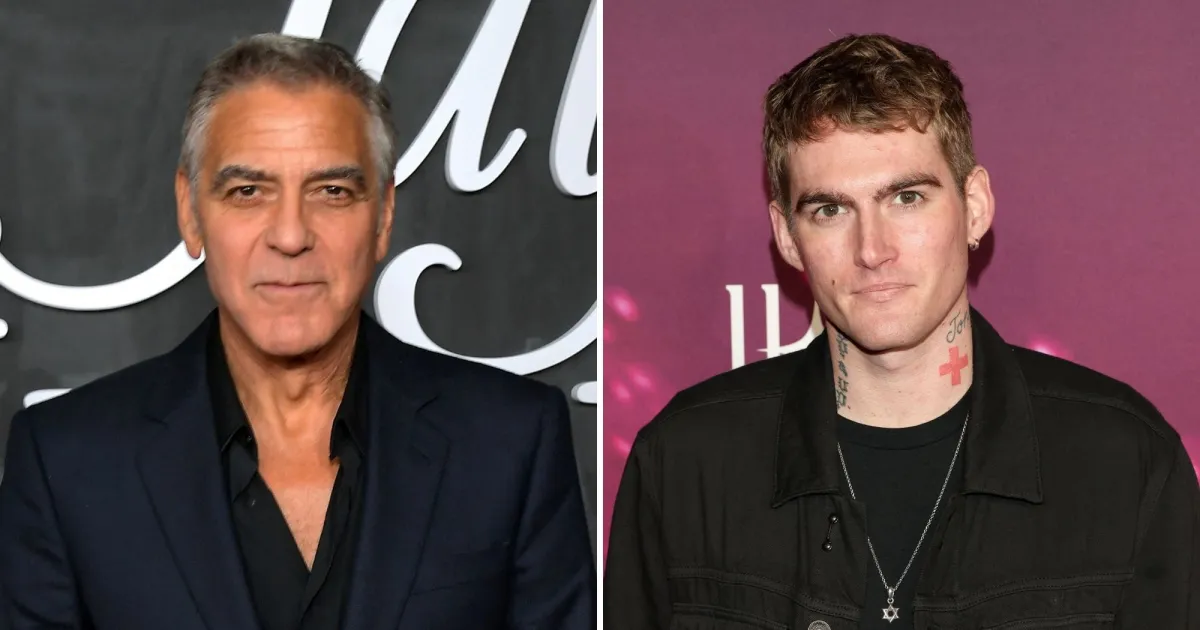
At The Albies, George Clooney’s annual celebration of people who quietly make the world better, the room was filled with stories of courage and kindness. But on Friday, October 9, Clooney himself seemed to be carrying a sorrow that no spotlight could ease. Speaking to Entertainment Tonight, he addressed the death of Presley Gerber, the 27-year-old son of his longtime friends Cindy Crawford and Rande Gerber. Presley had died on September 20 while in rehab, and the shock had not faded. “I don’t think we’re even in the position of even being able to talk about it,” Clooney said, his voice heavy with the kind of grief that does not care how famous you are. “Quite honestly, it’s one of the most devastating things that’s happened to our family.” He paused, not because he was searching for words, but because the words themselves were too small. “Their family is just, as you can imagine, it’s the worst thing that could happen to the family.” There was no polish, no prepared statement, no actor’s composure. There was only a friend who had watched a young man grow up and who now had to face a future without him. The Albies are meant to inspire hope, to honor people who have saved lives and lifted communities. But grief does not follow a script. Even as the room celebrated extraordinary deeds, Clooney’s heart was elsewhere, anchored to a family in pain. That contrast—applause and heartbreak sharing the same evening—was a reminder that joy and loss are never far apart. For Clooney, simply showing up took courage. He did not have to speak, but he did, and his words carried the weight of a love that predated the fame, the awards, and the tequila empire.
The bond between Clooney and the Gerber family was not built overnight. It was forged over decades, long before Casamigos Tequila became a billion-dollar name. Clooney and Rande Gerber first became friends in the 1990s, when Rande was building a career in nightlife and Clooney was becoming one of the most recognizable faces in Hollywood. They were two men who could have been content with casual friendship, but instead they built something deeper. In 2013, they co-founded Casamigos Tequila with entrepreneur Mike Meldman, turning a private joke into a global brand. What started as tequila made for sharing with friends became a company that was later sold to Diageo in a deal that could reportedly reach one billion dollars. Clooney and Rande often joked that they had accidentally created a real business, but the foundation of Casamigos was never really about money. It was about trust, loyalty, and the rare comfort of knowing someone will always have your back. That same comfort extended to their families. Clooney watched Cindy and Rande’s children grow up. He saw Presley as a little boy, then as a teenager, then as a young man trying to find his own path in a family that was already in the spotlight. He watched Kaia, Presley’s younger sister, become a model and a public figure in her own right. He was woven into the fabric of their lives—celebrations, holidays, ordinary moments that never made the tabloids. So when Presley died, it was not a distant tragedy happening to someone he vaguely knew. It was a blow to Clooney’s own heart. His use of the word “our” was deliberate and true. The Gerbers are his family in every way that matters, and grief, like love, does not follow bloodlines. In the aftermath, Clooney has reportedly been a quiet source of support for Cindy and Rande, offering the kind of presence that does not need to be announced or photographed.
The circumstances of Presley’s death are still painful and unresolved. Us Weekly confirmed on September 20 that Presley had died while in rehab. He was 27 years old. The Santa Monica Police Department told reporters that officers responded to a call about a possible overdose at 9:35 a.m. local time on the morning of September 20. When they arrived, they found an unresponsive adult male at the scene. Presley was pronounced dead. His death is being investigated as a possible overdose, though authorities have said that no foul play is suspected. An autopsy was completed on September 21, and his body was cremated. Yet despite those steps, the official cause of death remains listed as “deferred,” pending further investigation and toxicology results. For the public, that leaves a frustrating gap. For the family, it is an agonizing limbo. They have already had to plan a funeral, to say goodbye in a way no parent should ever have to experience, and to watch a daughter lose her older brother. And still they do not have the full answer to the question that haunts every grieving family: Why? In a statement, the family asked for privacy during “this very difficult and painful time.” It was a simple request, but in an age of viral news and endless speculation, it felt almost radical. They were not asking for sympathy or attention. They were asking to be allowed to grieve in peace. The loss of a child is a trauma that defies language. Add to that the public nature of their lives, and the weight becomes almost unbearable. Every headline, every comment, every stranger’s opinion becomes another small cut. The family is not refusing to share; they are simply protecting the fragile space they need to survive.
Presley Gerber was not just a model or the son of famous parents. He was a young man who, in the last stretch of his life, made a deliberate choice to be honest about his struggles. He used Instagram as a kind of public journal, not to curate a perfect image but to break the silence that so often surrounds addiction and mental illness. In December 2025, he shared a video in which he detailed the medications he was taking. “Here’s some clarity for ya — the truth will set you free (hopefully) haha,” he wrote. The “hopefully” and the “haha” are telling. Presley was not pretending to have answers. He was trying, sometimes awkwardly, sometimes painfully, to make sense of his own life while reaching out to others who might be lost. He listed one milligram of Buprenorphine twice a day—a medication commonly used to treat opioid use disorder and pain—and mentioned Valium as well. This was not a dramatic cry for help. It was something braver: a quiet, unglamorous disclosure of the daily reality of living with addiction. “I’m hoping this reaches people in many ways … so you feel like you’re not alone, because that is how I feel most of the time,” he said. “I have a feeling if I say all of this, a lot of people will at least know that there’s someone else going through it.” Those words now carry an unbearable weight. He was telling strangers the things he could not say easily to the world. He was trying to turn his pain into a bridge for others. In doing so, he revealed the profound loneliness that so often accompanies substance use—the sense that no one truly understands, that the shame is too heavy to carry alone. His willingness to share his medication list was not sensational; it was practical. It was a way of saying, “Here is what real recovery can look like, with all its ups and downs.” He wanted to be useful. He wanted his suffering to mean something. That is not the act of someone who gave up; it is the act of someone who was still fighting.
Presley’s death is a painful reminder that addiction does not care about privilege, fame, or love. It can touch anyone, anywhere, at any time. Cindy Crawford and Rande Gerber gave their son every opportunity a parent could imagine. They had resources, connections, and access to treatment. And still, the disease found him. That truth is almost too difficult to face, because it suggests that no amount of wealth or care can fully protect the people we love. Rehab was supposed to be a safe place, a sanctuary for healing. Instead, it became the setting of his final chapter. There is a particular cruelty in that. For Clooney, the loss is a reminder that friendship cannot always save someone, even when it is deep and genuine. He could not shield Presley from the battle Presley was fighting. None of them could. What they could do was love him, and they did. The family’s request for privacy is a reminder that grief is not a performance. The public may want answers, but the people at the center of this tragedy need time, space, and grace. The investigation into Presley’s death is ongoing, with the cause still deferred. Toxicology results may take weeks. But no answer will bring back a son, a brother, a friend. It will not erase the sound of his laugh or the shape of his smile. It will not help his parents sleep at night. What it can do, perhaps, is provide a small measure of understanding—a reason, if one exists—and a warning to others. But for now, the family is left with the unbearable work of learning to live without him. They will do it because they have no choice, and because grief, however vast, is a testament to love. Grief is the price of having loved deeply, and the Gerbers’ grief is a measure of how much Presley meant to them.
In the end, the most fitting response to Presley Gerber’s death is not fascination or judgment, but compassion. George Clooney’s halting, heartfelt words at The Albies are a model of that compassion. He did not try to explain away the tragedy or offer false comfort. He simply acknowledged that he and his family were devastated, and that the Gerbers were living through the worst thing that can happen to a family. Sometimes that is all we can do: stand beside someone and say, “I’m here.” For Cindy, Rande, and Kaia, the road ahead will be long and unpredictable. There will be moments when the grief feels as fresh as the day it happened, and moments when it is possible to smile again without guilt. There will be reminders of Presley everywhere—in a song, in a photograph, in the way his sister tilts her head. The rest of us can honor his memory by refusing to let addiction be a source of shame. We can talk about it openly, as Presley tried to do. We can listen without judgment. We can tell the people we love that they are not alone, and we can mean it. If you or someone you know is struggling with substance abuse, help is available. The Substance Abuse and Mental Health Services Administration (SAMHSA) National Helpline can be reached at 1-800-662-HELP (4357). It is a small number, but it can be the beginning of a different story. Presley wanted people to know that they were not alone in their struggle. That wish can still be fulfilled, even in his absence. We can carry it forward. We can hold his family in our hearts, even as we respect their privacy. And we can remember that behind every headline is a human being, a family with a broken heart, and a friend like George Clooney who cannot stop thinking about them. Rest in peace, Presley Gerber. Your honesty mattered. Your life mattered. You were not alone.