

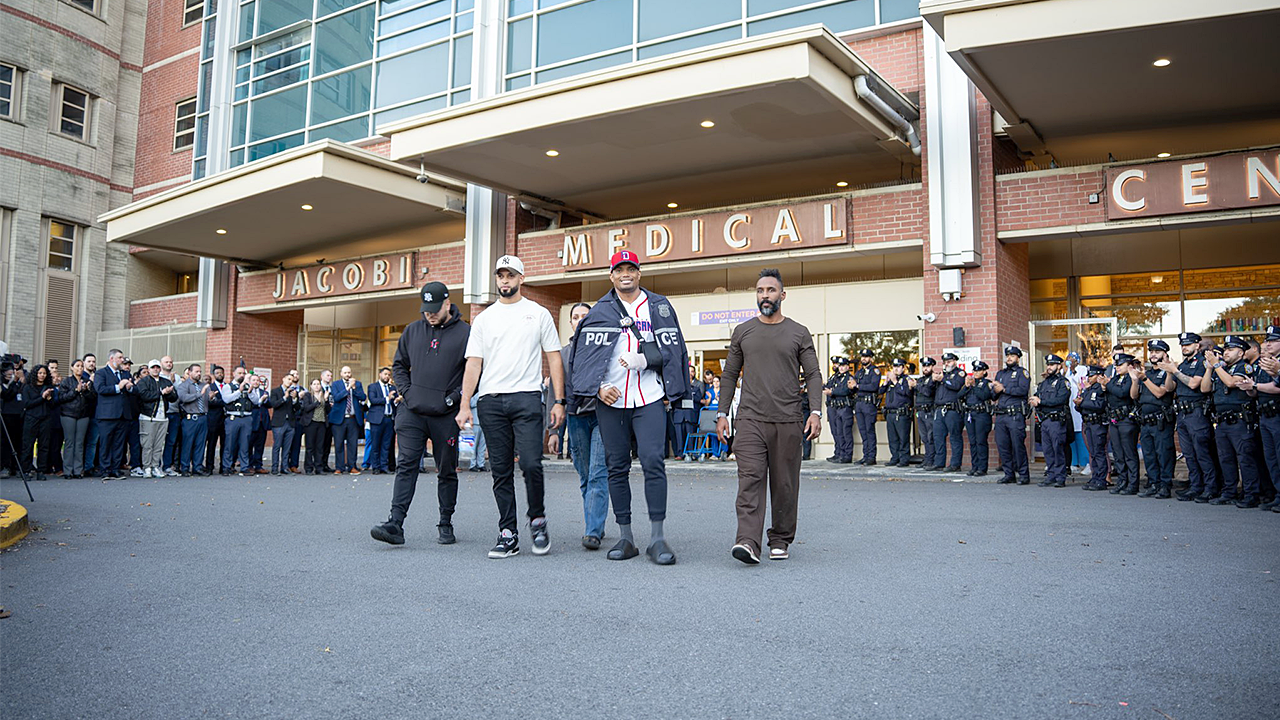
It begins with a hospital door opening, but the moment that followed felt like something far bigger than a discharge. Detective Jose Mercedes, a member of the New York City Police Department, was wheeled out of Jacobi Medical Center in Morris Park on Monday morning, his body still bearing the fresh and brutal evidence of a violent street attack. For days, his colleagues had waited by their phones, by hospital corridors, and in their own quiet thoughts for word that he would pull through. When he appeared, the crowd of officers gathered outside erupted in applause. But the most powerful image, the one that would echo across the department and beyond, came when the detective, with visible effort and unmistakable will, rose from that wheelchair and walked out of the hospital on his own two feet. It was a small number of steps for most people, but for a man who had been stabbed and slashed seven times just days earlier, it was a monumental declaration of resilience. Hundreds of members of the NYPD stood there to cheer their brother on, their voices rising in a chorus of relief, pride, and unbreakable loyalty. Families, too, had gathered, holding signs and wiping tears, because in moments like this, the badge is not just a piece of metal; it is a bond that ties every officer to every other. The scene was not merely a celebration of survival; it was a shared exhale after a terrifying weekend, an affirmation that the worst street violence cannot extinguish the spirit of a man who has sworn to protect others. As the detective moved past the glass doors, the applause grew louder, and for a few shining moments, the horror of what had happened to him was replaced by the sheer, undeniable power of human courage.
The story of how he got there is one that no officer should ever have to live, and no family should ever have to fear. Detective Mercedes was off duty on Friday afternoon, doing something ordinary and unremarkable: clearing out the trunk of his car in the Norwood neighborhood of the Bronx. It was a simple errand, the kind every New Yorker knows, a few trips to the back of the car, arms full of bags, mind already drifting toward the weekend. But in a city where danger can arrive without warning, that ordinary moment turned into a nightmare. Two suspects on an e-bike swooped in, not with a word, not with a warning, but with an attempt to snatch the gold chain from around his neck. For many, such an encounter might have ended in fear or surrender. But Detective Mercedes is not built that way. He fought back. He refused to hand over his dignity, his property, or his life without a battle. What followed was a violent struggle on a Bronx street, a chaotic and brutal collision between a trained detective and two predators who were willing to commit murder over a piece of jewelry. During that struggle, he was stabbed and slashed seven times. The pain must have been excruciating; the blood must have been everywhere. Yet even as his assailants broke free and fled, he did not fall still. The detective, bleeding heavily and fighting against shock, made a choice that defined his character: he stayed in the fight. What began as a robbery had become an attack on a peace officer, but for Mercedes, it had also become a mission. He was not going to let them simply ride away.
What happened next borders on the incredible, and it is the part of this story that has moved so many people. Despite his injuries, despite wounds that would have sent most human beings to their knees, Detective Mercedes forced his body to keep moving. He chased the two fleeing attackers on foot for about two blocks, running through the streets of Norwood with blood soaking through his clothes, his vision surely blurring, his lungs burning, his mind locked onto one thought: stop them before they hurt someone else. He made it to the intersection of East 206th Street and Rochambeau Avenue before his body finally gave out. It was there, on the pavement, that he collapsed, surrounded by the quiet shock of a neighborhood that had just witnessed something horrifying. Emergency responders arrived quickly, and he was rushed to Jacobi Medical Center, where doctors fought to repair the damage done by those seven blows. In the days that followed, the full story began to emerge, and with it, a portrait of a man who seemed to run on something deeper than adrenaline. His colleagues were not surprised. Those who knew him described a detective who was relentless in his work, who cared about victims, who believed in the mission of justice down to his very core. The chase was not a moment of madness; it was a lifetime of devotion compressed into a desperate sprint. He was not trying to be a hero. He was simply doing what he had always done: protecting his community, even at the risk of his own life.
Police Commissioner Jessica Tisch did not hide her emotion when she spoke about the moment. In a message posted to X, she wrote, “Today, in another incredible feat of strength and determination, Detective Mercedes got up from his wheelchair and walked out of Jacobi Medical Center on his own two feet. Hundreds of members of the NYPD were there to cheer their brother on.” There was a weight in her words, a recognition that this was not just an official update but a deeply personal triumph for the entire department. She went on to promise that the full machinery of the NYPD would be dedicated to finding the people who had done this to him. “The entire department stands behind Detective Mercedes as he continues his recovery. And the greatest detectives in the world will relentlessly pursue those responsible for this crime,” she added. Those words were not rhetoric; they were a vow. In the days since the attack, investigators have been working around the clock, pulling surveillance footage, interviewing witnesses, and following every lead in a city that has little patience for those who attack police officers. The commissioner’s tone reflected both rage and resolve, the kind of determination that follows an attack on one of New York’s own. But there was also tenderness in her message, a reminder that behind the badge is a man with a family, a man who will carry scars from this day for the rest of his life. The applause outside the hospital was not just for a detective who survived; it was for a brother who embodied the very values that the NYPD holds most dear.
The hospital visit days earlier had been a moment of quiet sorrow and hope. Police Commissioner Tisch, along with New York City Mayor Zohran Mamdani, had gone to Jacobi Medical Center to see the detective and his family in the immediate aftermath of the attack. They sat with him, spoke with his loved ones, and offered whatever reassurance they could in a moment when nobody yet knew how the recovery would unfold. The mayor later released a brief but heartfelt statement: “I visited the detective and his family at Jacobi Hospital with Police Commissioner Tisch. I am hoping for his quick and complete recovery.” There is a strange intimacy in those visits, a reminder that public officials, for all their titles and duties, sometimes sit in hospital rooms and hold the hands of people who are hurting. For the family of Detective Mercedes, those visits were likely a source of comfort, proof that their husband, father, and son was not alone in his fight. But for anyone who has ever lived through a loved one being attacked, the waiting is the hardest part. Every hour in the intensive care unit feels like an eternity. Every update from a doctor is weighed in silence. Every new day brings both hope and anxiety. The detective’s family had to live through that unbearable uncertainty, watching as the man who had always been their protector suddenly became the one in need of protection. To see him rise from a wheelchair and walk out of the hospital, then, was not just a medical milestone; it was a gift to everyone who had prayed for him. It was a moment of grace in a city that has seen too much violence and too much sorrow.
Now, as he begins the long road to recovery, the search continues for the two attackers who remain at large. Police say the suspects fled after the stabbing, and despite an intense investigation, no arrests have been made as of Monday. There is frustration in that fact, and fear too, because the people who did this are still out there, still capable of turning an ordinary afternoon into a bloodbath. But there is also confidence in the NYPD’s response. The same department that cheered Detective Mercedes out of the hospital will now channel that energy into the hunt. Detectives are sifting through evidence, following digital footprints, and canvassing neighborhoods with the kind of focus that only comes after one of their own is wounded. They will not stop until justice is done. And perhaps, in the end, this story is not just about violence, but about the stubborn, radiant strength of the human spirit. Detective Mercedes could have been another statistic, another name on a list of officers hurt in the line of duty. Instead, he is a living testament to willpower. He walked out of that hospital because he refused to let hatred have the final word. He walked out for his family, for his fellow officers, and for the city he has sworn to serve. The pain will linger, the scars will remain, and the memory of that afternoon will never fade. But so too will the memory of the applause, the tears, the cheering, and the sight of a wounded detective taking his first steps back into a world that stands firmly behind him. In that moment, he was not just a survivor. He was proof that even in the darkest hours, courage has a way of walking forward.