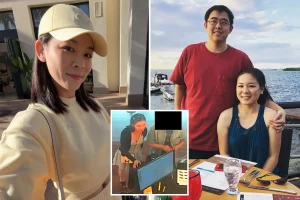


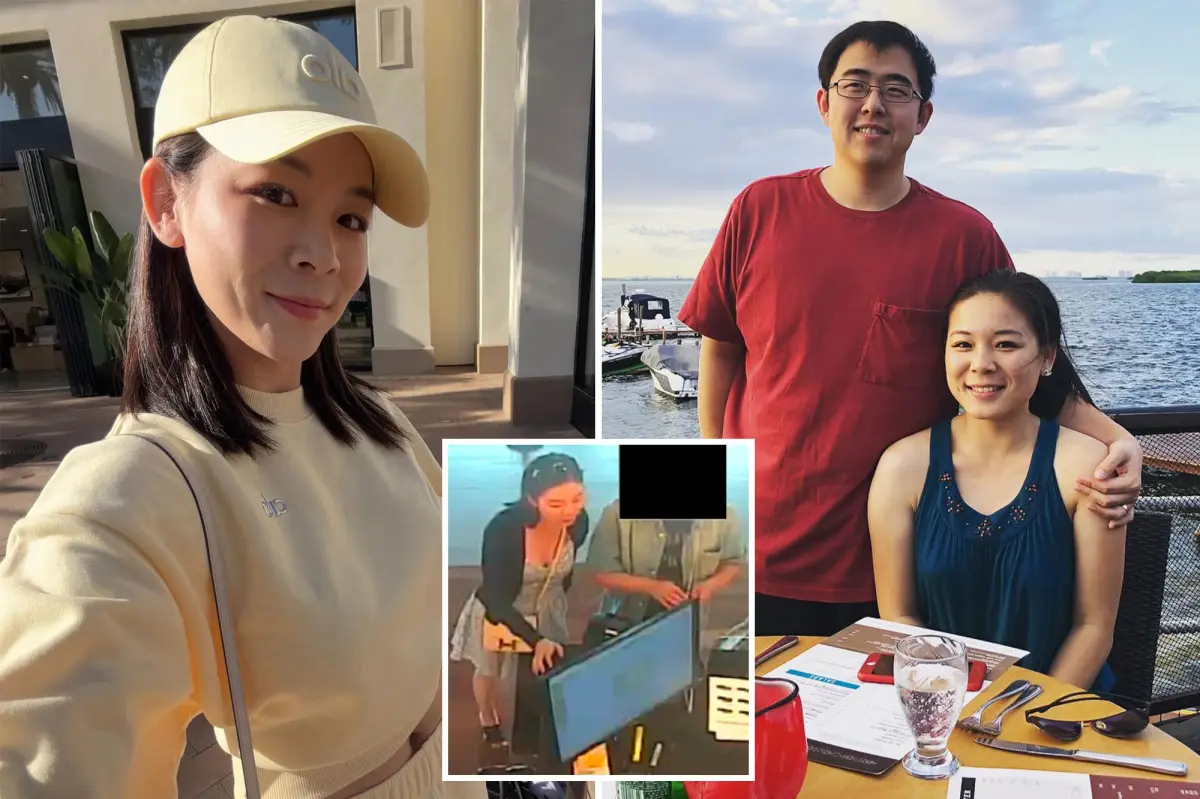
Glitz and federal gravity collided in a downtown Los Angeles courtroom on Monday, as Wanying Zhang—a glamorous California realtor accused of spying on a world leader’s son—made her first court appearance. Zhang, who also goes by “Heather,” walked before a judge looking more like a polished professional than an accused foreign agent. She wore a high-collared designer jacket, black pants, and highlighted hair, but the upscale styling could not soften the harsh reality of the federal shackles around her wrists. Her husband, Edric Ding, sat in the gallery, watching in silence as the woman he both lives and works with faced accusations that could reshape their lives forever. The hearing took a bizarre turn almost immediately: Zhang’s public defender, Chad Pennington, asked for a sidebar conversation with the judge just seconds after the proceeding began. That quiet request triggered a lengthy twenty-minute recess, leaving the courtroom waiting in suspense. When the parties finally returned, Zhang was asked if she understood the charges against her. “Yes,” she answered, her voice calm but subdued. The judge then continued the matter to Wednesday, giving Zhang time to decide whether to retain private counsel. It was a brief, procedural moment in the legal books, but the scene was heavy with an almost cinematic tension—a wealthy 34-year-old real estate agent from Orange County, standing in federal court, accused of espionage.
Perhaps the most revealing moment of the day happened outside the courtroom, after the hearing had ended and the media’s attention shifted to the man who had stood quietly by. Edric Ding spent the entire afternoon in the courthouse hallway, scrolling through his cell phone, waiting for any word about his wife. He was not allowed inside for much of the proceedings, or perhaps he simply preferred the distance. When he finally walked out, reporters pressing for answers were waiting for him. Asked directly whether his wife was a Chinese spy, Ding offered no response. He stared straight ahead, his face unreadable, and at one point raised a hand to block a camera and shield himself from the flashing lenses. His silence was louder than any denial could have been. The couple live in Irvine, a comfortable, manicured community in Orange County, and together they work at a real estate firm—a business built on trust, charm, and personal connections. That ordinary suburban life now seemed shattered. Zhang had been arrested at LAX the day before, just as she was allegedly trying to board a flight to Shanghai. Video taken moments after the arrest showed several FBI agents leading the handcuffed realtor through the airport terminal, her designer outfit contrasting sharply with the jackets and badges around her. It was an image that summed up the entire case: glamour and suspicion walking together into the hands of federal law enforcement. The USC-educated realtor had reportedly been under investigation for some time, and whatever she planned to do in Shanghai would have to wait indefinitely.
The allegations against Zhang are as detailed as they are startling. According to the federal criminal complaint, the 34-year-old is accused of working with handlers from the People’s Republic of China to surveil Ting-Yu Lai, the son of Taiwan’s president, Ching-te Lai. Ting-Yu Lai is an engineer in his thirties, based in the United States and employed by the electronics giant Philips. He is not a political figure or a public personality; by most accounts, he is a private individual trying to build a career far from the intense political spotlight that surrounds his father. Federal investigators allege that Zhang traveled to Seattle in September 2025 specifically to spy on him. Surveillance camera photographs reportedly captured Zhang sitting in a car with an accomplice, taking pictures of Lai’s house and close relatives. The idea that a wealthy California realtor would travel hundreds of miles to photograph the family of a Taiwanese official’s son seems almost absurd, yet the evidence laid out in the complaint paints a methodical picture. Zhang allegedly tracked her target’s daily movements, documented his home, and kept records of those around him. For Lai, a young engineer who has little to do with politics, the discovery that he was being watched must have been deeply unsettling. The complaint suggests that his private life, his routines, and his loved ones became the focus of a foreign intelligence operation, allegedly headed by Chinese officials eager to monitor the family of Taiwan’s leader.
The government’s case hinges significantly on a series of text messages exchanged in September 2025 between Zhang and other suspected agents. These messages, described in the FBI’s criminal complaint, show a chillingly casual tone about what should have been a serious crime. At one point, Zhang allegedly told a Chinese government official that she had seen the Taiwanese president’s son. “It’s that young one,” she wrote. The official then asked whether Zhang was available for an audio call to discuss the matter further. Zhang responded that she was busy recording video of him. That single detail—a realtor filming the son of a foreign leader from what prosecutors describe as a surveillance position—gives the case something more solid than a vague accusation. Text messages are concrete, often irrevocable, and they anchor the prosecution’s narrative. They also strip away any spy-movie mystique and replace it with something more ordinary: a person texting back and forth, checking in, sharing updates, as though surveillance were just another task on a to-do list. Zhang’s defense, for now, remains unknown. Her public defender has not offered a substantive response to the allegations, and Wednesday’s hearing will likely reveal whether she plans to hire a private attorney or continue with court-appointed representation. What is already clear is that federal prosecutors believe those texts are enough to tie a luxury real estate agent to a foreign intelligence operation aimed at monitoring the son of a democratically elected leader.
Zhang’s arrest is not happening in a vacuum. It is the latest in a series of high-profile cases involving allegations of Chinese influence and espionage in California, a state with deep cultural, economic, and political ties to the Asia-Pacific region. In March, disgraced former Arcadia mayor Eileen Wang entered a plea in federal court after the bombshell admission that she had been a spy for China. Her case sent shockwaves through local politics, as residents and officials alike struggled to understand how someone so embedded in community life could be secretly working for a foreign power. Then, in August, newly released FBI files revealed that former Democratic Rep. Eric Swalwell had confessed to a prescription drug-fueled sexual encounter with Christine Fang, also known as “Fang Fang,” a suspected Chinese agent. That story blurred the lines between personal vulnerability and national security in a way that generated endless headlines. Together, these cases have fueled growing unease about Beijing’s willingness to recruit Chinese-Americans and use them as instruments of state policy. As Bill Essayli put it, “We have a problem with Beijing using Chinese-Americans for their own purposes in California. They are using them for their own foreign affairs because they are playing the long game to get a competitive advantage over us.” The alleged surveillance of Ting-Yu Lai is especially sensitive because it involves Taiwan, a self-ruled island that China claims as part of its territory and has repeatedly threatened to bring under its control. The stakes of Zhang’s case, then, extend far beyond one woman’s future; they are tied to a larger geopolitical struggle.
For now, Zhang remains in federal custody, her next court appearance scheduled for Wednesday, her professional life in ruins, and her husband’s silence leaving more questions than answers. There is something profoundly human about the image she projected in court—a woman who built her career on polish, presentation, and personal connection, suddenly forced to appear before a judge in chains. It is worth remembering that Zhang has not been convicted, and her attorneys may offer explanations that reframe the government’s story. The American legal system still presumes her innocent until proven guilty, and Wednesday’s hearing could bring new details or signals about how she intends to fight the charges. But the human cost is already visible. A marriage strained beyond comprehension. A career in real estate, built on trust and reputation, likely destroyed. A family thrust into the glare of international media. And on the other side, a young engineer who must live with the knowledge that he was photographed, watched, and discussed in coded messages by strangers. The case is a reminder that espionage is not always carried out by shadowy figures in trench coats slipping through the dark. Sometimes it looks like a successful realtor in a designer jacket at Los Angeles International Airport, heading home to Shanghai. Sometimes it looks like a husband staring ahead silently while reporters shout questions he refuses to answer. As the legal process unfolds, the public will likely learn more about what Zhang actually did, why the FBI was watching her, and what her alleged handlers hoped to gain. Until then, the image of a glamorous fate in federal court will linger—a reminder that the line between ordinary life and international intrigue has rarely appeared so thin.