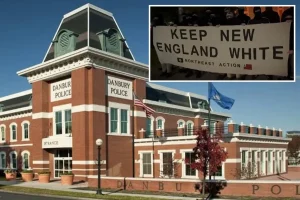


The morning air was heavy with something more than humidity. It carried the kind of tension that settles on a campus when the unspoken finally becomes impossible to ignore. Students and faculty gathered in the gray light outside the administration building, a stately old structure whose limestone facade had been tagged overnight with dark spray paint. The marks were raw, defiant, and unfinished — a scrawl that looked less like a political slogan than a scream translated into letters. Some had come early, standing in small clusters, warming their hands on coffee cups. Others drifted in slowly, drawn by texts and rumors and a need to be near people who understood. It was the first large gathering on campus since the sexual assault allegations had come to light, and the absence of official structure made it feel honest. No podium, no printed program, no welcoming remarks. There was only the building, the vandalism, and a crowd of people deciding that silence was no longer bearable. The gathering was not announced. It simply happened, the way grief happens, the way anger happens. A professor in a wool coat stood beside a student in a hoodie, both staring at the painted words. No one asked why the damage had occurred. In a way, everyone knew. The building had been a destination for complaints, a place of meetings, a symbol of institutional response — or lack of it. The spray paint was crude, but it spoke a truth that many in the crowd carried quietly for years. There was a strange intimacy to the moment, the way strangers nodded at each other without needing introduction. They were bound by an exhaustion that preceded the scandal. And now, with the allegations public, that exhaustion had a face, a name, and a place to stand.
The revelations had hit the campus like a slow earthquake. First came the article, meticulously reported, listing accounts from survivors who had long carried their stories alone. Then came the official statements, careful and legalistic, promising investigations and cooperation. But for many in the crowd, the words had arrived not as news but as confirmation — a long-buried secret finally unearthed. The allegations were specific enough to feel personal, and vague enough to feel universal. That was part of the pain. The gathering outside the administration building was not a celebration of revelation. It was a wake for decades of small denials, sidelined concerns, whispered warnings about certain people, certain parties, certain floors of certain dormitories. As more people arrived, the crowd grew dense. A student with a bullhorn opened her mouth, then closed it, deciding that words were not yet possible. Instead, she held up a piece of paper. On it was written a date. Someone else added a name. Then another. The paper became a collage of disjointed fragments, and the crowd began to understand that these fragments formed a pattern too large for any single story to contain. Faculty members stood awkwardly, unsure of their role in a moment that demanded more than academic neutrality. Some cried openly. Others offered their jackets to students who shivered in the morning chill. The administration building behind them seemed to loom larger than usual, its clean glass windows reflecting a sea of faces that had finally stopped looking away. No one in the crowd knew exactly what would happen next. But they knew that the old rhythm of silence had been broken. That knowledge was terrifying, and also freeing.
Then the gathering found its voice. It began with a young woman in a gray sweatshirt who stepped forward and told the crowd her name. She did not tell a story. She did not need to. She simply said she was tired of carrying. The crowd responded with a murmur of recognition, not applause — applause felt wrong for what they were mourning. Another survivor stepped up, then another. Some spoke through tears, their sentences halting and incomplete. Others read names or dates, as if reading a memorial roll. A professor of sociology, visibly shaken, spoke about the culture that allows predators to thrive — the networks, the euphemisms, the quiet agreements to look away. Her voice cracked on the word “complicity.” A group of students in matching t-shirts, the names of their club stamped across the back, stood in a tight circle, swaying. There was no single demand, no unified list of policies. What united them was simpler: the insistence that the building behind them change what it represented. The speakers did not point at the vandalism, but it stood as a backdrop, a visible wound. Some in the crowd worried that the vandalism would take over the narrative, that the damage to property would obscure the damage to people. But the voices kept going, and slowly the spray paint became less a distraction and more a mirror. It reflected back to the administration everything that had been written in student surveys, in confidential reports, in the cold language of official letters that politely declined to say too much. The crowd was not there to defend a broken window or a painted wall. They were there to say that the institution had been broken long before anything was touched. The difference was that now, the break was visible. And once something is visible, it can no longer be denied.
The emotional center of the morning, however, was not in the words but in the spaces between them. There were long silences in which people simply stood, listening to the wind and their own breathing. There were moments when someone would cross the crowd to embrace a friend, and that embrace would ripple outward like a chain of grief. There was a group of students who knelt on the wet grass, their heads bent, their hands on each other’s shoulders. An older staff member, someone who had worked in facilities for twenty years, stood by the edge of the gathering and held a box of tissues, saying nothing but offering them to anyone who needed. The body language of the crowd told a story that statistics could not: the rounded shoulders of people who had long braced themselves for bad news, the fists clenched inside coat pockets, the eyes that avoided the building’s windows for fear of seeing an official face looking out. At one point, a young man began to cry unexpectedly, his shoulders shaking, and those around him closed in like a shield. No one asked why. They simply stood closer. The vandalism, too, acquired a kind of sorrow. What had seemed like anger at 3 a.m. now looked, in the daylight, like the work of a person who had run out of avenues. The spray paint had been an act of desperation, a plea to be seen. The gathering echoed that plea, but with more patience, more gravity. People were not saying anything the administration didn’t already know. They were saying it in a way that demanded acknowledgment. And in that demand, there was a fragile hope — the hope that by standing together, by making the private public, they could force the institution to move beyond words of sympathy and into the difficult work of change.
As the morning wore on, the crowd’s tone shifted from raw grief to something like resolve. Student organizers, who had initially seemed stunned by the turnout, began to speak with clarity. They named specific requests: an independent investigation, transparency in reporting, a clear, humane procedure for survivors who wished to file complaints, and an end to the unofficial networks that allowed accusations to be buried. A woman from the faculty senate said that she could not promise change, but she could promise pressure. That honesty was met with nods, not cheers. The crowd understood that promises from the administration had been made before. What they were building was not trust — it was a presence that could not be ignored. The vandalism became part of the conversation, too. Some argued that it was destructive and would hurt their cause. Others countered that the real destruction was the one that had happened to people’s lives, and that a painted wall was not a tragedy but a symptom. A compromise seemed to form: the crowd would not condemn the act outright, nor would they embrace it. They would use it as a point of departure, a broken window through which to see the broken system. One student said something that lingered in the air: “The building got a little uglier this week. But it has been ugly inside for a long time. We are the ones who are here to make it beautiful.” It was not a slogan. It sounded like a commitment. By then, the sun had risen fully, casting long shadows across the lawn. The administration building was still closed, its doors roped off, a tacit acknowledgment that the vandalism required attention. That attention would come. But so would the voices gathered outside. And those voices had learned something important that morning: they were not alone.
The gathering ended not with a speech or a chant but with a long, collective silence. There was no signal, no instruction. People simply stopped speaking and stood together for a minute, maybe two. Then, slowly, the crowd began to disperse, not in a rush but in small clusters that broke off like pieces from a glacier. Some went to class. Some went home. Some stayed behind, sitting on the steps of nearby buildings, unwilling to fully leave. The smell of spray paint still hung in the air, sharp and chemical, a reminder that the night’s anger had not fully evaporated. But the day had changed its meaning. What had begun as a spontaneous gathering of the hurt had become something more deliberate, a shared recognition that the path forward would be long and uncertain. The administration would eventually issue its statements, investigate its policies, hold its meetings. But the people who came that morning would carry the memory of having been present when the silence cracked. The vandalism would be cleaned, painted over, washed away — but the questions it raised would remain, embedded in the very walls it had defaced. The crowd had not solved anything. They had not excused the overnight destruction, nor had they let the institution off the hook. They had simply stood. And in standing, they had reminded each other that change begins not in boardrooms but in the stubborn, trembling presence of bodies refusing to look away. The first large gathering since the allegations was not an end. It was the beginning of a long vigil — one that would continue long after the cameras left, after the paint faded, after the quiet settled back into the halls of power. And the people who gathered there, carrying stories that were not their own and some that were, would not let the memory of that morning disappear. They would carry it with them, into meetings, into classrooms, into every conversation where the temptation to be silent returned. They would open their mouths. They would speak. And the building would have to listen.