


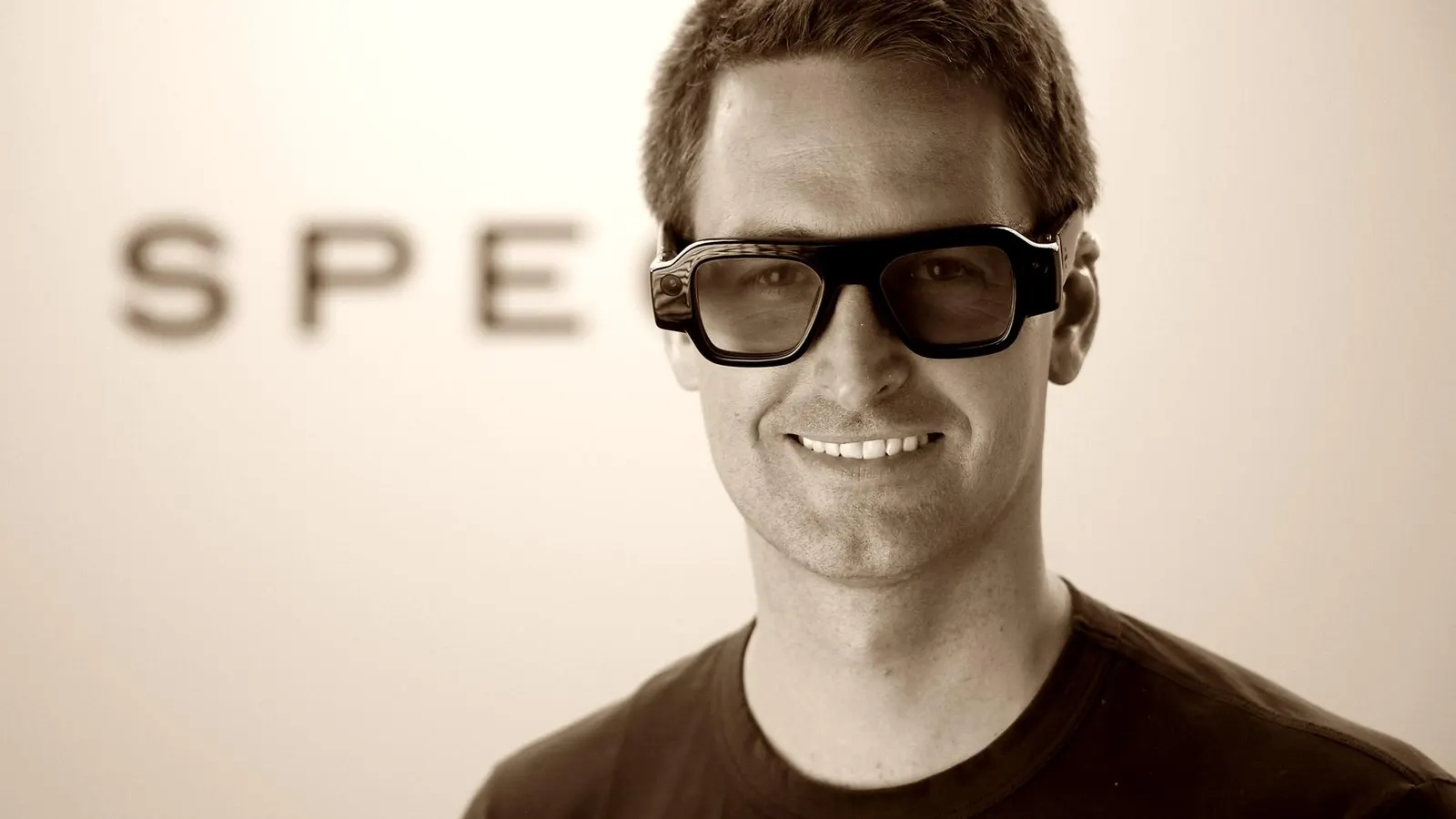
In mid-September, inside a small Beverly Hills theater, Evan Spiegel took the stage in his usual armor: a black T-shirt, jeans, and the kind of quiet confidence that once made him the heir apparent to Silicon Valley’s throne. But the newest addition to that armor was impossible to ignore. The $2,195 Specs—chunky black smartglasses that he has effectively staked his company on—hung over his eyes. When they had been unveiled in June, the internet had mocked them mercilessly: too big, too expensive, too awkward, looking more like safety equipment meant for someone fixing a gas leak than the next great wearable. Spiegel, now 36, leaned into the joke. He thanked the internet for the memes, cracked a self-deprecating line about the feedback, and tried to move the conversation past the obvious. But the jokes were only part of the story. This launch was Snap’s chance to prove that Specs were more than an expensive science project, more than a vanity play from a founder who once seemed destined for unrivaled greatness. After more than a decade of work and roughly $3 billion invested, Spiegel needed to show that he wasn’t just right—he needed to show that he could beat rivals with far deeper pockets. He had been right before. Snapchat helped invent modern social media, a fleeting antidote to Facebook’s permanent, polished scrapbook. But those golden days felt increasingly distant. Now Snap, a mid-cap company fighting for relevance, was trying to usher in a new age of smartglasses while going up against Meta, Apple, and Google—trillion-dollar giants with seemingly endless resources, their own high-tech eyewear, and artificial intelligence capabilities that Snap could only dream of.
The event itself seemed to be going reasonably well. Then came a hitch. Testing the glasses’ ability to play YouTube videos, Spiegel spoke a voice command asking Specs to pull up videos about Specs themselves. Nothing happened. “The suspense is killing me,” he said, fiddling with the device. “Why is that not clicking? Should we try again here?” He murmured to himself as the audience sat in a growing hush. About a minute later, the feature finally kicked in. He picked a video and read its title aloud: “AR Smartglasses Are Finally Here. Goodbye Meta Ray-Bans.” The room burst into laughter and applause. Live demos are always a gamble, but this little stumble felt like a perfect metaphor for Snap as a whole: ambitious technology, genuinely decent ideas, execution that often fell short, and the eternal shadow of Meta and Mark Zuckerberg hanging over everything. The history between the two men runs deep. Back in 2013, Zuckerberg—then a twenty-something billionaire worth around $13 billion—offered to buy Snap for $3 billion in cash. Spiegel, just 23, famously refused. The decision drew enormous scrutiny. Soon after, Meta responded with a wave of copycat features: Poke, a disappearing-message knockoff; Stories, a direct ripoff of Snapchat’s wildly popular format; and a flood of AR filters that superimposed digital graphics on the world around us. Those last two became pillars of Instagram. Spiegel even jokes on his LinkedIn profile that he is Meta’s VP of Product. The joke points to a deeper truth: even as Snap pushes forward with Specs, Meta continues to haunt it. During development, Snap employees internally compared the size and thickness of their frames to the rival Meta Ray-Bans. “We were like, ‘This is actually really close,’” one employee recalled. Snap declined to comment on those internal comparisons.
To be fair, Specs and Meta Ray-Bans are not actually the same species of product. Meta’s glasses are fairly normal-looking frames carrying technology for recording video, playing audio, and accessing Meta’s AI assistant. Specs are true AR glasses, with more computing power. They can draw a digital whiteboard over your field of vision, let you brainstorm a project on a walk, or turn a tabletop into a board game. The thick, clunky frames are the price of that extra brainpower. Meta’s own Orion AR glasses, announced in 2024, are still not on the market. Snap, in fact, prefers to think of itself as chasing Apple’s $3,700 Vision Pro—a futuristic goggle-like device with premium AR features and immersive virtual reality—rather than playing in Meta’s sandbox. But consumers haven’t shown much patience for such distinctions. So far they have chosen Meta’s cheaper glasses, sold under beloved brands like Ray-Ban and Oakley, including the iconic Wayfarer frames. One of Meta’s biggest weapons is its long-standing partnership with EssilorLuxottica, the world’s largest eyewear company, which gives it vast distribution and access to dozens of fashion labels. Specs, by contrast, were designed entirely in-house, and Spiegel has said Snap has no plans to partner with outside fashion or eyewear brands. So the largest advantage Meta has may simply be that people don’t feel ridiculous wearing its glasses in public. The company has sold more than seven million pairs. That doesn’t mean Meta’s hardware has escaped mockery—its glasses have been called “pervert glasses” because of their stealth recording ability, and Meta announced an audio-only version at its September conference to counter that image. But the price criticism for Specs was immediate. Snap apparently knew the risk. A person familiar with the project said the company understood consumers preferred a price closer to Meta’s Ray-Bans, which top out around $500—a quarter of Specs’ cost. Spiegel nonetheless insisted on developing deeper, more expensive technology that would be harder to steal, motivated no doubt by Meta’s long history of borrowing Snap’s best ideas.
After the more polished September launch, some observers softened. Snap showcased an AI assistant called Specs Intelligence and a Shopify-powered augmented-reality shopping feature. “It’s easy to critique how something looks on the outside but we all know it is about what’s on the inside,” Andreessen Horowitz partner Josh Elman posted on X. “And the inside here is magic.” Others remained unconvinced. One former employee who worked on Specs said, “I have no idea who this device is for.” Snap says the initial audience is early adopters and developers, and declined to discuss preorder numbers. Meanwhile, Meta, once seen as an AI laggard, has stirred up genuine excitement among consumers. In early September, it released Muse, a personal AI agent that goes beyond answering questions to actually carry out tasks like scheduling meetings or chasing refunds. It became a viral hit. A week after the Specs launch event, Zuckerberg helmed Meta’s Connect conference, where he touted how Muse would be folded into the company’s AI glasses to guide workouts or help buy products. Meta’s stock jumped almost 6 percent. Investors, by contrast, have not been kind to Snap. The stock hovers around $5 after a post-Covid high of about $80 in 2021, and the Specs launch did nothing to revive it. In March, activist investor Irenic Capital Management wrote a scathing open letter demanding layoffs and an end to the Specs business. A month later, Snap cut about 1,000 jobs, 16 percent of its workforce. Fidelity sold off about a quarter of its prior holding in the second quarter, while BlackRock sold about 7 percent. The smartglasses unit has not been sold, although if it were, it might lift the stock and force the company to focus on the core Snapchat app—which is still a bright spot. Snap pulled in $1.6 billion in revenue last quarter, up 19 percent year over year, and Snapchat has 970 million monthly users, far more than X’s estimated 560 million. But Spiegel remains devoted to Specs. Earlier this year, the company created a subsidiary called Specs Inc., housing the smartglasses teams in their own building at Santa Monica headquarters, with special badge access. When Snap laid off 1,000 people in April, none of the victims appeared to be from Specs Inc., according to three current and former employees, and some regular Snap staff were transferred into the group. In a town hall after the June unveiling, Spiegel tried to reassure employees that the mockery was actually positive: it had spread word of the product beyond the usual developer crowd.
Spiegel’s determination reflects an iron grip on Snap that has defined his career. Tech founders often inspire cultlike devotion, but Spiegel’s DNA is woven into the company at an unusual depth. As Google and Meta swelled to hundreds of thousands of employees, their founders receded into the distance. Snap, with only about 5,200 employees, remains within Spiegel’s orbit. He regularly dives into the details of feature design and app updates, according to current and former employees, and his fingerprints are everywhere. The best way to get a project approved, one former employee said, is to “speak Evanese.” He has always seen himself as a product maker of refined taste. He built an elite design team of about 20 people that acts as his inner circle, working with teams across the company and presenting projects to him weekly. Those meetings can decide what goes into development, two former employees said. One joked that Spiegel treats the team like the Precogs in Minority Report—psychics who can see the future. The team travels to lavish offsites in Japan, India, and Italy for inspiration. Spiegel’s biography is well known by now. He grew up in Pacific Palisades, the son of two powerful lawyers. At Stanford, he and fraternity brother Bobby Murphy, now Snap’s CTO, created Picaboo, an app for disappearing messages that eventually became Snapchat. His affluent upbringing was itself a competitive advantage, one former employee said; a former executive used to say that Spiegel embodied a rich teenager, so he knew how to build products for them. That perspective faded when he married and had children, the former employee suggested. Spiegel has three sons with supermodel Miranda Kerr, and a teenage stepson from Kerr’s marriage to Orlando Bloom. Snap rejected this characterization, saying the company has a diverse user base and noting that 80 percent of Snapchat users are over 18. But even in failure, Spiegel has shown an uncanny sense of where the world is headed. In 2017, not long after Snap went public, he traveled to Beijing to visit ByteDance, then still under the radar. TikTok had yet to launch, but Spiegel was fascinated by its predecessor, the viral news app Toutiao. The trip inspired a major overhaul of Snapchat, known internally as Project Cheetah, which shifted the app from chronological feeds to algorithmic ranking, just like Toutiao. The results were disastrous. Celebrities complained, more than a million users signed a petition, and Spiegel eventually sent a 6,000-word memo apologizing before reverting most of the changes. He was right about the future—TikTok did indeed take over the world—but Snap was not the right company to carry that torch at that time.
Almost a decade later, history may be repeating itself with Specs. Spiegel may be right about the future of smart glasses, but he may not be the one to lead us into it. Once hailed as the next Zuckerberg, he was a young, brash titan in the making. When he spurned Zuckerberg’s takeover offer, it positioned Snap to build itself into a tech giant that could challenge Facebook and Google. That never happened, despite a modestly successful IPO four years later. Now, while Meta and Google reach stratospheric valuations in the AI era—$1.8 trillion and $4.2 trillion in market capitalization, respectively—Snap is worth only about $9.4 billion. Spiegel, once the world’s youngest self-made billionaire at 23, never made the leap into true tech moguldom. A new generation of leaders—OpenAI’s Sam Altman, Anthropic’s Dario Amodei—have taken the mantle of progress, and Snap remains a scrappy mid-cap. “I think that comparison probably made sense 10 years ago,” one former Snap executive said of the Spiegel-Zuckerberg analogy. “But as a CEO, Mark is clearly on a different planet at this point.” Even Meta appears to have moved on. This summer, when Meta agreed to pay up to $18 billion to settle a lawsuit over teenage social media addiction—a case that also involved Snap, TikTok, and YouTube—its lawyers and executives tried to pull rivals along. In full-page newspaper ads, Meta wrote an open letter to competitors urging them to join in imposing new restrictions for teen users: a two-hour daily limit, no notifications during school hours. The letter was addressed only to TikTok and YouTube. Snap wasn’t mentioned. That omission might be the most revealing metaphor yet. For all of Spiegel’s vision, for all of the $3 billion poured into Specs, for all of the memes and the demos and the hope that this time he is right and also first, Snap has become an afterthought in the story of the next great technology. The glasses are real, and they may even be magical. But the world’s most powerful companies are already moving faster, and the man once destined to lead the future is still waiting for it to call his name.