


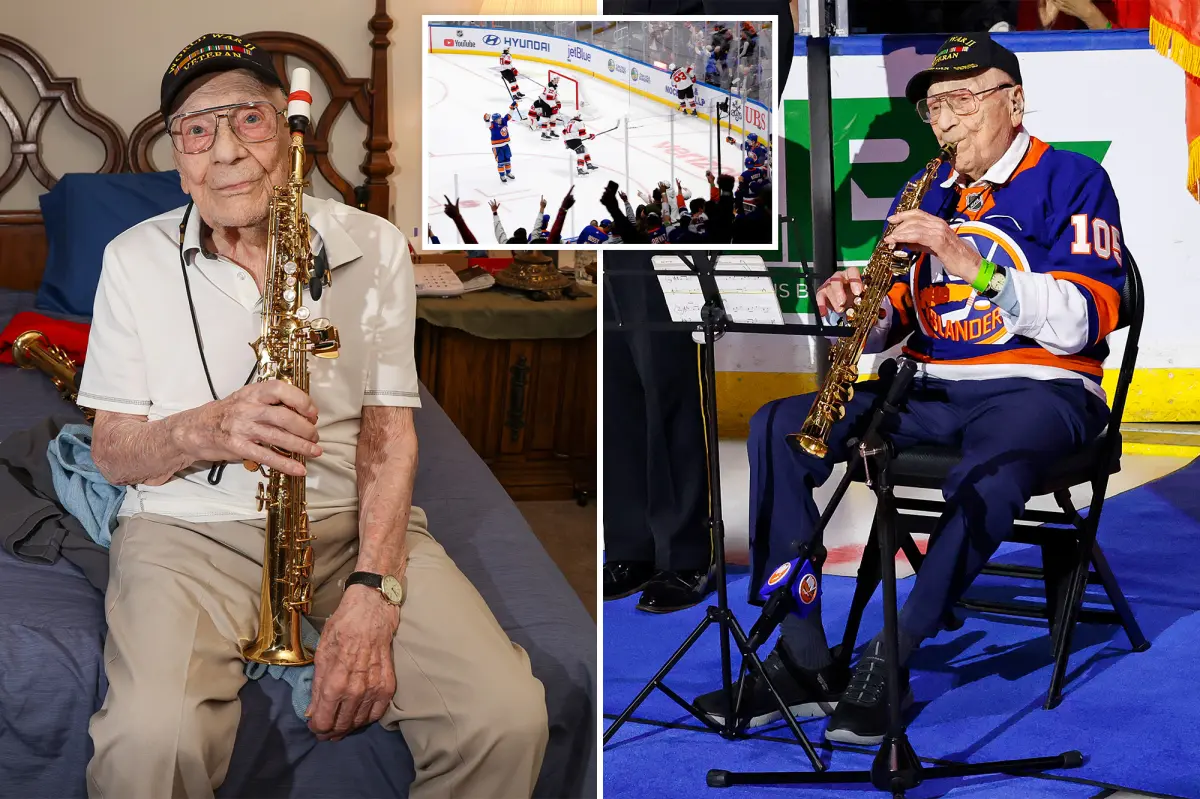
At 105 years old, with a saxophone in his hands and a lifetime of loyalty in his heart, Dominick Critelli looked out at a roaring UBS Arena and did what he has done for nearly a century: he made people feel something. The Long Island centenarian, a beloved World War II Army veteran from Floral Park, returned to the ice on Saturday night for the New York Islanders’ home opener against the New Jersey Devils. It was his second time playing “The Star-Spangled Banner” before an NHL crowd, and the encore was somehow even more electric than the first. Last December, Critelli went viral after delivering a soulful, stirring rendition of the anthem that united rival Islanders and Rangers fans in mutual awe. That performance turned a 105-year-old retired teacher and builder into an internet sensation and a local legend. On Saturday, the same magic filled the arena. Fans from both sides stood, cheered, and let the rivalry dissolve for three and a half minutes while an old soldier honored the flag with a jazz player’s touch and a patriot’s reverence. The Isles made the moment official by honoring Critelli as the game’s veteran and giving him a jersey with “105” on the back—a number that represented not just his age but his status as an American original—handed over by Islanders legend Butch Goring. Critelli, never comfortable with fuss, simply pointed to the flag. His own words still resonate: “What this country has done for me, no other country in the world could do—and I mean that. I love the USA, and I wouldn’t change it.” It is the kind of sentence that sounds like a slogan until you know the story behind it. And Critelli’s story is one of the most remarkable of his generation.
Critelli’s love affair with America began when he was a boy. Born in 1921 in Calabria, Italy, he was eight years old when his family boarded a ship to the United States. He remembered standing on deck, straining to see the Statue of Liberty, and feeling as if he had arrived in a dream. He would later say he was grateful he wasn’t “stuck” with Mussolini on the wrong side of history—a gratitude that would shape the rest of his life. By the time World War II came, Critelli was a flight mechanic and staff sergeant, serving his adopted country in the fight to liberate Europe. He survived the Normandy landings at Utah Beach, a moment of chaos and courage that he rarely describes in detail. Then came the Battle of the Bulge, the frozen Ardennes Forest in Belgium, where he flew fourteen supply and medicine drops behind enemy lines for stranded soldiers. Each mission was a gamble. The weather was brutal, the enemy was close, and the men on the ground were running out of time. Critelli’s summary is simple: “We saved a lot of lives.” For his bravery, he received the Air Medal and three Bronze Stars. In 2024, French President Emmanuel Macron knighted him, an honor that acknowledged his role in helping liberate France from Nazi occupation. It was a long-delayed thank-you from a country that had not forgotten. After the war, a close friend and ranking officer urged Critelli to re-enlist, promising an officer’s commission if he stayed for four more years. It was a tempting offer. But Critelli had carried enough weight. He wanted to go home, to build a life, to make music, to teach. And so he traded the uniform for a chalkboard and a tool belt, eventually becoming a teacher and a house builder in the community where he still lives today.
Music, not medals, has always been Critelli’s native tongue. He fell in love with it at thirteen, and before the war he studied at NYU, soaking up the jazz tradition that would become his signature. When he shipped overseas, he packed his saxophone in his gear, a small rebellion against the ugliness around him. It became his secret weapon. Between missions, he played for troops at dances and before VIP speeches, giving exhausted young men a few minutes of release. The instrument was more than entertainment; it was proof that the world they were fighting for still existed. His greatest performance, he insists, had nothing to do with hockey arenas. At the end of the war, he climbed on top of a tank in the Netherlands and played for thousands of newly liberated civilians. “I’ll tell you, those people are very thankful to us for what we did for them,” he said. “That was a wonderful day.” He still has that wartime saxophone at home near Belmont Park. It sits in the house where he has lived for decades, a silent but powerful artifact of history. Nearby, by his bed, he keeps the sheet music for “The Star-Spangled Banner”—not because he doesn’t know it by heart, but because he likes seeing it there. After the war, he continued performing his jazz specialties for troops and civilian audiences, never losing the feeling that music was a way of giving back. It was also a way of staying young. He plays with the same energy, the same swing, the same feeling that he had as a young man in Army fatigues. The notes have changed a little, but the heart hasn’t.
In recent months, Critelli has tasted the kind of stardom that usually belongs to much younger men. He says it makes him giddy, especially when he thinks about the rehearsal room at UBS Arena that bears his name in brass. “I thought that was very nice,” he said, with a smile that suggests he still can’t quite believe it. But fame has not softened his routine or his sense of purpose. After suffering a leg injury, he was treated at a physical therapy facility. Instead of simply recovering, he performed a show there in September, bringing his saxophone to the very place that had helped heal him. “I’ll be alright,” he said, waving off concern from behind his temporary walker. He is not the kind of man to sit still and mope. He believes in movement, in music, in red wine, and in keeping a schedule full of people who need him. Ask him the secret to his longevity and he might tell you it’s the wine. Ask again and he might tell you it’s the music. But anyone who sees him on stage knows the real answer: it’s purpose. He has never stopped showing up for others. At 105, he doesn’t have to prove anything. He simply chooses to keep going because people keep asking him to play, and he could never say no to kids—or to anyone else, it seems. The Islanders’ gesture, the crowd’s ovation, the bright lights of the arena—they all feel good. But Critelli knows the difference between a hero and a celebrity. He is the former. He just happens to be getting a little of the latter now, and he’s enjoying it with the innocent glee of a man who never expected any of this. He has earned every second of it.
Perhaps the most meaningful performances of Critelli’s long life are not the ones played for thousands of hockey fans, but the ones played for a few dozen teenagers in a school auditorium. Since his story began circulating on the global stage, schools have called, asking him to speak and perform for high schoolers. He cannot refuse. “Every day people call me—‘will you please talk to my kids?’” Critelli said. “I could never say no to kids.” His method is simple and effective. He begins with a tune on the saxophone, letting the music soften the room and give the students something to focus on before he starts talking. Then he tells them about freedom of speech. He doesn’t recite the First Amendment from a textbook. He tells them what it meant to fight for a country where people can speak their minds, where a kid from Calabria can grow up to play the national anthem at an NHL game. He watched the students take out their notebooks and start writing. “They’re listening,” he said, with the satisfaction of a master teacher. He walks them through the other freedoms they enjoy in America: freedom of religion, freedom of assembly, freedom to chase a dream as far as it will take them. He makes it personal. He makes it vivid. And he makes it matter. The kids clap. They have a good time. They leave with a face and a voice attached to ideas that can otherwise feel abstract. That, Critelli believes, is the whole point. He is not just telling his own story. He is giving young people a reason to care about the story of their country. And in a time when attention is scarce, a 105-year-old man with a saxophone can still hold a room full of teenagers in the palm of his hand. That is no small thing.
Critelli knows why he keeps telling his story, and it isn’t for the applause—although he appreciates it. It isn’t for the jerseys, the brass nameplates, or the headlines. It’s for the people who can’t tell their own stories. “The people left behind—they couldn’t talk the way I do, couldn’t do what I do,” he said. “I’m doing it for them.” Those words hang in the air like a benediction. He carries the memory of his fallen comrades, his fellow soldiers, and the millions of men and women who fought and died so that a nation of immigrants could stay free. He knows he was lucky. He survived Utah Beach. He survived the Battle of the Bulge. He survived nine decades after the war, which is more than most of his generation could do. And so he has taken on the role of witness and voice. When he stands on the ice at UBS Arena and plays “The Star-Spangled Banner,” he is not just a solo performer. He is a choir of ghosts, a generation’s farewell, a reminder of what tombstones cannot say. At 105, Dominick Critelli has earned the title “national treasure” many times over. But he would probably tell you that the real treasure is the freedom he has spent his entire life celebrating. He loves the USA, and he wouldn’t change it. And as long as he can raise his saxophone to his lips, the country he loves will keep raising him onto its shoulders. That is the exchange that defines him. He gave America his youth, his courage, his music, his heart. In return, America gave him a life worth singing about. But listening to him play, it’s clear who got the better deal. It was us.