


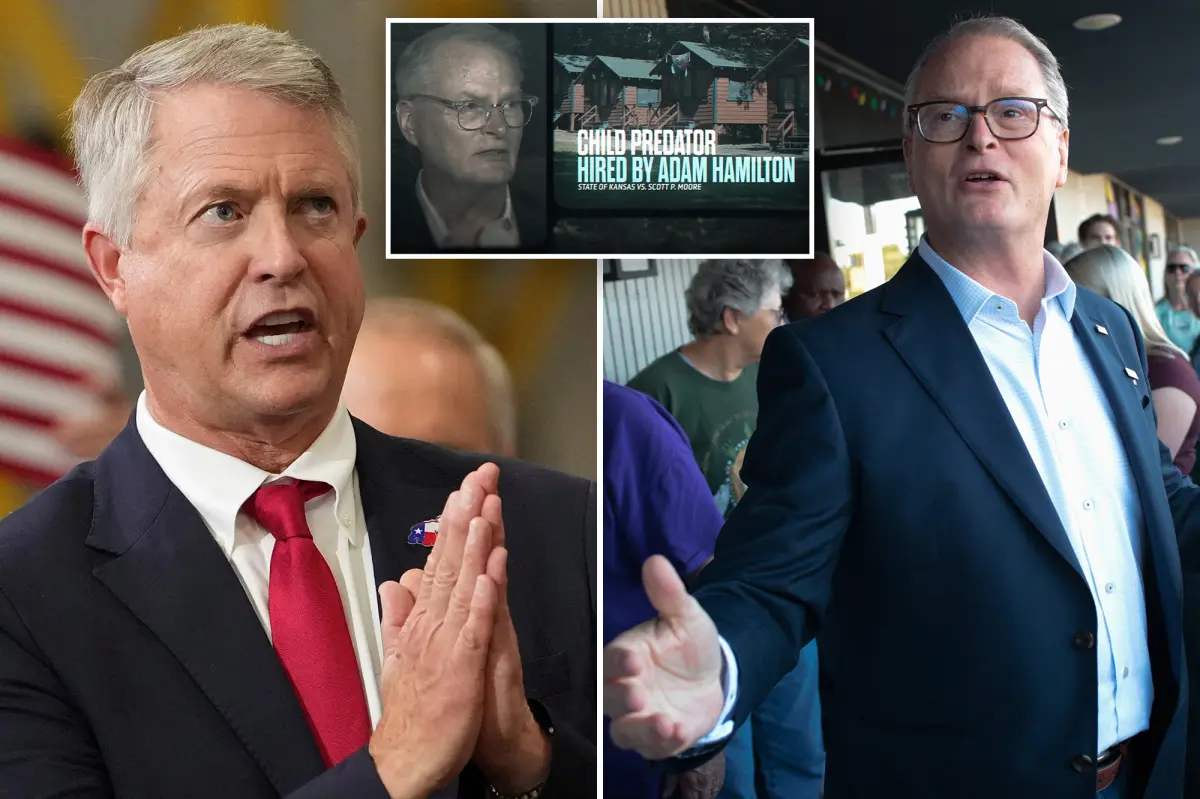
In the closing weeks of a remarkably close Kansas Senate race, the campaign has turned bitter and personal in a way that can feel far removed from the everyday concerns of voters. Incumbent Republican Senator Roger Marshall has unleashed a $1.2 million advertising blitz across broadcast, cable, and streaming platforms, and at the center of it is a devastating accusation aimed at his Democratic challenger, Adam Hamilton. The ad claims that Hamilton, the founding pastor of the United Methodist Church of the Resurrection in Leawood, failed to report a church volunteer named Scott Moore to law enforcement after Moore was accused of molesting teenage boys at church retreats in 2005 and 2006. The 30-second spot is blunt and visceral, telling viewers that Hamilton let a “child predator” return as a camp counselor after parents’ complaints were ignored, and that Moore went on to be convicted of more child sex crimes. The ad ends with a chilling line: “Adam Hamilton protected a pedophile. He should never be our senator.” For voters who know Hamilton only as a beloved pastor who built one of the largest Methodist congregations in the country, the commercial is jarring. But for Hamilton and his supporters, it is a distortion of a painful, complicated chapter in the church’s history, one that they say has been twisted for political gain.
The story behind the attack ad begins nearly two decades ago, at the church’s annual sleep-away camp for teenagers in November 2005. According to trial testimony later viewed by reporters, two boys were assaulted in a cabin during the weekend retreat. One victim, who was 15 at the time, testified that he felt a hand on his penis as he lay in his sleeping bag, and that when he began to stir, the person quickly rose and left the room. A second boy, then 14, described Scott Moore thrusting his hand inside the sleeping bag near his groin before being scared off as other boys in the cabin began to wake. The teenagers said Moore had come into their cabin that night and repeatedly mentioned an “open door policy,” even as they tried to shut the door to keep him out. The next morning, the boys found the courage to tell church leaders what had happened. Instead of being met with concern and protection, they said they were accused of slander. A youth minister essentially told them they were trying to ruin Moore’s name, that they were “messing with his life,” and that there could be serious repercussions. One victim later testified that no action was taken to investigate further at that moment. It is impossible to read those words without feeling the weight of their betrayal. These were children, in a place that was supposed to be safe, and when they spoke up, they were silenced. That raw, human detail is what makes this story so powerful and so painful, and it is also what makes the political battle over it so intense.
In the weeks that followed, the church did conduct an internal investigation, led by two officials named Randy Meyer and Nancy Brown. But the investigation was deeply flawed. Neither Meyer nor Brown was a trained investigator, a licensed social worker, or a mandatory reporter under Kansas law. Brown had served on the church’s sexual ethics committee and had even authored training materials for handling abuse allegations, but she had no state certifications. Despite the boys’ detailed statements, the investigators ultimately cleared Moore of wrongdoing. Parents were never told the outcome of the investigation, and one mother later testified that she never really learned what had been decided after a meeting in November 2005. That meeting was held in Hamilton’s office, but Hamilton himself did not attend. By the following fall, Moore was allowed to return as a camp counselor. Then, in November 2006, another incident occurred involving a 15-year-old boy, and the church finally fired Moore and referred him to the Linn County Sheriff’s Office. But the county attorney’s office declined to pursue charges, in part because the teenage victims from the earlier incidents had not been able to positively identify Moore at the time. Prosecutors later wrote that the victims had provided “detailed” statements to church officials, but because the church investigators were not experienced, they decided not to report the disclosures to social services or law enforcement. For the families involved, the sense of justice delayed and denied is almost unbearable. They had done the right thing, and the system had failed them at nearly every step.
What remains unclear is how directly Hamilton was involved in the 2005 investigation or the 2006 referral. Hamilton has acknowledged meeting with one of the boys and his parents at the time of the allegations, and he has admitted that he would handle things differently today. But he has consistently denied any cover-up. “There was no attempt at a cover-up,” he told the Kansas Reflector, adding that the church’s aim was to get things right if they had gotten something wrong. His campaign spokesperson, Tyson Brody, has pushed back hard against the Marshall ad, calling it a “desperate and shameful attack” from a losing politician against the state’s largest church. Brody pointed out that local reporters examined these same smears during the Democratic primary and found that the church did report the incidents to law enforcement, and that Hamilton later personally worked to help get Moore convicted. That last point is significant. In 2010, a fourth alleged victim came forward to police, saying Moore had sexually abused him in 1979. According to court documents, that man spoke with Hamilton and was encouraged to come forward, even though the statute of limitations had long passed. Hamilton’s encouragement helped prompt a report that was documented and preserved. In 2013, Moore was convicted of misdemeanor sexual battery for inappropriately touching his son’s friend at a sleepover in 2010. Among those who testified against him were the teenagers from Church of the Resurrection who had been abused in 2005 and 2006. Jason Gant, who took over as director of student ministries in January 2006 and later worked at the church for two decades, told The Post that Hamilton always made the safety of children his highest priority. Gant described Moore as “positive” and “engaged,” which made many people in the community initially doubt the accusations. But after the second round of claims, there was a complete “overhaul” of church policies, and Gant insisted that everything was “very above board.”
The human cost of this story extends beyond the political ads and campaign press releases. Scott Moore, after serving less than a year in prison and being released on probation, was found dead in 2015 in a family member’s home. According to reports, he had been caught in the backseat of a car, half-naked, with a teenage boy, and fled the scene. He then took his own life. Gant confirmed Moore’s death, saying simply, “He took his life.” For the victims, there is no clean ending. They carried the trauma of their abuse for years, watched the church fail to protect them, and later had to relive their painful memories on the witness stand. Some of Moore’s alleged 2005 victims did not respond to requests for comment, and one of Hamilton’s former assistants, Sue Thompson, could not be reached. The story is a reminder that behind every political scandal, there are real people whose lives were shaped by what happened to them. The boys who were abused are now grown men, and they have had to live with the knowledge that the institution they trusted did not believe them at first. The parents who demanded answers were left in the dark. And Hamilton, whatever his role, has had to carry the burden of leading a congregation through a terrible crisis while knowing that some will always see him as the man who failed to protect children. That complexity is hard to capture in a 30-second attack ad, but it is essential to understanding the full story.
Now, with the election just days away, the Marshall campaign is betting that this painful chapter will resonate with Kansas voters. Current polling averages show Marshall leading Hamilton by only 1.5 percentage points, a margin that makes every attack ad feel like a desperate attempt to shift the momentum. Hamilton’s team, in turn, has tried to turn the spotlight back on Marshall, accusing him of hypocrisy on the issue of protecting children. In their response, they point to Marshall’s votes to block the release of the Epstein files and his involvement in legislation that led to pregnant mothers being arrested and jailed. “Roger Marshall is desperate to hide from his record of protecting predators, and preying on low-income families in Kansas,” the campaign said. It is the kind of rhetorical escalation that has become all too familiar in American politics, where every vulnerability is exploited and every past mistake is magnified. But for the people of Kansas, the choice is not just about which candidate can sling mud more effectively. It is about trust, character, and the kind of representation they want in Washington. They must weigh Hamilton’s decades of pastoral work and his acknowledgment that he would act differently today against the pain of the families who say they were ignored. They must decide whether Marshall’s record on other issues matters more than the accusations he is making now. And they must do all of this while knowing that the real victims in this story are not politicians or campaigns, but the children who were harmed and the families who fought for justice. In a race this close, every vote will matter, and every ad will try to shape the narrative. But the truth, as always, is far more complicated than any commercial can convey.