


Bitcoin Climbs Above $86K as Crypto Market Rides Risk-On Wave Into Friday’s Jobs Report
Digital assets rally broadly, with altcoins leading the charge and stablecoin share slipping ahead of September payrolls data.
A Broad Rally Takes Shape
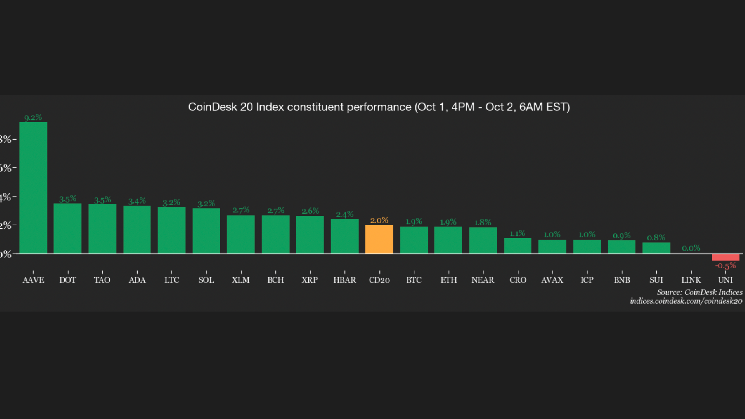
The cryptocurrency market has moved into familiar territory: a sea of green, with risk appetite firmly intact, ahead of one of the most important reports on the U.S. economic calendar. Bitcoin climbed above $86,000 in early trading, adding 3.4% over the previous 24 hours and reclaiming ground that had looked uncertain just days earlier. At 9:10 UTC, the world’s largest digital asset was holding its gains, drawing support from a rally that touched virtually every corner of the market. Ethereum, the second-largest cryptocurrency by market capitalization, was also firmly in positive territory, changing hands at approximately $2,743. XRP, Solana, and BNB all rose alongside it, though none managed to keep pace with bitcoin’s percentage gain. The coordinated move higher came as traders braced for the U.S. government’s September nonfarm payrolls report, due at 8:30 a.m. ET. By any measure, the mood on trading desks had shifted. Even in a market accustomed to sharp swings, the breadth of the jump stood out, especially with significant macro uncertainty still hanging over the global outlook. The fact that bitcoin was leading the advance rather than being dragged upward by speculative altcoin activity suggested that institutional investors were participating in the move, not merely retail traders hunting for quick profits. Trading volumes across major spot and derivatives exchanges picked up as the session unfolded, and market participants appeared increasingly willing to add exposure before the data release. The green light was visible across the entire digital asset complex, and the message from traders was unmistakable: they are leaning into risk rather than fleeing from it.
Altcoins Steal the Spotlight
While bitcoin’s move served as the anchor, the most eye-catching gains unfolded further down the market-cap ladder. Among the 100 largest cryptocurrencies, SKY, AAVE, and APT emerged as the clear standouts, each jumping between 7% and 10% over the past day. Aave, one of the most established lending protocols in decentralized finance, posted gains that many traders read as a vote of confidence in crypto’s higher-risk segments. Aptos, a layer-1 blockchain known for its speed and scalability, rode the same wave as investors sought exposure to projects with strong technical narratives. SKY, the governance token at the center of the Sky ecosystem, also delivered an outsized move, landing near the top of the gainers list. Altcoin rallies of this magnitude often reflect an improved tolerance for volatility, and today’s price action fits that pattern neatly. Instead of directing all new capital into bitcoin alone, traders were actively hunting for assets with higher beta — names that tend to move more violently than the broader market when sentiment improves. The appearance of both DeFi tokens and layer-1 assets among the leaders is particularly notable because it signals that the rally is not confined to one narrative or niche segment. In recent months, such broad-based strength has often preceded further upside, as risk-tolerant money cascades through the ecosystem. Ethereum’s gains, while more restrained, provided a solid foundation for the altcoin rebound. Investors who had spent recent weeks on the sidelines were clearly ready to re-engage with the market. Some caution may still be justified, because an aggressive rotation into smaller tokens can be a sign of speculative froth. But for now, the market appears to view it as a healthy broadening of the crypto bull case. Until the jobs report lands, however, those bets remain unconfirmed.
Risk Sentiment Shows Up in Market Structure
Beyond the daily price action, two important structural indicators were telling the same story about sentiment. Bitcoin’s dominance — its share of the total cryptocurrency market — has been pushing steadily higher and was closing in on the 60% threshold on Friday. That is a significant signal because it suggests that, within the digital asset world, bitcoin is acting as the primary recipient of fresh capital. At the same time, USDT, the largest dollar-pegged stablecoin in the industry, saw its share of the overall crypto market slip to around 6.3%. When stablecoin supply expands sharply, capital is often being parked on the sidelines, waiting for more attractive entry points. When that share falls, the typical interpretation is that investors are rotating out of cash-like positions and into tokens. Put those two gauges together, and the message becomes clear: the market is growing more comfortable with risk. These metrics have historically offered valuable clues about the durability of a rally. A rising stablecoin share alongside falling bitcoin dominance often points to defensiveness. The reverse — what is happening now — suggests that participants are moving funds into the market rather than preparing to exit. It also implies there is still a meaningful amount of liquidity that could be deployed if the macro data delivers a favorable surprise. The declining USDT share is not purely a technical curiosity; it reflects real on-chain behavior. Traders are voting with their wallets, shifting away from the safety of dollar-pegged assets and back into more volatile instruments. If that trend continues in the coming days, it would provide further confirmation that Friday’s rally is being driven by genuine buying rather than leverage alone.
September Jobs Report Looms Large
The focal point of the trading day is the September jobs report from the U.S. Bureau of Labor Statistics. The nonfarm payrolls report is expected to show that the U.S. economy added 90,000 jobs in September, a sharp slowdown from the 162,000 positions created in August. According to FactSet’s consensus estimates, the unemployment rate is forecast to remain unchanged at 4.1%. These numbers carry enormous weight far beyond the labor market. Investors across stocks, bonds, and digital assets are reading the jobs data for clues about the Federal Reserve’s next policy move. If hiring cools more aggressively than expected, the Fed may feel emboldened to cut interest rates quickly, which would likely provide a tailwind for risk-sensitive assets like bitcoin. If hiring beats expectations, the central bank could take a more cautious approach, potentially damping enthusiasm across the crypto market. A gradual softening in the labor market has long been viewed as the ideal scenario: enough slowdown to justify rate cuts, but not enough to signal a recession. The cryptocurrency market has become deeply sensitive to these policy expectations over the past year. That is why traders are studying every component of the jobs report, from payroll additions to wage inflation. Even a modest surprise in the data could spark outsized moves in digital assets, especially given the quiet start to the trading week. For now, markets appear to have priced in at least some degree of Fed easing. But the precise path remains highly conditional on what the labor market shows. Friday’s report is arguably the single most important event risk for crypto this week, and its impact could extend well beyond the immediate reaction.
Treasury Yields May Matter More Than Jobs
Yet as important as the payrolls figure may be, analysts increasingly argue that the real test for bitcoin lies in the bond market. The key variable is how Treasury yields respond to the data — particularly inflation-adjusted, or real, yields. A rise in real yields tends to tighten financial conditions, raising the opportunity cost of holding assets that pay no interest, such as bitcoin. A decline in real yields typically has the opposite effect, making speculative assets more attractive to investors searching for returns. This is why Friday’s jobs report and the Oct. 14 consumer price index report have taken on outsized significance in the crypto community. If the jobs data arrives without triggering a selloff in Treasuries, bitcoin could extend its gains. If the report pushes inflation-adjusted yields higher, the rally may stall just as abruptly as it began. Monetary policy transmission no longer flows only through equities and bonds; it now moves directly into digital assets, which have evolved into a distinct risk-on asset class. Over the past few years, bitcoin’s sensitivity to real rates has become a recurring theme among market strategists. Some argue that the headline job number matters less than how the 10-year Treasury reacts to the report. A rise in nominal yields driven by stronger growth is very different from one driven by inflation expectations, and real yields capture that distinction. As a result, traders will be watching both the pre-report positioning and the post-release reaction in fixed income markets. If the bond market interprets the jobs data as dovish, with real yields falling, risk assets could enjoy a relief rally that pushes bitcoin toward new resistance levels. Conversely, a hawkish repricing would put the recent gains to the test. With the CPI report just around the corner, the macro calendar is packed, and the crypto market is no longer trading in isolation.
The Data-Fueled Road Ahead
In the hours after the jobs print, the direction of the crypto market will likely be determined by the data, the bond market’s reaction, and the story that traders construct around both. A weaker-than-expected payrolls number could reinforce the case for aggressive Fed easing, supporting bitcoin and the wider digital asset complex. A resilient labor market, on the other hand, could keep the central bank patient, putting downward pressure on speculative markets. Beneath all of this, however, the structural backdrop is notably more constructive than it was just a few weeks ago. Bitcoin dominance is rising, stablecoin share is falling, and the strongest price action is now concentrated in higher-beta tokens — all classic ingredients for a continuing risk-on phase. What remains uncertain is whether the macro data will cooperate. September payrolls, unemployment, Treasury yields, and the October CPI report will collectively determine whether this rally becomes a sustained trend or simply a sharp but temporary move. For traders, the next 48 hours are critical. The broad green across the market may give way to a more selective environment, where only tokens with genuine momentum survive. But for now, the crypto market has entered Friday with confidence, showing none of the fear that often dominates before major economic events. It is positioned for the kind of macro catalyst that can either ignite the next leg higher or trigger a sudden and violent bout of profit-taking. No one is forecasting with certainty, but the market’s pre-report behavior suggests that investors are not hiding from the data — they are leaning into it. The jobs report will arrive with the market already bid, and the response will say a great deal about how much risk appetite is truly left in this cycle. Until the numbers are released, the sea of green stands as the most telling statement of intent.