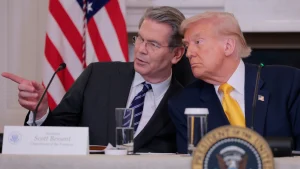



There is a certain kind of morning on a campaign trail when the sky is bright, the parking lot fills with pickup trucks and flags, and the music plays just loud enough to make the heart beat faster. People have driven through the night, wearing their best patriotic shirts, carrying signs that are not so much requests as declarations. They are not here to be convinced; they are here to belong. President Trump spent his day in that room, or one like it, speaking to the converted, soaking in the roar, and matching the crowd’s mood with his own. The report of his movements leaves us with a simple, uncomfortable summary: he preached to his most fervent fans, not to the voters he would need to help elect or re-elect a slate of Republicans fighting from Alaska to Maine. To humanize that observation is to see both the comfort and the danger in it. A rally is a beautiful thing for the people inside. It gives them a voice and a family. It makes them feel that their concerns are not small or shameful. But an election is not a campfire. It is a contest for the middle, for the hesitant, for the people who are still checking their choices. And those people were not in that hall. They were at work. They were making dinner. They were folding laundry and worrying about the price of gas. They were not chanting or clapping or waving flags. They were listening, perhaps for the first time, to see whether anyone out there was actually talking to them.
The word “preaching” carries a heavy truth. A preacher stands in front of people who already believe. He repeats the words that comfort them. He names their enemies and promises their vindication. There is nothing wrong with that, in its place. It can be a source of strength, a way of saying, “I see you, I know what you are going through, and I am with you.” The fervent fans who come to these events are not foolish and they are not evil. Many of them have seen their jobs move away, their towns hollow out, their churches close, their children leave. They feel ignored by the people in Washington, and they are tired of being dismissed. When a leader like President Trump stands before them and says he is fighting for them, they feel seen. That emotion is real, and it deserves respect. But the language of the sermon is not the language of the harvest. It does not go out to the field and gather what has not yet grown. It stays in the chapel and warms the regulars. The swing voter, the independent, the Republican who is not sure, the moderate who might be persuaded—these people are rarely in the choir. They may not watch the full speech. They may only see a clip on the evening news, and the clip may show the most intense moment, the sharpest gesture, the loudest crowd. They do not hear the policies or the promises. They hear the echo. And in the echo, they hear a wall being built between “us” and “them.” That wall may feel safe to the people inside, but it is very hard for anyone outside to climb.
Who are the voters he will need? They are not abstractions. They are a nurse in Bangor, Maine, finishing a double shift and still not sure whether she trusts the political system to keep her hospital open. They are a fisherman in Kodiak, Alaska, watching the weather and the markets, wondering if any candidate understands that the ocean is not a slogan. They are a mother in a small town in New Hampshire who voted for one party in the past but now finds herself listening more carefully because rent is too high and her son cannot afford a home nearby. They are older men and women in Pennsylvania or Minnesota or Nevada who do not post online, do not wear political hats, do not go to rallies, but do vote. They are not waiting for a movement to sweep them away. They are waiting for a reason. They want to know what will happen to their health care, their pensions, their roads, their schools, their water. They are not looking for an enemy. They are looking for a plan. When a leader spends an entire day in a room where every person already agrees with him, he is not talking to these people. He is talking over them. And in a democracy, talking over someone is very close to talking past them. The voters who decide elections are often the quietest ones. They do not scream at the television. They do not write letters to the editor. They sit at the kitchen table and look at the bills, and they ask each other a very simple question: “Are we better off than we were four years ago?” That question is not answered by applause. It is answered by the way a candidate speaks about the future, about ordinary people, about the things that matter in a life that is not a performance.
Consider the candidates themselves, the slate of Republicans fighting for their political lives in states from Alaska to Maine. Some of them are incumbents with long records. Some are newcomers with nothing to lose. But all of them face the same puzzle: they need the energy of the base to turn out, and they need the trust of the middle to win. These two groups are not the same. The base wants an unapologetic champion, a fighter who will never admit doubt and never compromise. The middle wants a steady adult, a problem-solver who can speak to everyone, even those who disagree with him. When President Trump spends a day preaching to his fervent fans, he gives the base exactly what it wants. But he may be leaving the candidates with something less than they need. A candidate who stands next to a roaring crowd looks strong to the converted and threatening to the wary. A candidate who wins that crowd’s applause may lose the quiet suburban mother whose vote is the one that actually decides the race. This is not a new problem, but it is a human one. Imagine a Republican volunteer in rural Alaska, knocking on doors in the cold, trying to explain why her candidate deserves another chance. She has not been to the big rally. She has not heard the cheers. She has only her own voice, her own story, and the uncomfortable task of translating a national mood into a local choice. When the leader is busy preaching to the faithful, she has to do the persuasion all by herself. She has to look a hesitant voter in the eye and say, “I know the chaos on TV is hard to watch, but listen to me for a moment.” That is not easy. And when the campaign’s energy is focused on the already convinced, the campaign’s message becomes sharper, louder, and narrower. The middle hears it as a warning, not an invitation.
There is a deeper contradiction in spending the day with the base when the stakes are national. A rally is a performance of strength, but it is also a mirror. The crowd reflects the leader, and the leader reflects the crowd. What happens when the mirror only shows one face? The leader begins to believe that the whole country thinks as the crowd does. He begins to forget that there are states where Republicans must win by small margins, not by shouting matches. He begins to treat politics as a war of loyalties instead of a negotiation of needs. This is the moment when a leader can become the very thing his opponents say he is: deaf to the outside world. The voters he needs are not asking him to abandon his beliefs. They are asking him to explain them in a way that includes them. They are asking him to remember that a vote is not a payment of loyalty; it is a gift of trust. And trust is built through patience, through listening, through the ordinary work of showing up in places where people are not already your fans. From Alaska to Maine, there are small towns and big cities, farms and fishing docks, industrial parks and college campuses. Each one has its own worries. A fisherman in Alaska worries about catch limits. A paper mill worker in Maine worries about the next layoff. A young family in a suburb worries about school board meetings and property taxes. None of these worries can be solved by a slogan. They can only be addressed by a conversation. And a conversation is exactly what a rally is not. A rally is a monologue. The crowd is there to receive, not to respond. It is there to be moved, not to move the leader. So when a leader spends the day preaching to his fervent fans, he is not having a conversation with the country. He is having a conversation with himself.
In the end, the story of the day is a story about the difference between feeling powerful and actually winning. There is a hunger in human beings to be surrounded by people who agree with us. It is comforting, even exhilarating, to be in a room where everyone shares your hopes and your fears. The supporters who filled the hall left with their faith renewed. That matters. It matters for their own sense of purpose, and it matters for the volunteers who will go out and work for Republican candidates. But elections are not decided by the people who are already sure. They are decided by the people who are not sure, who are tired, who have been burned before, who want a reason to believe again. Those people are not enemies. They are just human. They are trying to raise their families, keep their jobs, and make sense of a confusing world. They do not want to be lectured. They want to be listened to. They do not want to hear a preacher who already knows the answer. They want to hear a leader who understands the question. President Trump spent the day with his most fervent fans, and no one can blame him for loving the warmth of that fire. But the Republican candidates fighting from Alaska to Maine know something that the crowd in the hall may not: the fire that keeps you warm can also burn the bridge you need to cross. To win, a leader must eventually speak not only to the faithful, but to the doubtful; not only to the loud, but to the quiet; not only to the ones who have already decided, but to the ones who are still waiting for a voice worth trusting. That is the human work of politics. And on that day, it was left elsewhere.