


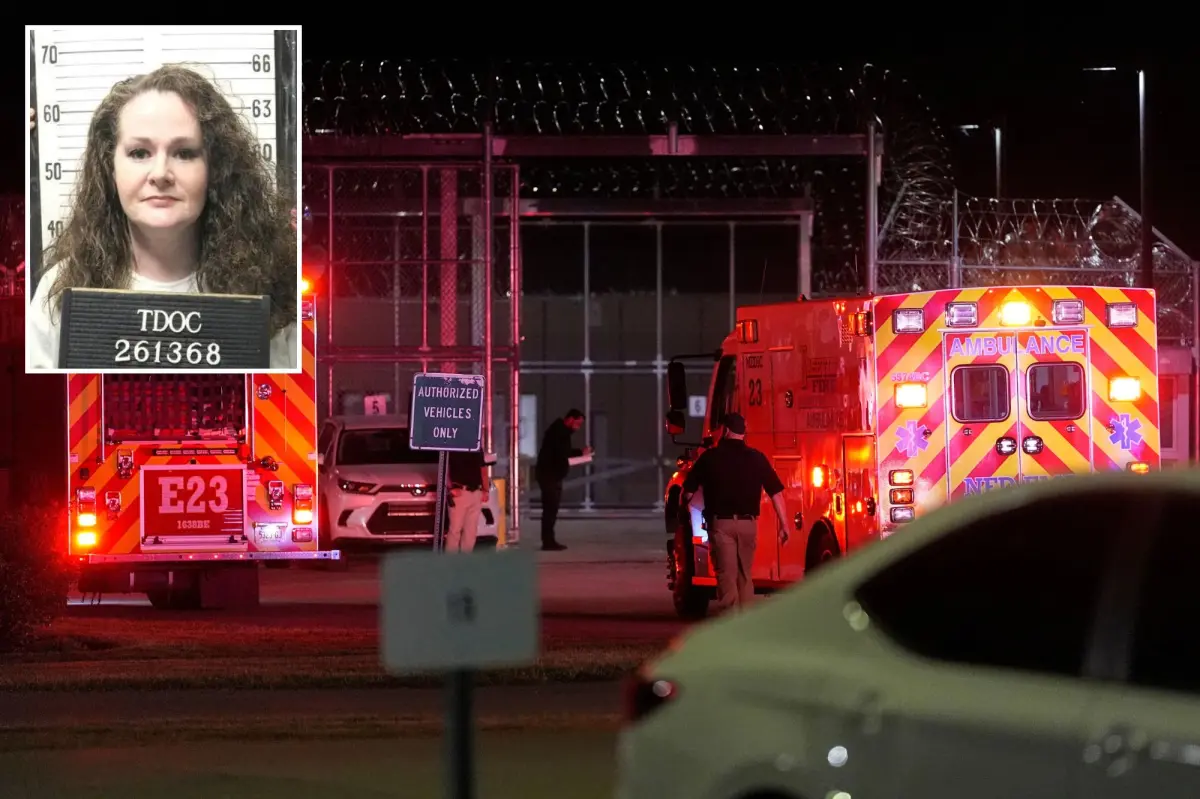
It was an evening meant to close a long chapter in Tennessee history, but instead it reopened questions that the state may never fully answer. At just before 7:30 p.m. Central Daylight Time, Christa Pike, a fifty-year-old woman who had spent the better part of her life on death row, was strapped to a gurney inside the Nashville death chamber. The hour was charged with meaning: she was about to become the first woman executed in Tennessee in more than two centuries. The United States Supreme Court had overruled a stay of execution barely sixty minutes earlier, clearing the way for the lethal injection to proceed. Witnesses stood behind glass, some holding their breath, others looking away. Reporters leaned forward, ready to record the final words and final moments of a condemned woman whose case had already shaped the state’s legal and moral imagination for decades. But the expected sequence of events never unfolded. As the first drug began to flow, Pike was still awake. She was still speaking, in full sentences, in a voice that cut through the sterile silence. The execution had begun, but something was wrong. And before the night was over, her attorneys would be rushing to file an emergency stay, not to stop an imminent death, but because the death they had been preparing for had mysteriously, and perhaps terribly, failed to arrive.
The witnesses who had gathered to observe the historic execution later recalled Pike’s final, ordinary words with a kind of quiet horror. She was not delivering a long speech or insisting on her innocence; she was describing what her body felt like under the cold pressure of the gurney. WKRN reporter Tori Gessner, watching from the witness room, heard her say, “My arm feels like it’s about to bust. One spot is really throbbing.” It was a small, human complaint, the sort of thing someone might say in a doctor’s office, not in a death chamber with the weight of the state behind her. And yet there she was, strapped in place, with needles in her skin and a chemical about to move through her veins. The images from those minutes are difficult to reconcile with the deliberate machinery of an execution. This was not a dramatic final statement or a last-minute revelation. It was the voice of a woman whose body was hurting, who was wide awake, who could still feel every sensation and name it with startling clarity. That moment, more than any legal brief, may become the lasting image of the evening: a condemned woman speaking plainly about the pain in her arm while state officials waited for her to slip into unconsciousness, and then for her heart to stop. But the slipping did not come. The silence did not come. Instead, Pike remained conscious, her eyes open, her words still forming in the air.
The execution team administered two syringes of pentobarbital, the powerful barbiturate intended to first render her unconscious and then to stop her heart. But something in her body refused to cooperate. After both doses, she was still alive. Her heart continued to beat. Her breath was audible. In the death chamber, the atmosphere shifted from ritual ceremony to crisis. Her attorneys, already on edge from the Supreme Court’s eleventh-hour decision, moved with urgent speed, filing an emergency stay in the United States District Court for the Eastern District of Tennessee. Their words were simultaneously clinical and devastating. “Ms. Pike has not lost consciousness and still has a heartbeat and is audibly snoring,” they wrote. The sentence is spare, almost matter-of-fact, but it contains a world of meaning. A woman who was supposed to be dying was instead breathing, snoring, her body stubbornly refusing the finality that had been arranged for it. The emergency filing was not a broad argument about the morality of capital punishment, though it carried that weight in its subtext; it was a simple and desperate plea rooted in the immediate, messy facts of her living body. The state had tried to end a life and had not succeeded. In doing so, it had created a new and chilling situation: a botched execution unfolding in real time, with the condemned prisoner still present, still conscious at some level, and still protected by a Constitution that prohibits cruel and unusual punishment. The attorneys were racing not only against the clock, but against the possibility that officials might try to administer another dose, another attempt, another needle.
To understand the peculiar gravity of that gurney, one must understand the long road Pike traveled to reach it. Christa Pike was only a teenager when she and another woman murdered nineteen-year-old Colleen Slemmer in Knoxville in January 1995, a crime driven by romantic jealousy and marked by extraordinary brutality. The case shocked a state already familiar with violence, and the graphic details of the murder haunted prosecutors and jurors alike. Pike was convicted in 1996 and sentenced to death, becoming the youngest woman on death row in the United States at the time. In the decades that followed, her case moved through an elaborate and exhausting web of appeals, stays, and legal maneuvers. She was not a symbol; she was a person with a history, with family, with a file of legal documents thick enough to fill several boxes. Her years on death row did not unfold in a vacuum. She was housed, fed, monitored, and visited. She wrote letters. She grew older. She watched the legal system either protect her or fail her, depending on one’s point of view. The families of her victim also lived with the consequences, marking anniversaries, waiting for a resolution that seemed to recede and then advance in equal measure. For nearly thirty years, all of those lives were bound together by a single, unresolved question: whether the state would eventually succeed in carrying out the sentence. On the night of the attempted execution, that question suddenly became more complicated. The woman on the gurney was not a forgotten prisoner in a distant facility. She was, for those awful minutes, the center of a living drama, a reminder that capital punishment, however abstract it may become in legal language, always ends in a particular, physical, fragile human body.
The failure of the lethal injection will almost certainly reverberate far beyond the walls of the Nashville death chamber. Botched executions have historically troubled American law, but each new case seems to deepen the unease. Lethal injection was adopted as a more humane alternative to the electric chair and the firing squad, yet the reality has never been as clean as its theoretical design. Drugs have been hard to obtain, protocols have been challenged, and condemned prisoners have, on more than one occasion, lingered for minutes or even hours before dying. This case carries an additional, uniquely troubling dimension because of its historical nature. Tennessee had not executed a woman in more than two centuries; when it finally attempted to do so, the execution did not work. The state may be forced to decide whether to try again, perhaps with a new warrant, perhaps after the emergency stay is resolved. Those decisions will carry enormous ethical and legal weight. Defense attorneys will argue that the state has already had its chance and that another attempt would be nothing less than torture. Prosecutors may argue that the sentence must ultimately be carried out and that the difficulty, however disturbing, does not erase the crime. The wider public will be left to wrestle with questions that neither party can easily answer: At what point does the pursuit of justice become cruelty? Does the failure of an execution invalidate the punishment itself? And what does it do to a society when its ultimate act of punishment is not only controversial but also disturbingly messy? These are not abstract questions. They were present in the room with Pike, in the reporter’s notes, in the attorneys’ emergency filing, in the hush that fell as the gurney did its work but not its intended end.
For now, Christa Pike is alive. Her heart is beating. Her breath is rising and falling. Her legal team is scrambling, and the world is watching a story that is still unfolding. The emergency stay may be granted or denied. The courts may intervene again, or they may allow the state to move forward. In one sense, this is the usual rhythm of capital litigation, a series of last-minute stays and hurried hearings, of dates rescheduled and appeals exhausted. But in another sense, nothing about the night was usual. A historic execution became a horror story about a body that would not die on schedule. No matter which side of the death penalty argument one stands on, the image of Pike on that gurney, awake enough to complain about the throbbing in her arm, is a hard one to forget. It strips away the theoretical carefulness of legal language and leaves something raw and undeniable. She was a woman, fifty years old, strapped down and waiting for death to arrive. She felt pain. She made a sound. She was snoring. And then, impossibly, she was still there. The story will continue, with new filings and new decisions and new headlines. But the scene in that Nashville death chamber will not be erased by any court ruling. It may come to stand as a stark, unwelcome reminder of the difference between the idea of punishment and its reality. The execution was meant to bring closure, to end a chapter, to make a statement about justice and consequence. Instead, it ended with a heartbeat, a breath, and the sound of an emergency filing being sent into the night. This is a breaking story, and by the time the next update arrives, the facts may have shifted. But for those who were there, and for those who read the accounts closely, the image of Christa Pike, alive against all expectation, will likely remain fixed in memory for a long time to come.