


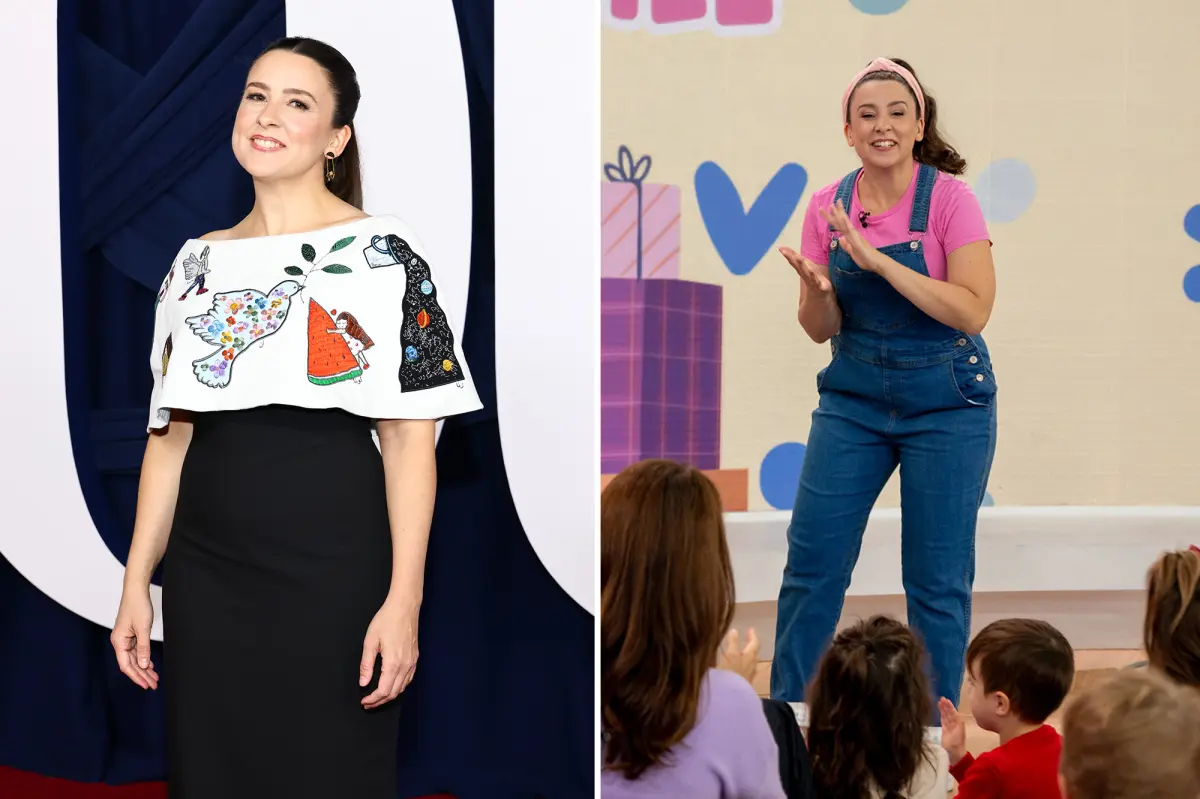
At first glance, Rachel Accurso seems like an unlikely source of political controversy. Better known to millions of young families as Ms. Rachel, she is the kind of children’s entertainer who greets her audience with a warm smile, denim overalls, a pink T-shirt, and a matching headband. Her videos are designed to be gentle, repetitive, and educational—a trusted screen-time choice for parents desperate for a few quiet minutes. In living rooms across the country, her face is a familiar comfort, a signal that the content playing on the tablet is probably safe. But beneath that cheerful surface, Accurso has become something more complicated: a polarizing public figure in the middle of a raging cultural argument. As war between Israel and Hamas unfolded, Accurso began speaking out about Gaza, and the reaction was swift. Critics accused her of amplifying Hamas data and elevating narratives they say have been proven false. Parents who once welcomed her into their homes now find themselves debating her intentions. The same online ecosystem that helped turn Ms. Rachel into a household name has now made her a flashpoint, with angry comment threads, deleted videos, and accusations of political bias overshadowing her educational mission. For many, the question is no longer simply whether she can teach a toddler to say “please” or “thank you,” but whether her platform has been overtaken by activism. In a media landscape where children’s entertainers are often expected to remain neutral, Accurso’s willingness to weigh in on a deeply contested geopolitical conflict has set her apart—and set off alarms.
The most visible flashpoint came when Accurso publicly sided with rapper Macklemore. Macklemore, who has been a vocal advocate for the Palestinian cause, was dropped from Ed Sheeran’s “Loop Tour” after repeatedly calling for a “Free Palestine” and performing his anti-Israel song “Hind’s Hall” during his opening set at MetLife Stadium. He said he would donate the $1 million he earned from the tour to organizations aiding Palestinians. Accurso then announced that she would match the rapper’s $1 million donation, directing her contribution to the Palestine Children’s Relief Fund, an organization for which she serves as an ambassador. The announcement thrilled some and enraged others, reinforcing the impression that Ms. Rachel had chosen a side. Her problems did not end there. In another controversial moment, Accurso called Palestinian photojournalist Motaz Azaiza her “friend” in a 2025 video, only days before Azaiza admitted on an Arabic-language podcast that he had hidden footage of Israeli hostages being beaten by a crowd in Gaza on Oct. 7, 2023. Azaiza said he concealed the footage because he feared it would put the Palestinians involved in the beatings at risk. Accurso later deleted the video, but not before clips resurfaced and spread widely. For critics, the incident was a perfect example of what they saw as reckless political posturing: a celebrity with a massive children’s platform embracing someone whose actions were, at the very least, ethically complicated. Supporters, by contrast, have framed Accurso’s involvement as a natural extension of empathy and humanitarian concern. Accurso herself has not shied away from the debate. When speaking to the Guardian, she addressed her choice to take political stands with a simple defense: she has “a really good moral compass.” It is that confidence, perhaps, that makes her such a divisive figure.
But for critics like Bethany Mandel, a Washington Examiner contributor, author, and homeschooling mother of six, Accurso’s self-certainty is exactly the problem. “This is the case for a lot of liberals,” Mandel told Fox News Digital. “They don’t see it as a political perspective at all. They just see the world in black and white and what they are doing is so clearly correct.” According to Mandel, this mindset is common among creators who rarely step outside their ideological bubble to engage with people who hold opposing beliefs. That can be dangerous in any context, but when it comes to a subject as volatile as the war in Gaza, Mandel argues, the consequences become particularly serious. She believes Accurso has adopted a singular narrative and platformed controversial numbers, sometimes supplied by Hamas-run agencies. “It’s important to understand that she only cares about one narrative,” Mandel said. “She only cares about this very false narrative where what’s happening in Gaza is a genocide, falsely categorizing it as such. She amplifies numbers that are not real, the numbers of deceased children, the numbers of people who have died in general, she’s accepting a Hamas narrative on every single thing and amplifying it.” Those are striking accusations, and they reflect a broader concern among some observers that activism has replaced education in Accurso’s content. Mandel’s criticism is not just about policy differences; it is about the responsibility that comes with a platform used by young children. When a beloved children’s entertainer lends her voice to a cause as divisive as this, Mandel suggests, she is doing more than expressing a personal opinion—she is shaping the worldview of an entire generation of impressionable viewers and, by extension, their parents.
Accurso’s controversies have also extended to the comment sections of her own posts, where digital forensics often mix with political messaging. In January 2026, she drew scrutiny after appearing to “like” a comment that read “free America from the Jews.” The backlash was immediate, and Accurso responded by explaining that she meant to delete the comment but “accidentally hit like and hide,” according to the Jerusalem Post. The explanation did not fully satisfy her critics. In a strange twist, an account called “thepalestinenewsnetwork” replied to her apology post with the spoiler: “They left the comment themselves.” Accurso replied “ooooooooooohhhhh,” but the comment was later deleted. The episode remains murky, but Mandel points to it as an example of the confusion and distrust that now surrounds Accurso’s digital footprint. “She is serving as their mouthpiece for a lot of Americans, not just children and not just the adults that follow her,” Mandel told Fox News Digital. The “their” in Mandel’s formulation refers to those pushing a pro-Palestinian narrative, and the quote reflects a deeper worry: that Accurso’s celebrity has given political activists an unlikely and powerful channel. For many parents, the idea that a children’s entertainer might be using her platform to advance a political agenda is deeply unsettling. For others, however, the scrutiny itself feels overblown. After all, celebrities are not required to stay silent, and Accurso has every right to use her money and fame to support causes she believes in. The question is whether she can do so without undermining the trust that makes her content work in the first place. Trust, once lost, is very hard to restore.
Mandel also argues that Gaza is not the first issue on which Accurso has taken a left-leaning stance, and in her view, it is part of a broader pattern of activism that goes far beyond geopolitical conflict. Mandel said she realized Accurso “cares more about activism than education” when the children’s entertainer featured a non-binary musician as a guest. She did not name the musician, but she was likely referring to Jules Hoffman, who has worked with Accurso and is known for creating content with them. “She’s had fellow musicians and performers on camera with her who have no gender, and she takes away gender from these individuals especially, and they are amorphous; they go by they/them,” Mandel said. “And it’s a woman, but you can’t really tell that, especially as a child. And this is something that’s really very damaging to children who are in the early stages of development, because one of the first ways that children learn to organize the world around them is by categorization, and the easiest way for a toddler to categorize the world around them is by female and male.” Mandel warned that erasing gender categories for young children could have “detrimental consequences” for how they understand the world. She invoked a phrase popularized by former Defense Secretary Donald Rumsfeld: “unknown unknowns.” Because society has never systematically altered these foundational development markers in early childhood education, Mandel says, no one really knows what the long-term effects will be. “When we take that ability to categorize away from children, we’ve never done that in human history before,” she said. “And it absolutely will have detrimental consequences to how they order the world around them, and we’re just going to have to find out what those consequences are.” This is, by nature, a speculative argument—but it highlights why Accurso’s content has become such a battleground.
Mandel’s advice to parents is simple: screen everything before you show it to children, and don’t assume that a familiar face on a screen shares your values. “Parents need to choose these entertainers wisely because perhaps parents don’t care about the gender stuff, perhaps parents don’t care about what she’s saying about Gaza, but if they are not ultra-ultra-liberal, Ms. Rachel will eventually land on something that they do feel discomfort with,” she told Fox News Digital. In her own home, Mandel has already made that call. Years ago, she removed Accurso’s channel from her family’s YouTube playlist, a decision she says has brought her peace of mind. “I feel relieved as a Jewish parent that I took Ms. Rachel off of our playlist on YouTube years ago, and I’m sure I will continue to feel great about that decision in the years to come,” Mandel said. Fox News Digital reached out to representatives for Accurso to request comment, but the story remains unresolved. What is clear is that the controversy over Ms. Rachel is about more than one woman or one YouTube channel. It is about the collision of childhood innocence and adult politics, the power of online influencers, and the difficulty of making choices when every option feels compromised. Parents today are not just choosing educational content; they are making moral decisions every time they press play. Whether they are worried about gender identity, political bias, or simply the discomfort of seeing a familiar face in a political storm, they are being forced to ask a question that would have seemed absurd a generation ago: What does Ms. Rachel actually believe, and am I comfortable letting my child learn from her? For now, there are no easy answers—only the quiet calculus of family life, remote in hand, ready to press stop.