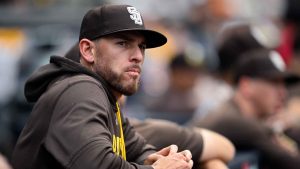


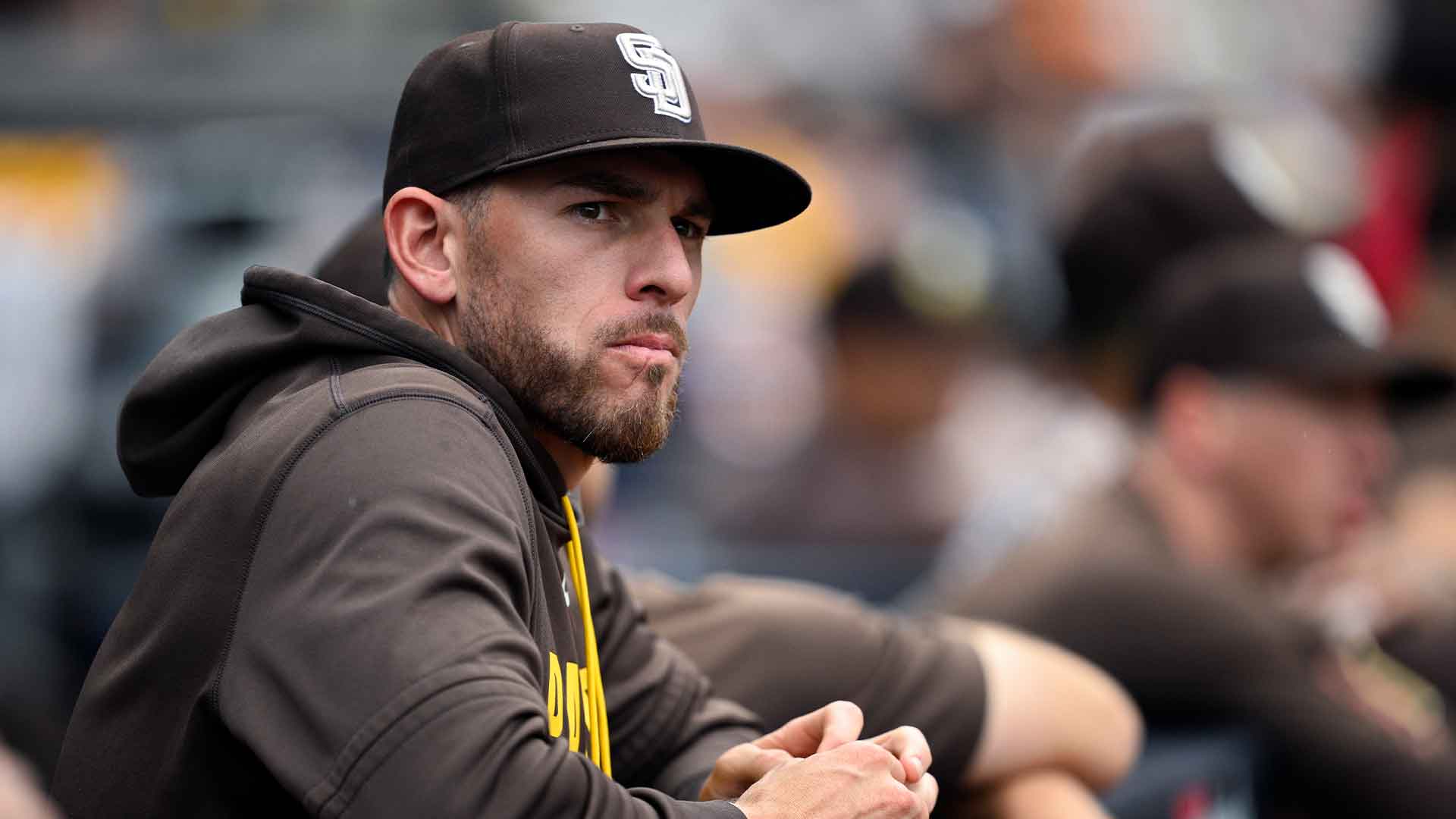
The late-afternoon sun settled over Petco Park, the kind of San Diego evening that feels more like a beginning than an ending, and yet for Joe Musgrove, the moment carried the weight of two long, uncertain years. As the Padres announced their 26-man roster for the NL Wild Card Series against the Chicago Cubs, the most striking name was his. There he was, a hometown kid who had grown up dreaming of wearing brown and gold, now back on a postseason roster for the first time since he walked off the mound in pain nearly two full seasons ago. It was not simply a roster move; it was a story of stubborn hope, of a right elbow that refused to cooperate, of a man turning 34 who had spent countless mornings wondering whether his body would ever allow him to pitch in a major league game again. The Padres, for their part, chose to believe in him. They had watched him labor through rehabilitation, had seen him struggle through August appearances, and still, when the moment came to build a pitching staff for a short, sudden October series, they reached for the veteran who had never stopped reaching for them. Musgrove’s last real game had been on Oct. 2, 2024, when he helped the Padres clinch a Wild Card Series victory over Atlanta, only to feel something give in his right elbow. He underwent Tommy John surgery. He missed all of 2025. Then, when his recovery moved more slowly than anyone expected, he missed the entire 2026 regular season too. Now, after all that waiting, he was back, standing on the edge of October again, and no statistic could capture what that meant.
The road back was never straight, and Musgrove lived every twist of it. Tommy John surgery is never a simple procedure for a pitcher in his thirties, but Musgrove approached it with the same relentless work ethic that had defined his entire career. Yet the body has its own timeline, and his was slower than he could have imagined. The 2025 season came and went without him, and as 2026 spring training arrived, there was still no guarantee that he would ever pitch again. He threw, but his arm ached. He rested, then tried again. The Padres, cautious and hopeful, kept him on a path that wound through rehabilitation starts, bullpen sessions, and long afternoons of ice and treatment. In August, he appeared in four rehab games, and for a while, it seemed as though a return might be near. But he admitted after those outings that his postgame recoveries were still difficult, that his arm was not bouncing back the way it had when he was younger. It would have been easy to shut it down, to accept that the baseball gods had taken their toll. But Musgrove kept throwing. This month, he pitched in instructional league games, and the Padres’ decision-makers began to see something familiar—the same bite on his breaking ball, the same life on his fastball, the same fierce competitiveness that had made him a key piece of their postseason hopes. They liked what they saw, not just in the results but in the resilience. It was enough for them to slot him onto an 11-man postseason pitching staff, passing over several dependable alternatives. The choice was not without risk, but baseball in October is built on gambles, and the Padres decided that Musgrove’s experience, his poise under pressure, and his intimate knowledge of the postseason stage were worth the uncertainty.
That decision came at the expense of names that could easily have made the roster on merit alone. Randy Vasquez, a quiet, dependable right-hander, had been a steady presence all season. Wandy Peralta, the veteran lefty reliever, had been counted on in big spots. Casey Mize, acquired at the trade deadline, brought the kind of stuff that managers dream about in high-leverage moments. Griffin Canning, another arm with starting experience, had been waiting for a chance to contribute. Yet when the roster was finalized, it was Musgrove who got the call, and the decision had little to do with numbers and everything to do with belief. The Padres were not just choosing a pitcher; they were choosing a narrative, a veteran who had been through the fire, who had known what it meant to pitch for his hometown team in the heat of October, and who had spent two years clawing his way back to this very moment. There was a certain poetry in it, the idea that a team with championship aspirations would trust a player who had not thrown a single regular-season pitch in two seasons. But postseason rosters are not always about who is hottest or most reliable; sometimes they are about who can handle the weight of a single game, a single inning, a single pitch. Musgrove had done that before. He had stood on the mound in front of his people, under the brightest lights, and he had not flinched. The Padres were betting that the muscle memory of those moments, combined with the raw desire that had carried him through rehab, would be enough. It was a leap of faith, but in October, faith is often the most precious currency a team can possess.
The roster’s surprises did not end with Musgrove. Miguel Andújar, the outfielder who had been out since July 19 with a broken wrist, was also included, a decision that raised eyebrows even among the most optimistic Padres fans. Andújar had not played in a major league game for weeks. He had spent the long, quiet summer months watching from the dugout, his wrist in a cast, his swing preserved only in memory. But on Monday, the day before the series began, he took at-bats at Petco Park, and the team’s coaching staff liked what they saw. There was something about the way he moved, the glimpse of the hitter who had once been one of baseball’s most promising young bats. The Padres decided that his presence in the clubhouse and his potential as a pinch-hitter were worth more than the uncertainty of his timing. It was a gamble unlike the one they had taken with Musgrove, but it came from the same place: a belief that talent, when mixed with desperation and desire, can sometimes overcome rust. Andújar’s journey had been frustrating, filled with setbacks and delays, but he had never stopped working. He had done everything the trainers asked, had remained patient through the pain, and now, with October unfolding before him, he had earned a chance to write his own redemption story. The Padres, clearly, were in the business of believing in comebacks. They had built a roster not just of players in the middle of strong seasons, but of men who had endured, who had suffered, who had refused to let their careers end in the shadows of injury and disappointment. It was a roster that reflected the very nature of the postseason itself—unpredictable, emotional, and full of people willing to stake everything on a single moment.
Then there was Ethan Salas, the 20-year-old catcher who had already made history before he ever took the field in the playoffs. When the Padres called him up on Sept. 1, he became the youngest player to catch a major league game since Iván “Pudge” Rodríguez in 1991, and now he was positioned to become the youngest catcher ever to appear in a postseason game if he saw action in the Wild Card Series. For a young man barely out of his teens, the moment felt impossibly large. Yet Salas carried it with a poise that belied his age. He had started slowly after his call-up, as most 20-year-olds would, struggling to find his timing against major league pitching and adjusting to the speed of the game at baseball’s highest level. But as the regular season wound down, something clicked. In his final 24 at-bats, he collected 10 hits, a late surge that reminded everyone why he had been so highly touted in the first place. The Padres had always believed he was special, not just for his physical tools but for his instincts behind the plate, his ability to frame pitches, and his calm presence when the game was on the line. To include him on a postseason roster was a statement of confidence, a decision to let the future share the stage with the present. If Salas played, he would etch his name into the record books, but more importantly, he would prove that the Padres were willing to trust youth, to embrace the possibility of greatness, even when it came wrapped in inexperience. His story added another layer to an already remarkable roster, a reminder that October is not just about veterans fighting off the end, but also about young players chasing the beginning of something wonderful.
Taken together, the San Diego Padres’ Wild Card Series roster was a portrait of baseball at its most human. There was Musgrove, the hometown veteran, standing at the end of a painful, winding road, ready to pitch in a major league game for the first time in nearly two full years. There was Andújar, the forgotten outfielder, holding on to his dream with a surgically repaired wrist and a stubborn heart. There was Salas, the 20-year-old catcher, standing on the precipice of history, and there were all the others, the players who had grinded through a 162-game season and now faced the brutal, beautiful reality of a short series. The roster was not perfect. It was certainly not conventional. But it was honest, a reflection of a team willing to make difficult choices, to take risks, to believe that heart and resilience can coexist with skill and preparation. For the fans filing into Petco Park, for the players stretching along the foul lines, for everyone who had followed the Padres through the long months of summer, this was more than just a playoff game. It was a reminder that baseball, at its core, is a game of stories—of men who fall, who rise, who wait, who hope, and who, on the most improbable of nights, get to stand in the light again. Joe Musgrove would take the mound, Miguel Andújar would sit ready in the dugout, Ethan Salas would wait for the opportunity to make history, and the city of San Diego would hold its breath. In the end, that is what October is all about: not just the final scores, but the journeys that lead there, the struggles that make the triumphs meaningful, and the moments that remind us why we love this game in the first place.