


For most of us, a train station is simply a place to pass through—a blur of departure boards, echoing announcements, and hurried footsteps. But every year, the Prix Versailles awards remind us that these everyday spaces can be so much more. Established to celebrate the most beautiful new architecture around the world, the prize has previously honored museums, hotels, shops, and restaurants. Now, in 2026, it has turned its attention to the places where our journeys begin and end, unveiling a shortlist of seven newly opened train stations that elevate the humble commute into something close to art. From the sun-soaked platforms of Australia to the underground marvels of Italy, these stations are not just transport hubs; they are cultural statements, community gathering spaces, and even archaeological adventures. In a world where travel has become increasingly functional and hurried, these projects make a compelling case for slowing down, looking around, and appreciating the spaces that move us—both physically and emotionally. The selection is deliberately global, but it is Europe that shines especially brightly this year, with three of the seven winners located in France and Italy, each one proving that a railway station can be a destination in its own right rather than merely a gateway to somewhere else.
The European contingent is led by Lyon Part-Dieu Station in France, a project that took a full decade to complete and transformed the existing railway terminus into what the jury calls a “real community space.” Designed by the architectural firms AREP and L’AUC, the station is no longer just a place where trains arrive and depart; it has become a sprawling multimodal hub, connecting buses, metros, trams, and pedestrians in a seamless flow. What makes this project particularly special, though, is the way it blurs the boundary between traveler and local. The architects deliberately opened up the station so that people moving between different neighborhoods can cut through it, treating the building as a public square rather than a restricted transit zone. It is a subtle but profound shift in thinking: why should a station be a barrier, a place you enter only when you have a ticket? Instead, Lyon Part-Dieu has become a kind of urban living room, a space that belongs to everyone, whether they are catching a high-speed train to Paris or simply crossing from one side of the city to the other. The result is a station that feels less like infrastructure and more like architecture with a civic soul, and it is easy to see why the Prix Versailles jury found it worthy of a place on this year’s list.
Rome’s new Colosseo – Fori Imperiali Station, on the other hand, has made headlines for an entirely different reason: the extraordinary archaeological discoveries unearthed during its construction. Located in the heart of the ancient city, along the Metro C line, this station is literally a journey through time. When the station opened late last year, it revealed layers of Roman history that had been buried for centuries—walls, foundations, and artifacts from the imperial era—and rather than hiding these finds away, the designers integrated them into the station itself. Passengers descending toward the platforms are treated to a kind of archaeological exhibition, with ancient remains visible through glass panels and carefully lit display cases. The Prix Versailles jury described it as “more than a station within a museum or a museum within a station,” noting that the structure has turned travel into an adventure in which the descent toward the trains is a literal dive into the city’s past. As if that were not enough, the station also features an oculus, a circular opening that offers transferring passengers an unexpected glimpse of the Colosseum rising above them. It is a breathtaking piece of staging, turning the mundane act of changing trains into a moment of genuine wonder. For commuters and tourists alike, this station transforms the daily grind into a confrontation with the deep layers of history on which modern Rome is built, and it does so without ever sacrificing practicality or comfort.
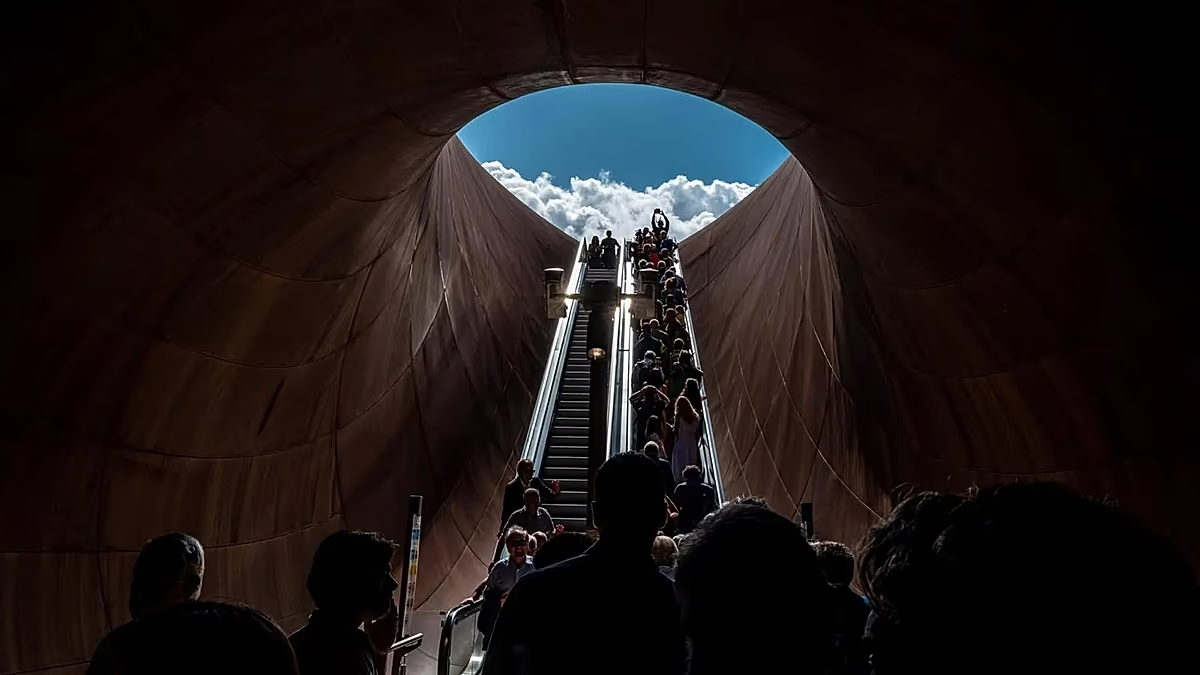
Further south, in Naples, the Monte Sant’Angelo Station offers a completely different kind of underground experience, one shaped by the imagination of the celebrated artist Anish Kapoor. Kapoor, known for his monumental and often mysteriously reflective sculptures, collaborated with the architectural firms Future Systems and AL_A to create a subterranean world that feels almost mythological. The station is carved into the earth beneath the city, and its cavernous interiors call to mind Mount Vesuvius, the ever-present volcano that looms over the Bay of Naples, as well as the ancient legend of the Cumaean Sibyl, the prophetess who was said to live in a cave and guide travelers through the underworld. The design is not merely decorative; it is a fully immersive environment, with sweeping curves, dramatic lighting, and raw materials that evoke the geological forces that shaped this landscape. The jury described the station as “a sculpture that the public can enter,” and that is exactly what it feels like—a work of art that you do not simply observe from a distance but physically inhabit. Riding the escalators down into the depths, passengers are enveloped in a strange, almost sacred atmosphere, as if they are descending into the belly of the earth itself. It is a bold and poetic vision, one that reminds us that even the most functional infrastructure can be elevated into something transcendent when artists and architects are given the freedom to dream.
Behind this year’s selection lies a clear and urgent philosophy, articulated by Jérôme Gouadain, the secretary general of Prix Versailles. In his statement, Gouadain spoke of the high stakes involved in designing transport stations today, calling for cultural expressions that are simultaneously beautiful, fashionable, and sustainable. He emphasized that great stations must do more than simply move people; they must reinforce passenger mobility while also revitalizing the local neighborhoods around them. They must embrace modernization without erasing the existing architectural character of their surroundings. Gouadain acknowledged that such strategies remain all too rare on the global stage, but he argued that the winning projects prove something important: that twenty-first-century passenger stations can be bridges to a more desirable future. This is a hopeful and humanistic vision of architecture, one that refuses to accept the idea that our public spaces must be purely utilitarian. Instead, it suggests that the places we pass through every day have the power to shape our moods, our relationships, and our sense of belonging. A beautiful station can make a journey feel less stressful, a city feel more welcoming, and a community feel more connected. It is a reminder that design is never neutral; it always tells a story about what we value, and these seven stations tell a story about a world that values beauty, history, and human connection alongside efficiency and speed.
The full list of the world’s most beautiful new train stations for 2026 includes Town Hall Station in Melbourne, Australia; Lyon Part-Dieu Station in France; Colosseo – Fori Imperiali Station in Rome, Italy; Monte Sant’Angelo Station in Naples, Italy; National Museum Station in Riyadh, Saudi Arabia; Western Station in Riyadh, Saudi Arabia; and LAX/Metro Transit Center in Los Angeles, United States. Each of these projects brings its own unique character and cultural context to the table, from the sleek urban integration of Melbourne’s underground hub to the grand ambitions of Riyadh’s new transit landmarks and the practical yet striking design of Los Angeles’s airport connection. What unites them all is a shared belief that transportation infrastructure should be more than just a necessary evil—it should be a source of pride, inspiration, and joy. Whether it is a station that opens up to the sky in Rome, a cave-like sanctuary in Naples, or a community thoroughfare in Lyon, these spaces invite us to reconsider what we expect from our public architecture. They challenge us to demand better, not just for ourselves but for future generations who will inherit these spaces. And they prove that even in an age of high-speed trains and digital ticketing, there is still room for poetry, history, and wonder in the simple act of going from one place to another.