




White-Hat Operators Move 52.37 BTC to Recovery Trust as Coldcard Exploit Fallout Deepens
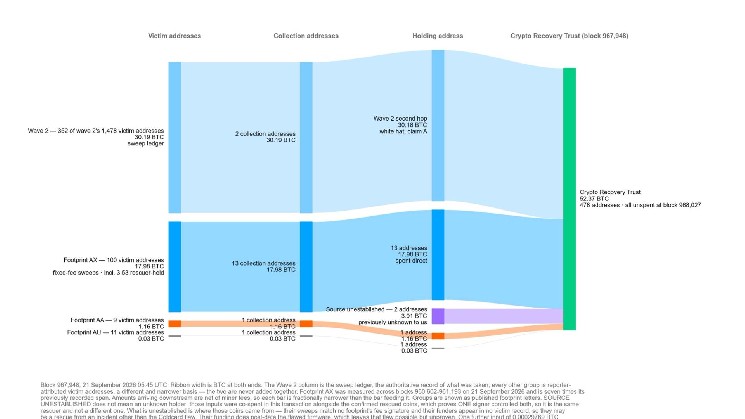
The fallout from the Coldcard hardware wallet exploit just took a surprising turn. According to Alex Thorn, head of research at Galaxy Digital, a group of whitehat operators has moved 52.37 Bitcoin to an address linked to a newly formed recovery trust. The transaction is notable not because of its size, but because of its intent. It was not sent to a mixer or an exchange, the usual destinations for stolen crypto. Instead, the funds were directed to an address that appears to have been created specifically to hold and eventually return money to victims. Thorn’s observation adds a rare layer of nuance to an incident that has otherwise been defined by fear and financial loss. The trouble began on July 30, when attackers started exploiting a flaw in one of Bitcoin’s most trusted hardware wallets. Over the next several days, the exploit unfolded in multiple waves, labeled by researchers as waves 1, 2, and 3. Each wave brought new breaches as attackers drained BTC from wallets they should never have been able to access. At one point, more than 4,500 addresses were identified as compromised, with losses estimated at close to $89 million. Later analysis suggested that the total could be even higher, possibly exceeding $100 million. For a Bitcoin community that has long believed that hardware wallets are the gold standard of self-custody, the news was a gut punch. But as this latest transfer shows, the story of the Coldcard attack is not just a tale of theft. It is also a story about the people who are trying to pick up the pieces.
To understand the severity of the July attack, it helps to understand what Coldcard is supposed to do. Coldcard is a hardware wallet manufactured by Coinkite, a company that has long marketed its devices to users who want extreme control over their private keys. The physical device is not a phone or a laptop. It is a small, focused piece of hardware, often used with no direct internet connection. Private keys are generated and stored on the device; transaction signing takes place inside the hardware, and users can transfer signed transactions to a connected computer using QR codes or microSD cards. The security model is simple: if the private keys never leave the physical device, they cannot be stolen by malware or remote attackers. At the heart of this model is a dedicated hardware random number generator. When a user creates a new wallet, the hardware RNG is supposed to generate a seed phrase using true physical entropy—unpredictable voltage fluctuations or thermal noise inside the chip. That seed phrase is then used to derive the private keys. The entire system collapses if the seed is not sufficiently random. And during the affected period, that is exactly what happened. Reports indicate that affected wallets generated seeds using a weaker software-based random number source instead of the dedicated hardware generator. The result was a set of private keys that could be reconstructed by someone who understood the flawed entropy. This kind of vulnerability is particularly dangerous because it leaves no clear trace. The user sees a normal wallet, a normal seed phrase, and normal balances. But behind the scenes, the keys are not as private as they should be. The attacker doesn’t need physical access to the device, doesn’t need to see the seed phrase, and doesn’t need to install any software on the user’s computer. The attacker just needs to recreate the randomness—or lack of it—that produced the wallet in the first place.
The attackers moved quickly, though the attack was not a single moment of chaos. It was a methodical process that unfolded over days. Security researchers following the incident said the exploit came in three distinct waves. The first signs appeared on July 30, when bitcoin began moving out of addresses that had no business being touched. A second wave followed, then a third. Each wave may have been based on a newly reconstructed batch of seeds, giving the attackers the ability to sweep many wallets at once. The scale was staggering. At one point, analysts counted more than 4,500 affected addresses. Early loss estimates hovered near $89 million. As more information emerged, some analysts suggested that the total amount at risk could cross $100 million. The staggered nature of the attack made it especially difficult to track. It also made it hard for victims to react quickly, because the exploit was still being understood as the funds were disappearing. The fact that this was a hardware wallet exploit made the losses feel even more unsettling. Traditionally, Bitcoiners are told to keep their coins in cold storage to protect against online threats. The Coldcard incident challenged that assumption. The wallets were not compromised by a badly typed address or a fake application. The private keys themselves were mathematically recoverable due to weak entropy. That is a different category of failure than most users have ever encountered. It also raises important questions about the broader hardware wallet market. If one manufacturer’s random number generation can fail, every device that uses similar software-based fallbacks might face the same risk. Security researchers are still investigating whether the vulnerability is unique to Coldcard or part of a wider problem in the firmware ecosystem. Either way, the incident has forced the crypto industry to rethink its most basic assumptions about the safety of offline key storage.
Some of the bitcoin that moved out of the affected wallets was not taken by criminals. This is the part of the story that took many observers by surprise. Galaxy Digital’s Alex Thorn reported that whitehat operators had swept 52.37 BTC into an address linked to a newly formed recovery trust. These are not hacktivists or thrill seekers. Whitehat operators are ethical cybersecurity professionals who use their skills to identify vulnerabilities, protect victims, and, in some cases, rescue funds before malicious actors can take them. In this instance, they appear to have moved quickly to secure a portion of the bitcoin that would otherwise have been drained by the original attackers. The recovery trust is a meaningful detail. A trust is not just a wallet address; it is a formal legal vehicle that can hold assets, document decisions, and, when the time is right, distribute funds to claimants. That makes the whitehat operation more than a technical gesture. It creates a pathway for restitution. Thorn did not provide details about who controls the trust or how it will verify ownership of the stolen funds. Those details will matter enormously as the recovery process plays out. But the fact that the funds were moved at all is significant. In the often-anonymous world of blockchain forensics, it is rare to see an attacker’s playbook interrupted by someone trying to save the victims. The amount recovered so far—52.37 BTC, roughly $4.5 million at current prices—is only a fraction of the total damage. Still, it is a tangible reminder that not every movement on the blockchain is malicious. Sometimes, the white hats show up too. For the victims watching their compromised wallets on chain, this could be the first sign that they might not lose everything.
The responsibility for protecting exposed funds, however, still lies with individual users. Coinkite has patched the firmware in Coldcard devices, and the patch is intended to prevent the affected devices from generating new seeds with the weakened software random number source. That is an important step, and all Coldcard owners should install the update immediately. But the patch is not a cure for wallets that were already created during the vulnerable period. Once a seed phrase has been generated with weak randomness, its private keys can be reconstructed. Updating the firmware does not erase the old private keys, does not make them harder to guess, and does not protect the bitcoin that is still sitting in those addresses. This is why security experts have been careful to distinguish between future security and past exposure. A firmware update can fix the generator for the next wallet, but it cannot rewrite history for wallets that were created before the patch. Users must take action themselves. The safest approach is to create a brand-new wallet on a fully updated Coldcard, make sure the new seed phrase is generated using the hardware random number generator, and then transfer all bitcoin out of any address that might have been affected. The old seed phrase should be retired forever. It is not enough to simply re-enter the old seed phrase into the new firmware; doing so would still recreate the same vulnerable keys. This is a hard truth for many users, especially those who have held the same wallet for years. But the alternative is far worse. Attackers may already have the private keys to the old wallet. They might be waiting for the right moment to drain whatever remains. In a market where millions of dollars can vanish in a few seconds, postponing this migration is an unnecessary risk.
As the dust settles, the Coldcard exploit is likely to become a defining case study in Bitcoin hardware security. It showed that even the most trusted tools can fail, and that the security of a wallet depends as much on random number generation as on physical storage. It also showed that the response to a crisis can be just as important as the attack itself. The whitehat rescue effort and the creation of a recovery trust are signs that the Bitcoin ecosystem is developing more mature mechanisms for dealing with theft. In traditional finance, customers can file claims, appeal to regulators, or rely on insurance. In decentralized finance, the path to restitution is far less clear. Blockchain transactions are final; there is no bank to reverse a transfer. But there are increasingly sophisticated professionals who specialize in tracing funds, tracking exchanges, and coordinating with law enforcement. And in this case, there were whitehats willing to intervene directly and move bitcoin to a safe location while the legal and technical details are sorted out. The recovery trust will not solve everything. It holds a fraction of the total stolen funds. It will likely take months to determine who is entitled to what, and some victims may never be fully compensated. But the principle is powerful: the fight to protect assets does not stop when an attacker moves the first batch of coins. The story is still unfolding. For now, the Bitcoin community is watching the affected addresses, waiting for signs of additional whitehat intervention or further malicious activity. The next few weeks will be decisive. Coldcard users who have not yet acted should treat the situation as urgent. Install the latest firmware, create a fresh seed phrase, and move any exposed bitcoin immediately. The Coldcard exploit may have exposed a bitter truth about hardware security, but it has also revealed that the ecosystem is willing to fight back. In a world where self-custody is the highest ideal, the whitehats may prove to be the closest thing the community has to a rescue service.