

In the warm, sun-drenched waters of the Caribbean, a quiet Saturday was shattered by the roar of a military operation. The U.S. military, acting on what it described as confirmed intelligence, executed a lethal strike on a fast-moving vessel suspected of ferrying drugs through one of the region’s most notorious trafficking lanes. According to U.S. Southern Command, or SOUTHCOM, the operation ended in flames and tragedy: four people believed to be narco-traffickers lost their lives in the attack. The vessel, a so-called “go-fast” boat—a sleek, nimble craft favored by smugglers for its speed and agility—was moving along an established route that has long been a corridor for illegal narcotics heading north. From the ground, it must have been a terrifying sight: a routine run under a blazing tropical sun, suddenly interrupted by the thunderous approach of military forces, and then the unmistakable fireball that engulfed everything aboard. For those four individuals, the journey ended not on some distant shore with a payload of illicit cargo, but in a violent, fiery explosion in the middle of the ocean, leaving behind questions about who they were, why they chose this perilous path, and what led them to that moment on the water.
The operation itself was no rogue act but a carefully orchestrated mission directed by SOUTHCOM through its Joint Task Force Western Hemisphere, the military command responsible for overseeing operations in the Caribbean and Eastern Pacific. In a statement released after the strike, SOUTHCOM laid out its rationale in stark, clinical terms: “On September 19, under the direction of #SOUTHCOM, Joint Task Force Western Hemisphere executed a lethal, kinetic strike on a go-fast vessel operating along established narco-trafficking routes in the Caribbean. Confirmed intelligence revealed the vessel’s active involvement in narco-trafficking.” Four alleged “narco-terrorists” were killed, the command confirmed bluntly. The phrase “lethal, kinetic strike” is military jargon, stripped of emotion, but it describes something profoundly violent: a deliberate, calculated act of force designed to destroy a target completely. For the people on that boat, there was no warning perhaps, no chance to surrender, no negotiation—just a sudden, catastrophic end. And for their families, waiting somewhere in coastal towns of South America or the Caribbean, the news of this death must have arrived like a thunderbolt, a confirmation that a loved one’s dangerous gamble with the sea had finally, fatally, caught up with them.
What makes Saturday’s strike so significant, however, is not just the event itself but the pattern it belongs to—a larger, monthslong campaign launched under the Trump administration aimed at dismantling cartel-linked trafficking networks that have long operated with near-impunity in the open waters of the region. This is not a new fight; the United States has waged a quiet war on drug smugglers for decades, using ships, planes, and intelligence to interdict cocaine and other narcotics moving from South America through Central America and toward the U.S. border. But the current strategy represents an escalation, a more aggressive posture that has seen the military authorized to use lethal force not just in self-defense but as a proactive measure against vessels suspected of engaging in drug trafficking. Just ten days before Saturday’s strike, on September 9, the military carried out a separate operation in the Eastern Pacific that resulted in three deaths, obliterating another suspected narco-trafficking vessel. And the numbers tell an even broader story: over the past year, the U.S. campaign has been relentless, with at least 69 reported strikes tied to at least 231 deaths, a staggering toll that underscores both the scale of the operation and the human cost it carries on the high seas.
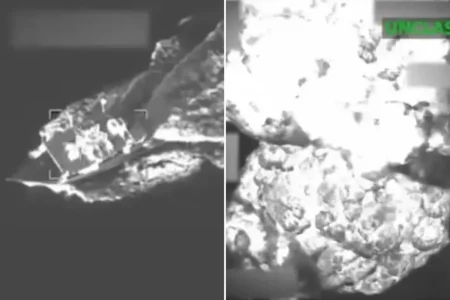
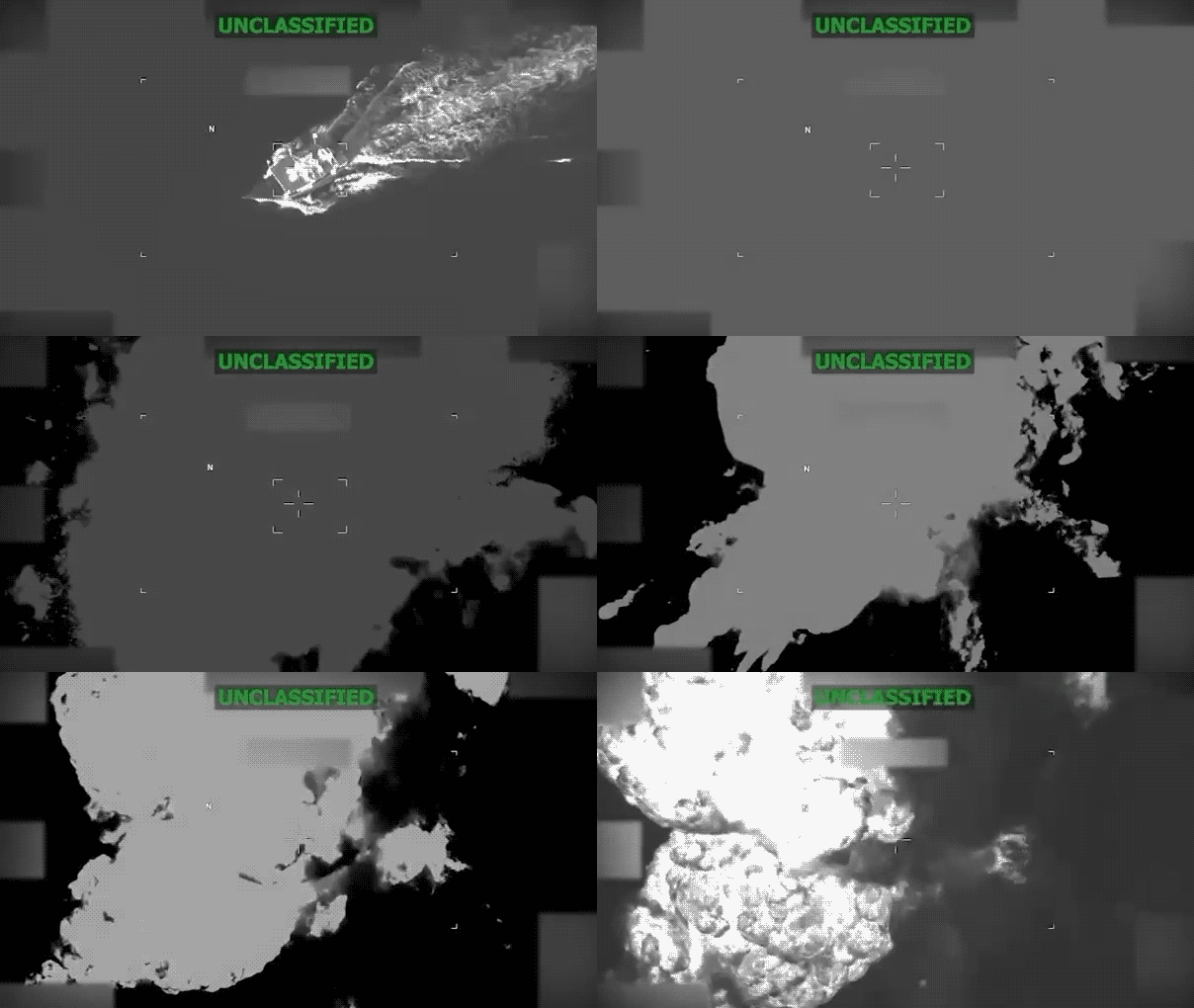
The videos released by SOUTHCOM offer a window into this violent reality. One clip from Saturday’s operation shows a vessel cutting through the water, its wake trailing behind it like a white scar, before erupting into a massive fireball that consumes the frame in orange and black. It’s a stunning, almost cinematic image—the kind you might expect from an action movie—but it’s real, and the reality is that it represents the end of four human lives. In recent weeks, SOUTHCOM has also shared footage of other operations: military personnel descending onto intercepted boats, methodically boarding vessels alleged to be involved in drug smuggling, removing crews from their decks, and then sinking the boats themselves to prevent them from returning to the trade. These videos are carefully curated, no doubt, designed to show the military’s resolve and capability, to project an image of control and deterrence to both the public and the traffickers who might be watching. But they also raise uncomfortable questions. Who are these “narco-terrorists”? Are they hardened cartel operatives, as the military suggests, or are they, in some cases at least, poor fishermen or desperate migrants who got swept up in a dangerous economy? The official framing is clear—these are enemies of the state, people deeply embedded in the illicit networks that fuel violence and addiction—but the raw imagery of burning boats and floating wreckage lingers, a reminder that every statistic has a face, a story, and a family.
Many of the recent operations highlighted by SOUTHCOM have targeted vessels allegedly tied to a specific organization: Los Choneros, a group the military describes as a violent “narco-terrorist” operation. Los Choneros, which originated in Ecuador, is a name that evokes fear across the region—a criminal syndicate with deep connections to drug trafficking, extortion, and brutal violence. For the U.S. military, they represent exactly the kind of adversary that justifies a lethal response: an organized, dangerous network that has turned the open seas into a battlefield. And in many ways, the campaign against them and others like them is part of a broader strategy that views these cartels not just as criminal enterprises but as a form of asymmetric warfare, threats to national security that demand a military response. This is a perspective that resonates with many who support the strikes, who see them as a necessary assertion of strength against organizations that have grown too powerful and too bold. They argue that the death of traffickers on a boat is a tragedy of their own making, a consequence of their choice to engage in a bloody business that destroys communities and poisons lives. The ocean, they say, is not a sanctuary but a battleground, and those who choose to run drugs on these routes know full well the risks they are taking.
Yet, as the tally of strikes and deaths continues to mount, this campaign has also opened up a broader conversation about the nature of this fight, its effectiveness, and its costs, both human and strategic. Supporters of the Trump administration’s approach point to the sheer scale of the interdiction effort as evidence of its success: hundreds of tons of cocaine intercepted, dozens of vessels destroyed, and a clear message sent to traffickers that the open seas are no longer safe for their operations. Detractors, however, ask whether killing suspected smugglers without trial truly solves the underlying problem—whether the drug trade that these operations aim to disrupt will simply adapt, shifting routes, methods, and personnel to fill the void left by those killed. They also raise the uncomfortable question of collateral damage: in the murky world of the high seas, where identity is not always clear and intelligence can be imperfect, there is always a risk of mistakes. And beyond the policy debates, there is the quieter, more solemn human reality—the families who will never see their loved ones again, the crews who took the risk and lost everything, the ripple effects of loss that echo through communities already struggling with poverty and instability. The Caribbean, a region of stunning beauty and deep contradictions, has long been a crossroads of opportunity and desperation, and the battles being fought on its waters are just one chapter in a much larger, more complicated story—a story that shows no signs of reaching a neat conclusion, as the military continues its mission, and the traffickers, in all likelihood, continue theirs.