



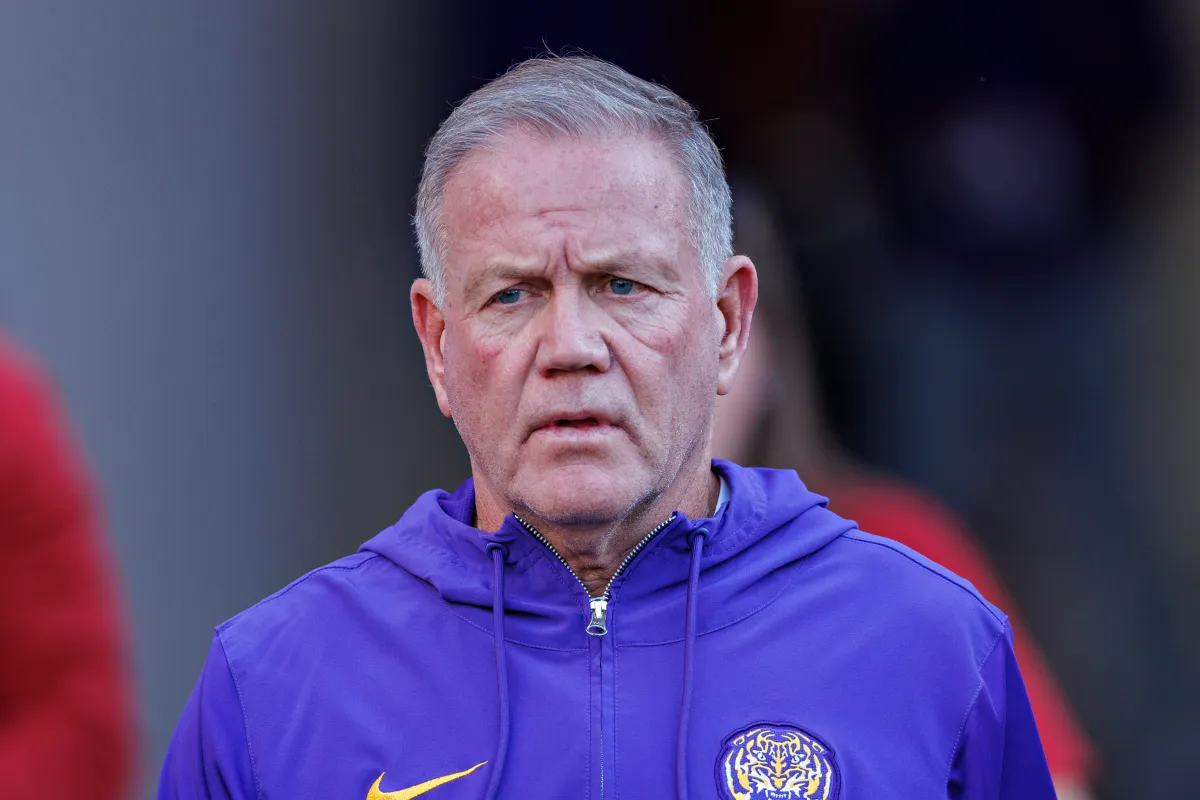
Brian Kelly’s time at LSU ended with a crash that could be heard all the way from Baton Rouge to South Bend, and it wasn’t a slow burn or a graceful exit. It was a sudden, painful flameout defined by back-to-back SEC losses to Vanderbilt and Texas A&M, and it was the second of those defeats that pushed everything over the edge. Texas A&M came into Death Valley and turned the game into a spectacle, blowing out the Tigers by a final score of 49-25. That score wasn’t just a loss; it was a statement. LSU dropped to 5-3 on the season, and with the SEC race tightening and the College Football Playoff no longer even a remote possibility, the decision was made to move on. Kelly was fired, and for a coach who had built a reputation on fixing broken programs and turning them into contenders, it was a humbling moment. But the story of Brian Kelly doesn’t end with a termination letter. He is reportedly very motivated to return to the sideline, and his name has been floated for multiple Power 4 jobs as the coaching carousel begins to spin. For a man who spent decades in the game, from Grand Valley State to Central Michigan to Cincinnati to Notre Dame and then to LSU, the idea of walking away on somebody else’s terms doesn’t sit right. He still has the energy, the hunger, and, perhaps most importantly, the track record to convince an athletic director that the last chapter in Baton Rouge was a mistake rather than a mirror. At 64, Kelly is not a young coach anymore, but age in this sport is often less important than the fire in your belly, and by all accounts, that fire hasn’t gone out. Now the question is where he’ll land, and one of the most interesting answers to that question sits in Piscataway, New Jersey.
The Rutgers Scarlet Knights have become the center of that conversation because they are, right now, the biggest dud in college football. Bruce Feldman of The Athletic put it bluntly, calling Rutgers “the biggest dud of the 2026 season.” It’s hard to argue with that label. The Scarlet Knights are 0-2, and their losses have come against UMass and Boston College, two programs that went a combined 2-22 last year. This isn’t losing to Alabama and Ohio State. This is losing to teams that were considered pushovers, and it’s been done in a way that has sent shockwaves through the Big Ten. Greg Schiano did some great work at Rutgers, and there’s no reason to rewrite history to make his current failures seem worse than they are. He brought a dead program back to life. He gave the Scarlet Knights an identity, a defensive edge, and a belief that they could compete in a conference built on powerhouses. But the present is what it is. Schiano’s future looks dire, and even the most loyal Rutgers fans have started to ask when the program will admit that the magic is gone. The schedule ahead doesn’t offer any relief. Rutgers faces USC on the road on Saturday, and after that, it gets FCS Howard before a matchup with Indiana. USC is ranked No. 12 and is exactly the kind of opponent that can expose every flaw in a struggling team. If Rutgers loses to the Trojans in the same way it lost to UMass and Boston College, the question won’t be whether Schiano gets fired. It will be when, and the search for his replacement will start immediately, with Kelly’s name already being whispered in the same circles.
Into that void steps the idea of Brian Kelly, and it’s a union that makes more sense than it might first appear. Feldman’s report noted that another “60-something coaching retread” who could find a Power 4 landing spot is Kelly, calling him a Boston native and saying he is “very, very motivated” to get back on the sidelines. The word retread can sound like an insult, but in college football, it’s often the highest compliment. Programs hire retreads because they’ve already demonstrated they can handle the chaos. They’ve been through the fire, survived the scrutiny, and come out the other side with a clear sense of what it takes to win. Kelly may have failed at LSU, but he didn’t fail because he forgot how to coach. He failed because the fit wasn’t right, and sometimes that’s just how it works. Rutgers, on the other hand, is a program that hasn’t won anything in decades and has been searching for the right head coach since before Kelly was even a household name. There is a certain symmetry to the idea of him walking into Piscataway. He grew up in Massachusetts, just a few hours away from New Jersey, and that kind of regional familiarity can be a huge advantage in recruiting. He knows the high school coaches. He knows the seven-on-seven circuit. He knows how to walk into a living room on the East Coast and convince a family that he’s the guy who’s going to take care of their kid. That is a skill that no amount of spreadsheets or analytics can replace, and it’s a big reason why Kelly’s name keeps coming up in the same sentence as Rutgers. It’s also why a struggling program like Rutgers might be willing to take a chance on a coach with a complicated past. Sometimes you don’t need a perfect candidate; you just need the right one, and Kelly has been doing this long enough to know how to be exactly that.
Of course, it’s easy to forget how good Kelly was before LSU, because LSU is the last thing most people remember. His record with the Tigers was 34-14 over four seasons. That’s a winning record, but it’s not a championship record, and at LSU, anything short of a championship is a failure. Kelly won 10 games in each of his first two seasons, and at that moment, it looked like he was building something real. But the program declined in the years that followed. The defense, which should have been a strength, started bleeding points in the biggest moments. The explosive offense that had carried him through the early part of his tenure began to sputter, and the losses began to pile up in ways that couldn’t be explained away by injuries or bad luck. Vanderbilt was a bad loss. Texas A&M was a catastrophe. When the Aggies put 49 points on the board in Death Valley and LSU could only answer with 25, it felt like the entire Kelly experiment had been laid bare for everyone to see. But let’s be fair: Kelly didn’t turn into a bad coach overnight. He’s the same guy who turned Notre Dame from a national punchline into a legitimate powerhouse. He’s the same guy who won 10 games at LSU in consecutive seasons. The problem in Baton Rouge was not a lack of talent or a lack of effort. It was a lack of fit, a lack of patience, and a standard that very few coaches in the country can actually meet. That’s not an excuse. That’s just the truth. And the truth also is that given a new environment, a different kind of roster, and a more realistic set of expectations, Kelly is exactly the type of coach who can surprise people again. He has done it before, and he hasn’t suddenly lost the instincts that made him so successful in the first place.
Before LSU, there was Notre Dame, and that is Kelly’s actual masterpiece. He spent 12 years in South Bend and went 113-40, which is a record that deserves to be appreciated in context. Notre Dame is not a normal job. It comes with academic restrictions, a unique recruiting footprint, and the kind of national attention that makes every mistake a headline. Kelly handled all of that and thrived. He produced seven seasons with double-digit wins, collected multiple national coach of the year awards, and somehow managed to become the all-time winningest coach in school history. That’s a list that includes Knute Rockne, the man who invented modern football, and Lou Holtz, the man who restored Notre Dame’s pride in the 1980s. Kelly is ahead of both of them. The significance of that cannot be overstated. When you’re mentioned in the same sentence as Rockne and Holtz, you’re not just a good coach. You’re a legendary one. And while LSU may have stained the end of his career, it did not erase the beginning, or the middle, or the incredible body of work he produced while leading one of college football’s most iconic programs. That’s why his name still has so much value. Rutgers wouldn’t be hiring a random retread; it would be hiring a Hall of Fame-level builder who happened to take one job that didn’t work out. If the Scarlet Knights can look past the LSU years and see the man who rebuilt Notre Dame, they’ll see someone capable of doing the same thing in Piscataway. It would take time, and it would take patience, but the blueprint is right there in the record book. The history is real, and it’s exactly the kind of history that a program like Rutgers has never had.
None of this is guaranteed, of course, and the timing has to be right. If Rutgers somehow beats USC, or if the administration decides to give Schiano one more season, the Kelly-to-Rutgers story loses its urgency. But if the losses keep piling up, as they almost certainly will, the program won’t be able to ignore the reality of the situation. Rutgers has put itself in a tough spot, and coaching changes are rarely made when things are going well. They’re made when things are falling apart. That’s exactly where Rutgers finds itself right now. It’s 0-2, it has a coach with a brilliant past and a bleak present, and it has a fan base that doesn’t want to hear another word about “the process” or “the long-term vision.” It wants results. Brian Kelly can offer results. He’s a 64-year-old coach who was just fired from LSU, but he’s also a 64-year-old coach who knows how to win, and he’s more motivated than he’s been in years. He grew up in the Northeast, he knows the recruiting terrain, and he wants another chance to prove that his final chapter isn’t written yet. There’s something poetic about a man from Massachusetts going to New Jersey to revive a program that has been stuck in neutral for so long. It’s not a glamorous job on paper. Rutgers is not LSU. It’s not Notre Dame. It doesn’t have the same history or the same resources or the same national brand. But it also has lower expectations, and lower expectations can be a gift. Kelly wouldn’t have to win a national championship in Year 1. He’d just have to make Rutgers competitive, and that’s a bar he cleared years ago. If he gets the chance, he’ll almost certainly take it. And if he does, the college football world should probably pay attention, because Brian Kelly has never needed a second chance this badly, and hungry coaches with something to prove are the most dangerous ones on the board.